Browse › 1782
Saturday 5 January 1782
Page 1
AI transcription (Google Gemini, 2026)
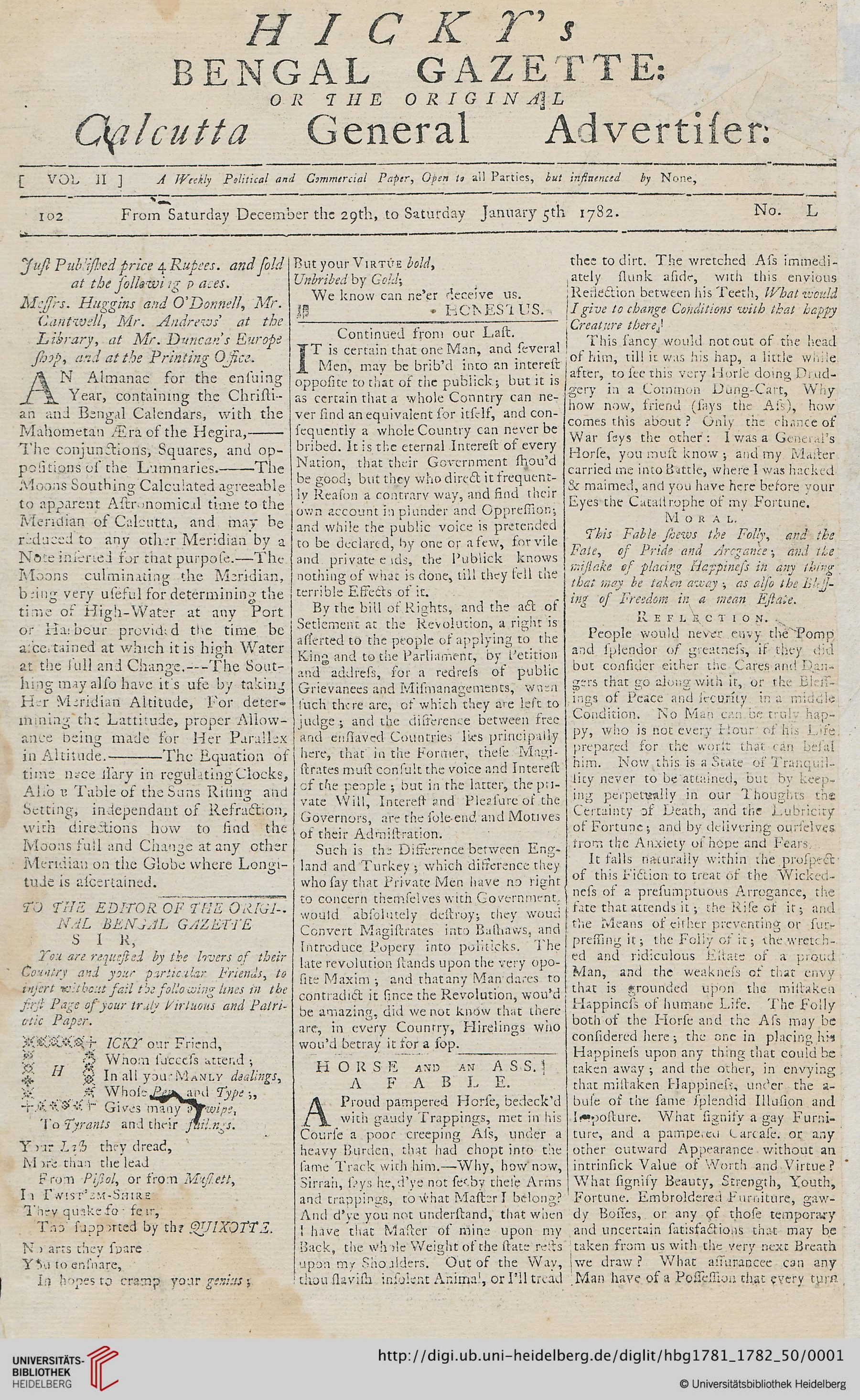
HICKY's
BENGAL GAZETTE;
OR THE ORIGINAL
Calcutta General Advertiser.
———————————————————————————————————————————————————————
[ VOL II ] A Weekly Political and Commercial Paper, Open to all Parties, but influenced by None.
———————————————————————————————————————————————————————
102 From Saturday December the 29th, to Saturday January 5th 1782. No. L
———————————————————————————————————————————————————————
Just Published price 4 Rupees. and sold at the following places.
Messrs. Huggins and O'Donnell, Mr. Cantwell, Mr. Andrews' at the Library, at Mr. Duncan's Europe shop, and at the Printing Office.
AN Almanac for the ensuing Year, containing the Christian and Bengal Calendars, with the Mahometan Æra of the Hegira,—The conjunctions, Squares, and oppositions of the Luminaries.—The Moons Southing Calculated agreeable to apparent Astronomical time to the Meridian of Calcutta, and may be reduced to any other Meridian by a Note inserted for that purpose.—The Moons culminating the Meridian, being very useful for determining the time of High-Water at any Port or Harbour provided the time be ascertained at which it is high Water at the full and Change.—The Southing may also have its use by taking Her Meridian Altitude, For determining the Lattitude, proper Allowance being made for Her Parallex in Altitude.—The Equation of time necessary in regulating Clocks, Also a Table of the Suns Rising and Setting, independent of Refraction, with directions how to find the Moons full and Change at any other Meridian on the Globe where Longitude is ascertained.
———————————————————
TO THE EDITOR OF THE ORIGINAL BENGAL GAZETTE
S I R,
You are requested by the lovers of their Country and your particular Friends, to insert without fail the following lines in the first Page of your truly Virtuous and Patriotic Paper.
HICKY our Friend,
Whom success attend;
In all your MANLY dealings,
Whose Pen, and Type,
Gives many a wipe,
To Tyrants and their failings.
Your Lash they dread,
More than the lead
From Pistol, or from Muskett,
In TWIST'EM-SHIRE
They quake for fear,
Tho' supported by the QUIXOTTE.
No arts they spare
You to ensnare,
In hopes to cramp your genius;
But your VIRTUE bold,
Unbribed by Gold;
We know can ne'er deceive us.
HONESTUS.
————————————————————
Continued from our Last.
IT is certain that one Man, and several Men, may be brib'd into an interest opposite to that of the publick; but it is as certain that a whole Country can never find an equivalent for itself, and consequently a whole Country can never be bribed. It is the eternal Interest of every Nation, that their Government shou'd be good; but they who direct it frequently Reason a contrary way, and find their own account in plunder and Oppression; and while the public voice is pretended to be declared, by one or a few, for vile and private ends, the Publick knows nothing of what is done, till they feel the terrible Effects of it.
By the bill of Rights, and the act of Settlement at the Revolution, a right is asserted to the people of applying to the King and to the Parliament, by Petition and address, for a redress of public Grievances and Mismanagements, when such there are, of which they are left to judge; and the difference between free and enslaved Countries lies principally here, that in the Former, these Magistrates must consult the voice and Interest of the people; but in the latter, the private Will, Interest and Pleasure of the Governors, are the sole end and Motives of their Administration.
Such is the Difference between England and Turkey; which difference they who say that Private Men have no right to concern themselves with Government. would absolutely destroy; they woud Convert Magistrates into Bashaws, and introduce Slavery into politicks. The late revolution stands upon the very opposite Maxim; and that any Man dares to contradict it since the Revolution, wou'd be amazing, did we not know that there are, in every Country, Hirelings who wou'd betray it for a fop.
————————————————————
HORSE AND AN ASS.
A FABLE.
A Proud pampered Horse, bedeck'd with gaudy Trappings, met in his Course a poor creeping Ass, under a heavy Burden, that had chopt into the same Track with him.—Why, how now, Sirrah, says he, d'ye not see by these Arms and trappings, to what Master I belong? And d'ye not understand, that when I have that Master of mine upon my Back, the whole Weight of the state rests upon my Shoulders. Out of the Way, thou slavish insolent Animal, or I'll tread thee to dirt. The wretched Ass immediately slunk aside, with this envious Reflection between his Teeth, What would I give to change Conditions with that happy Creature there!
This fancy would not out of the head of him, till it was his hap, a little while after, to see this very Horse doing Drudgery in a Common Dung-Cart, Why how now, friend (says the Ass), how comes this about? Only the chance of War says the other: I was a General's Horse, you must know; and my Master carried me into Battle, where I was hacked & maimed, and you have here before your Eyes the Catastrophe of my Fortune.
MORAL.
This Fable shews the Folly, and the Fate, of Pride and Arrogance; and the mistake of placing Happiness in any thing that may be taken away; as also the Blessing of Freedom in a mean Estate.
REFLECTION.
People would never envy the Pomp and splendor of greatness, if they did but consider either the Cares and Dangers that go along with it, or the Blessings of Peace and security in a middle Condition. No Man can be truly happy, who is not every Hour of his Life prepared for the worst that can befal him. Now this is a State of Tranquillity never to be attained, but by keeping perpetually in our Thoughts the Certainty of Death, and the Lubricity of Fortune; and by delivering ourselves from the Anxiety of hope and Fears.
It falls naturally within the prospect of this Fiction to treat of the Wickedness of a presumptuous Arrogance, the fate that attends it; the Rise of it; and the Means of either preventing or suppressing it; the Folly of it; the wretched and ridiculous Estate of a proud Man, and the weakness of that envy that is grounded upon the mistaken Happiness of humane Life. The Folly both of the Horse and the Ass may be considered here; the one in placing his Happiness upon any thing that could be taken away; and the other, in envying that mistaken Happiness, under the abuse of the same splendid Illusion and Imposture. What signify a gay Furniture, and a pampered Carcase, or any other outward Appearance without an intrinsick Value of Worth and Virtue? What signify Beauty, Strength, Youth, Fortune. Embroidered Furniture, gaudy Bosses, or any of those temporary and uncertain satisfactions that may be taken from us with the very next Breath we draw? What assurance can any Man have of a Possession that every turn
Page 2
AI transcription (Google Gemini, 2026)
of State, every Puff of Air, every change of Humour, and the least of a Million of common Casulties may deprive him of?
Moreover, the Envy of the Ass was a double folly; for he mistakes both the Horse's Condition and his own. 'Tis Madness to envy a Creature, that may in a moment become miserable; or for any Advantage that may in a Moment be taken from him. The Ass envies the Horse to day; and in some few days more, the Horse comes to Envy him. Wherefore let no Man despair so long as it is in the Power either of Death, or of chance, to remove the Burden. Nothing but Moderation and Greatness of Mind, can make either a prosperous or an adverse Fortune easy to us. The only way to be happy is to submit to our Lot. for no Man can be properly said to be miserable that is not wanting to himself. It is certainly true, that many a poor Cobler has a merrier Heart in his stall, than a Prince in his Palace.
————————————————————
To Mr. HICKY,
SIR,
I Beg your insertion of the following short reply to the letter signed Observator in your Paper of the fifteenth Instant. Your Correspondent wishes Information, regarding the circumstances of the Prize Money, divided by the Officers at the Capture of Bejee Ghur, on account of the injurious (He might have added false and infamous) reports which have been circulated on that subject.—It is well known that prior to the Surrender of the place, a suspension of Arms took place between the Garrison and the Besiegers, in consequence of proposals offered by the Rannee to Major Popham.—The Major sent an express to the G—r (at Chunar) mentioning the Terms, and desiring to know if they should be acceded to.—The G—r conceiving that the Effects left in the Fort were very inconsiderable (for a report had universally prevailed, and been believed, that the Rajah had carried away the whole of the Treasure) advised the refusing of them "as it would be "depriving the Troops of so much (as "the Rannee demanded for herself) as "they had every Right to from the "Capture of the Place."—That this was allowing whatever was found in the Fort to be the property of the Captors, as Men of common sense will, I presume attempt to dispute; but as the Treasure which was found so far exceeded all expectation, the Officers very wisely, and as, the event has proved, very justly surmised, that if left to consideration, arguments might be adduced to thwart, or entirely overset the preceeding favourable intention towards them.—They therefore judiciously resolved to divide the produce without delay (former events having shewn that delays are dangerous, Witness the Prize Money given on account of the Rohillah War, the most infamous service that ever disgraced the British Arms, not excepting the present Mahratta one, being still detained) and as properly have refused compliance with all orders to refund it.—The G—r therefore has the satisfaction to find that his usual Sutterfuges for altering his intentions have been for once of no avail, that his show of generosity was all intended mockery, and that he has even lost the merit of giving with a good grace what it was not in his power to withhold.——Least scruples of delicacy should have prevented Major P. from giving the above relation. it is here offered by his friend.
CANDOUR.
Mr. Hicky is requested to republish the two inclosed Paragraphs, extracted from the London Papers in his entertaining Gazette.
The following Extracts are taken from one of the Europe papers, and which already confirms how indispensably necessary, and of what great utility the Original Bengal Gazette is of in this part of the World, if conducted by a Man of Spirit, and firm resolves.
Extract from the London Courant.
To the Court of Directors of the East-India Company
AN enquiry into the conduct of the Company's servants in Bengal, is, at length to take place among you on this day. The policy and conduct of the Maratta war is to be presented to you as the immediate and most important object of consideration, you are possessed of every information upon that subject, and the public expect from you a fair investigation and a candid decision.
But there are other matters of equal moment which merit your observation, and demand redress. I shall enumerate them without ceremony.
The equipment and expence of an unserviceable marine.
The enormous encrease of military establishments in and out of the provinces.
Daring and repeated disobedience of orders.
Jobs, Contracts, and increase of salaries, and a profusion of the public treasure unparalleled, at any period, in any country.
Mr. Barwell's modest requisitions at parting, supported and carried by the indulgent voice of your Governor General.
New military regulations by which a great additional expence is created, and a door opened to false musters, the worst of military evils, by the abolition of the office of commissary of musters.
The disgraceful treaty with the Ranna of Ghode.
Your constituents and the nation call aloud for your verdict upon these interesting subjects, and will form their opinion of your honour and honesty, from the rectitude of your determination. Should partial motives govern your councils, remember, that there are more tribunals than one, to which you are amenable.
A Friend to the Company.
The following Paragraph was also taken from an English Paper.
A terrible fracas has happened among the pages belonging to a Great Personage at Windsor, which we are informed was occasioned by the following circumstance;—Colonel Lake, one of the Sub Governors to the Prince of Wales, took down with him to Windsor a person to dress his hair. The abilities of the man did not escape the eye of the Prince, who applied to the Colonel to let him dress him at the same time his Royal Highness observe'd, that he was informed of his being settled in business, and to make it an object to him, would settle on him, by way of compensation, a salary of two hundred pounds a year. The man agreeing, and becoming a servant of the Royal Family, he was ordered to dine at the page's table. This was a mortal stab to the consequence of these great men, and Mr. Ramus particularly refused to dine at the table with him, all the rest joining, and the person finding his situation likely to become very uneasy to him, solicited the Prince to permit him to return to town. Prince Fredrick, whose temper is reported to be rather warm, went to Mr. Ramus, and gave him a severe reprimand. Mr. R. retorted, and is said to have observed to Prince Fredrick, that when he behaved like a Prince, he would give him answers suitable to his dignity. The dispute arriving to such a pitch, the King was made acquainted with it, who for the present took no notice, but on his coming to town to the levee, he acquainted Mr. R. that unless in future he did conduct himself with better manners, and dine as usual at the table, he should not go again to Windsor. This unexpected command had a wonderful effect, and Mr. R. is contented once more to eat his mutton as usual.
————————————————————
To Mr. HICKY,
SIR,
THE following Letter was sent to me, by an Acquaintance at Berhampore with his permission to make it public if I thought proper, from the very high respect I have for the Army, and the reputation of every deserving Man in it.—I am induced to suppose, my friend has been imposed on by the person, that sent him a Copy of the Bill, which might be written from Prejudice perhaps, to injure the reputation of C.——as I conceive no Man dressed in the honorable Garab of a Colonel could be guilty of so much meanness, I am to request you will be pleased to insert it in your next Gazette, that he may have an opportunity, if false, of clearing himself to the public, from a Charge, that reflects so much dishonor on him as a Military Man, and at the same the most unheard of Ingratitude, both Charity and humanity should incline us to hope that the Charge is Malicious, for it really does not come within, almost the colour of a possibility to suppose that Lieutenant Colonel —— Commanding the Garrison of G— G— should after so many years residence amongst soldiers, in the King, and Company's service, wish to exchange so many Honorable Stations, as he must have been in, for that of a Tavern Keeper, if this dreadful and shameful Charge is justly founded, the best advice I am capable of giving him, is immediately to strip off those Cloaths, which has ever been honorable, untill disgraced by him, and put on the Blue apron, and in the room of the FLAG STAFF Substitute the Horse shoe and Magpye in its room.—written underneath in large Capital Letters, Entertainment for Man and Beast, paying for the same, by William —— late a Colonel in the Honorable Com-
Page 3
AI transcription (Google Gemini, 2026)
pany's Service, these distinctions, will be highly necessary to inform Travellers what they are to expect, then none but Men of the highest Stations, will attempt to put up at so dear a House.
I am Sir,
Your very Obed. Servant,
A. G. W.
Calcutta, 25th Dec. 1781.
Berhampore 19 Dec. 1781.
Dear Sir
A Severe fever and Cold which has Attended me for Several days past, prevented me the pleasure of Answering Yours of the 10th Sooner, all our Conversation at present is intirely on Colonel —— very shameful behaviour to the G—— G——, who it seems lived with him during the troubles at Beneras, Inclosed I send you a copy of a Bill, which it is Said, he sent to Mr. H. before his departure from Chunar Ghur, after what his friend and patron has done for him, though I am sorry to say at the Expence of a very deserving Officer, let every Man draw his own Conclusions on so mean and pitiful an Act of Ingratitude, how far Mr. H——s may be blameable or Justifiable, by the steps he has taken, respecting his promotion, I shall not take the liberty to determine, but I will boldly assert, that nothing can plead the Smallest excuse for the Ingratitude shewn on this Occasion by Colonel —— and as I am perfectly convinced, it is the only Instance ever given in this service) so Renowned for their Hospitality) of an Officer Serving a Tavern Keepers Bill to his Guests, that you have my permission to publish it in the Gazette, in hopes that the Accusation against Colonel —— and for the honor of the Army, is false and Groundless, and at the same time to afford him an opportunity of clearing himself to the Publick, of a Meanness; which if true, renders him disgraceful in a private station, and infamous in his publick one.
H. S.
The H—— W—— H—— Esq; G—— G——l to Lieut. Col.
Dr.
To Dieting himself—and Family for 33 days, Feeding Elephants, Camels, Horses, and Bullocks &c. &c. &c. Breaking of Tables, Chairs, Couches, Teapoys, Shades, Decanters, Bottles, and Glasses, &c. &c. &c.
Sicca Rupees 42,000.
E. E.
(Signed) Willlam ——
Lt. Col. Commanding at Chunar.
An ELEGY an Mrs Bowes.* By Lady M. W. MONTAGUE.
HAIL happy Bride! for thou art truly blest,
Three months of pleasure crown'd with endless rest!
Merit like yours was Heaven's peculiar care;
You lov'd—yet tasted happiness sincere.
The sweets of love to you were only shewn,
The sure, succeeding, bitter dregs unknown.
You had not yet the fatal change deplor'd.
The tender lover for the imperious Lord;
Nor felt the pangs that jealous fondness brings,
Nor wept the coldness from possession springs:
Above your sex, distinguish'd in your fate,
You trusted, yet experienc'd no deceit.
Swift were your hours, and wing'd with pleasure flew;
No vain repentance gave a sigh to you:
And if superior bliss Heav'n can bestow,
With fellow Angels you enjoy it now.
*First wife to Mr. Bowes, father to the present Lady Strathmore.
EPIGRAM.
By Dr. DODDRIDGE, on his Motto, Dum vivimus, vivamus.
LIVE while you live, the Epicure will say,
And take the pleasure of the present day:
Live while you live, the sacred preacher cries,
And give to God each moment as it flies.--
Lord, in my view let both united be!
I live in pleasure when I live to Thee.
A PRESCRIPTION for HAPPINESS.
I Have read several treatises upon happiness, and the authors are pretty well agreed in shewing wherein it does not consist: but are not so precise and particular as they should be in settling wherein it does. I have therefore ventured to give a prescription, which I think will effectually answer the purpose, if pursued under a proper regimen: and may serve as an application or practical use of Mr. Sterne's late sermon, and all other discourses upon this subject.
A Receipt for an infaliable Medicine to procure Happiness
Take of volatile pleasures; the Cordials of the table; the confections of buildings, and all works of art, munificience, and benevolence; fixed œconomy; rectified spirits of ambition, and the extract of philosophy; of each a proper quantity. Mix them all well together, and work them up into an electuary with the syrup of religion, made of the flowers of morality, and heightened with the pure essence of Christianity.
A spoonful of this electuary regularly taken every day, will create as much happiness as our constitutions are capable of at present. Probatum est
N. B. If any of these ingredients are left out, the medicine will not operate effectually to procure the full quantity of happiness: and if some of them are too predominant, it will be very hurtful to the patient and must be succeeded by the bitters of repentance.
CALCUTTA.
Extract of a Letter from Chunar Ghur,
THE conduct of the Beejam and Saadut Ally, during the late commotions in Chyte Sing's Country having come to the knowledge of the Vizier, he has resolved to deprive the former, of that influence, which has so nearly cost him his Dominions.—Orders have been dispatched by the Governor General to Sir John Cumming's to march immediately to Lucknow with four Regiments to quell a seditious spirit that rages among the inhabitants of that Quarter. Occasioned by the Nabob's having taken possession of the Bejams
Jaguire. An enquiry will take place, when it will evidently appear that tho' the Bejam and Saadut Ally did not openly declare against the English, they granted every aid and assistance for their extirpation, and that every Zemindar from Lucknow to the banks of the Guduck acted from their immediate authority.
LETTERS of the 14th from Madras say that Chitor was closely besieged by a Detachment of Hyder's Army, and there are others in Town that mention its being in the Enemy's possession, that the whole of the British Army is Encamp'd within nine miles of Madras in 3 divisions Com'd by Col's Pearce, Lang, and Crawford, and that they are making preparations for another Campaign.
Hyder having sent a detachment against wandewash. Gen. SIR EYRE COOTE it is thought, has ordered a secret expedition for its relief.
The General at the desire of the settlement has resolved to remain at Madras and not return to Bengal as was reported.
A report prevails in Town of a duel being fought up the Country by two Gentlemen of Rank, but we have not yet learned the particulars when we do they shall be laid before the public.
On Thursday last the following Appointments took place.
John Mackenzie Esq; President of the Board of Customs.
John Hany
Arch. Montgomery Esq's; } Commissioners
Mr. HICKY. SIR.
YOUR ARE requested to republished the following extract taken from one of English papers relative to the Printer of the PUBLIC LEDGER being found guilty of a Lible on Alderman Kennett.
Mr. William Faden, who was convicted on Monday the 27th of February last, of Printing a Libel on Alderman Kennet, in the Public Ledger of Tuesday, September 27, 1774, was brought up in the Court of King's Bench to receive sentence, when Mr. Justice Aston delivered the Judgement of the Court, sentencing him to pay a fine of two hundred Marks and remain in custody till the same was paid.
Mr Faden the Printer of the PUBLIC LEDGER is a Man of very considerable fortune and property, and he was by a fair Trial in his own Country, without a pack'd jury found guilty of publishing a Lible against Alderman Kennett, a Senator of one of the first City,s in the British Empire, or of the known world, yet, he was only fined about 135 £. without imprisonment, And the printer of the Original Bengal Gazette was fined 250l. and to remain one Year in Prison!
THE Editor of the Original Bengal Gazette presents his compliments to Aristides, and requests he will receive his grateful acknowledgement for the receipt of his very valuable and masterly Letter, such a head, heart and pen as Aristides; may at any time (abstracted from the present) render infinate services to his Country, and it never stood in greater need of it, than it does at present, and hopes for the Continuance of his favours.
Page 4
AI transcription (Google Gemini, 2026)
**POET's CORNER.**
**An OLD BACHELOR's Reflection on MATRIMONY.**
DOWN to the vale of life I tend,
Where hoary age creeps slowly on:
And with the burd'ning thought I bend,
That youth and all it's joys are gone!
Successive years have roll'd away
In fancied views of future bliss:
But—'twere the phantoms of a day—
And all that future dies in this.
Now, with a retrospective eye,
I look far back to early life,
When Hymen promis'd to supply
My highest wishes in—a wife.
I waited, hop'd, and trusted still
That time would bring th' expected day:
But never, happ'ly to my will,
Did fortune throw it in my way.
Too nice, too wise, too proud was I,
To wed as taught by natures rule;
The world was still to chuse for me—
And I—the condescending fool.
Hence are my days a barren round
Of trifling hopes and idle fears;
For life, true life, is only found
In social joys, and social tears.
Let moping monks, and rambling rakes,
The joys of wedded love deride:
Their manners rise from gross mistakes,
Unbridled lust, or gloomy pride.
The sacred sweets, connubial love,
Flow from affections more refin'd;
Affections sacred to the dove,
Heroic, constant, warm, and kind.
Hail, holy flame! hail, sacred tye!
That binds two gentle souls in one!—
On equal wings their troubles fly,
In equal streams their pleasures run.
Their duties still their pleasures bring;
Hence joys in swift succession come:
A Queen is she, and he's a King,
And their dominion is—their home.
Happy the youth who finds a bride
In sprightly days of health and ease:
Whose temper, to his own allied,
No knowledge seeks but how to please.
A thousand sweets their days attend!
A thousand comforts rise around!
Here husband, parent, wife, and friend,
In ev'ry dearest sense is found.
Yet think not, man, 'midst scenes so gay,
That clouds and storms will never rise;
A cloud may dim the brightest day,
And storms disturb the calmest skies.
But still their bliss shall stand its ground;
Nor shall their comforts hence remove:
Bitters are oft salubrious found,
And lovers quarrels heigten love.
The lights, and shades, and goods, and ills,
Thus finely blended in their fate,
To sweet submission bow their wills,
And make them happy, in their state.
W. O.
**A THEATRICAL TALE.**
WHILE poor Calista, viley injur'd maid,
To ruin, by the man she lov'd, betray'd,
In soul-taught energy of grief complain'd
Of false Lothario, and her honor stain'd
Young Stelia pensive sat; each word she caught,
And sympathiz'd with every plaintive thought:
Her breast, thick throbbing, answer'd to the sigh,
And the big gush swell'd social in her eye,
While rival beauties sneer'd, and each vain beau,
Indulg'd his smiles, nor social pity shew;
To Juba's eye alone her charms appear'd
By raying clouds, like Iris' bow endear'd;
With elegance of taste and wisdom blest,
He knew compassion in the human breast
Was the rich soil where all the virtues shoot,
And bear abundant life's best flavour'd fruit:
He knew a worthy object might improve,
And rise from pitying tears, to balmy love.
Grac'd with youth's beauty, and an honour'd name,
A splendid fortune, and unsullied fame,
He to the virtuous fair his suit address'd,
(Virtue and beauty, all that she possest)
He urg'd his soul by genuine love inspir'd
First from the hallow'd beams at virtue fir'd,
Mention'd his fortune as it might supply
Indulgence to her darling charity.
Struck with the portrait of Calista's woes,
With joy, a spouse, like Altamont, she chose;
That each great soul its partner's worth might prove,
And share alike that gem of happiness, true love.
**The FAIR MORALIST.**
AS late by Ganges verdant side,
With solitary, pensive air,
Fair Chloe search'd the silver tide,
With pleasing hope and patient care;
Forth as she cast the silken fly,
And musing stroll'd the bank along,
She thought no list'ning ear was nigh,
While thus she tun'd her moral song:
The poor, unhappy, thoughtless fair,
Like the mote race, are oft undone;
These with a gilded fly we snare,
With gilded flatt'ry those are won.
Careless like them, they frolic round,
And sportive toss th' alluring bait;
At length they feel the treach'rous wound,
And struggle to be free, too late
But ah! fair fools, beneath this shew
Of gaudy colours lurks a hook.
Cautious the bearded mischief view,
And, ere you leap, be sure to look.
More she'd have sung—but from the shade
Rush'd forth gay Damon, brisk and young;
And whatsoe'er he did or said,
Poor Chloe quite forgot her song.
**WANTED.**
AN Apprentice to a very genteel Business, the Son of a European, he must be well acquainted with the English Language, and Write a good hand, understand something of accounts, and of good connections, the Parents, or Guardian of such a Person, by applying to Mr. HICKY, at the Printing Office, may meet with an Opportunity of providing for their Son or Pupil.
Calcutta 26th Dec. 1781.
**WANTED.**
A Very excellent Horizontal Gold stop Watch, Capp'd and Jewelled made by any of the following Persons Graham, Madge, Tomkin, or Hughes, whoever has got such to dispose of they may apply to Mr. Hicky at the Printing Office.
**JUST PUBLISHED**
**BY AUTHORITY.**
AND is Sold at the Library, the late Bye Law either bound or in Sheets.
**NOTICE.**
IS hereby given, that on Monday the 7th of January and following days, the Effects belonging to the Honnorable Johannes Matthias Ross Esq. will be exposed at Public Auction at Chinsurah—They Consist of Furniture, Plate, CHINA, Ware, LIQUORS of different, Sorts, Carriages, Horses, (amongst which a Set of six gray Toorkays). Different Books in English, French, and Dutch, mongst which the Encyclopedie and the Corps diplomatique with its Suppelments.
GLOBES, TELESCOPE and MICROSCOPES, and Many other Articles.
Conditions of Sale.
The Goods are to be Sold for Sicca Rupees, and not to be delivered to the Purchasers, until they have paid for them, and in Case they are not paid for, and removed at the end of the Month January, they will be re-sold for account, and at the Expence of the first Purchaser.
ANY Person or Persons who can give information of Mr. William Maynard, will hear something to his advantage Mr. M—was 5th Mate of the Shrewsbury Indiamen Capt. Coggan about two Years and a half ago; but remain'd in India; he was seen in Calcutta. on October 1781. a line directed to K. P. or to Mr. Hicky printer of the Bengal Gazette.
**To be SOLD.**
A BUDGEROW the Dimensions &c. of an Indiamans Long Boat with a Large Hall and Venetians enquire of Mr. Nyss in Calcutta—also a small Convenient 8 Oar'd Budgerow of 2 Rooms both in good repair, and fit for immediate Use.
24th Nov. 1781.
**FOR SALE by PRIVATE CONTRACT.**
AN Extensive Spot of Ground in the best and Most airy Place of Calcutta whereon is erected two Substantial Commodious Pucka Brick Houses.—This Estate already brings in four Hundred Sicca Rupees per month and is lett to the Company for a Term at the Will and option of the Purchaser. For the convenience of the Buyer two thirds of the purchase Money may remain on Mortgage; For further Particulars enquire of Mr. Duncan at the Old Play-House.
N. B.—If not Sold by Private Sale before the end of February, it will be submitted to Public Outcry by Mr. Duncan.
Calcutta 17th December 1781.
CALCUTTA Printed by J. A. HICKY, First and late PRINTER to the HON. COMPANY.