Browse › 1781
Saturday 29 December 1781
Page 1
AI transcription (Google Gemini, 2026)
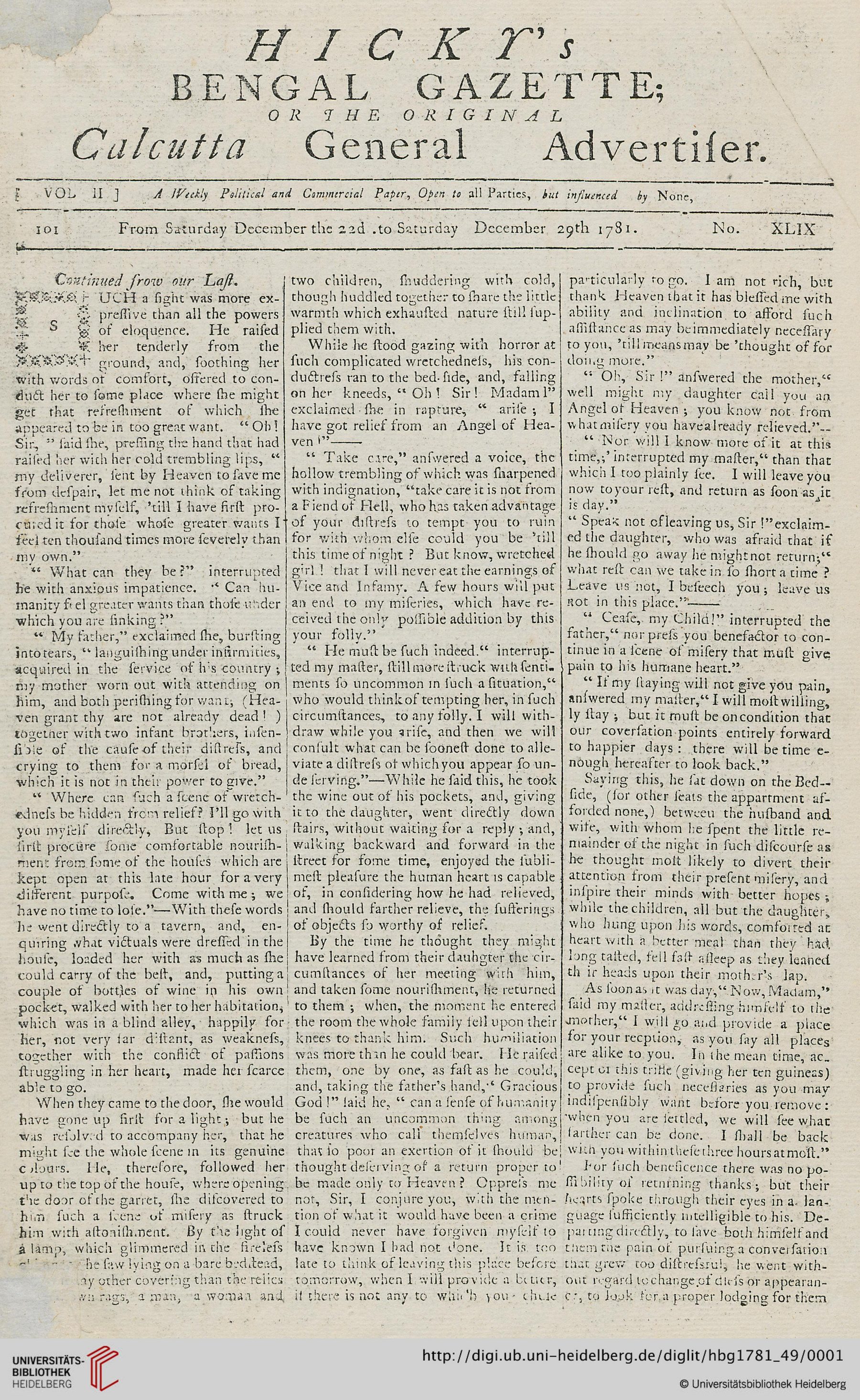
HICKY's
BENGAL GAZETTE;
OR THE ORIGINAL
Calcutta General Advertiser.
[ VOL II ] A Weekly Political and Commercial Paper, Open to all Parties, but influenced by None.
101 From Saturday December the 22d .to Saturday December 29th 1781. [No. XLIX]
Continued from our Last.
SUCH a sight was more expressive than all the powers of eloquence. He raised her tenderly from the ground, and, soothing her with words of comfort, offered to conduct her to some place where she might get that refreshment of which she appeared to be in too great want. "Oh! Sir," said she, pressing the hand that had raised her with her cold trembling lips, "my deliverer, sent by Heaven to save me from despair, let me not think of taking refreshment myself, 'till I have first procured it for those whose greater wants I feel ten thousand times more severely than my own."
"What can they be?" interrupted he with anxious impatience. "Can humanity feel greater wants than those under which you are sinking?"
"My father," exclaimed she, bursting into tears, "languishing under infirmities, acquired in the service of his country; my mother worn out with attending on him, and both perishing for want, (Heaven grant they are not already dead!) together with two infant brothers, insensible of the cause of their distress, and crying to them for a morsel of bread, which it is not in their power to give.”
"Where can such a scene of wretchedness be hidden from relief? I'll go with you myself directly, But stop! let us first procure some comfortable nourishment from some of the houses which are kept open at this late hour for a very different purpose. Come with me; we have no time to lose."—With these words he went directly to a tavern, and, enquiring what victuals were dressed in the house, loaded her with as much as she could carry of the best, and, putting a couple of bottles of wine in his own pocket, walked with her to her habitation, which was in a blind alley, happily for her, not very far distant, as weakness, together with the conflict of passions struggling in her heart, made her scarce able to go.
When they came to the door, she would have gone up first for a light; but he was resolved to accompany her, that he might see the whole scene in its genuine colours. He, therefore, followed her up to the top of the house, where opening the door of the garret, she discovered to him such a scene of misery as struck him with astonishment. By the light of a lamp, which glimmered in the fireless chimney, he saw lying on a bare bedstead, without any other covering than the relics of their own rags, a man, a woman and two children, shuddering with cold, though huddled together to share the little warmth which exhausted nature still supplied them with.
While he stood gazing with horror at such complicated wretchedness, his conductress ran to the bed-side, and, falling on her knees, "Oh! Sir! Madam!" exclaimed she in rapture, "arise; I have got relief from an Angel of Heaven"—
"Take care," answered a voice, the hollow trembling of which was sharpened with indignation, "take care it is not from a Fiend of Hell, who has taken advantage of your distress to tempt you to ruin for with whom else could you be 'till this time of night? But know, wretched girl! that I will never eat the earnings of Vice and Infamy. A few hours will put an end to my miseries, which have received the only possible addition by this your folly."
"He must be such indeed." interrupted my master, still more struck with sentiments so uncommon in such a situation," who would think of tempting her, in such circumstances, to any folly. I will withdraw while you arise, and then we will consult what can be soonest done to alleviate a distress of which you appear so undeserving."—While he said this, he took the wine out of his pockets, and, giving it to the daughter, went directly down stairs, without waiting for a reply; and, walking backward and forward in the street for some time, enjoyed the sublimest pleasure the human heart is capable of, in considering how he had relieved, and should farther relieve, the sufferings of objects so worthy of relief.
By the time he thought they might have learned from their daughter the circumstances of her meeting with him, and taken some nourishment, he returned to them; when, the moment he entered the room the whole family fell upon their knees to thank him. Such humiliation was more than he could bear. He raised them, one by one, as fast as he could, and, taking the father's hand," Gracious God!" said he, "can a sense of humanity be such an uncommon thing among creatures who call themselves human, that so poor an exertion of it should be thought deserving of a return proper to be made only to Heaven? Oppress me not, Sir, I conjure you, with the mention of what it would have been a crime I could never have forgiven myself to have known I had not done. It is too late to think of leaving this place before tomorrow, when I will provide a better, if there is not any to which you chuse to go. I am not rich, but thank Heaven that it has blessed me with ability and inclination to afford such assistance as may be immediately necessary to you, 'till means may be 'thought of for doing more."
"Oh, Sir!" answered the mother," well might my daughter call you an Angel of Heaven; you know not from what misery you have already relieved."--
"Nor will I know more of it at this time,;" interrupted my master," than that which I too plainly see. I will leave you now to your rest, and return as soon as it is day."
"Speak not of leaving us, Sir!" exclaimed the daughter, who was afraid that if he should go away he might not return;" what rest can we take in so short a time? Leave us not, I beseech you; leave us not in this place."—
"Cease, my Child!" interrupted the father," nor press you benefactor to continue in a scene of misery that must give pain to his humane heart."
"If my staying will not give you pain, answered my master," I will most willingly stay; but it must be on condition that our conversation points entirely forward to happier days: there will be time enough hereafter to look back."
Saying this, he sat down on the Bed-side, (for other seats the apartment afforded none,) between the husband and wife, with whom he spent the little remainder of the night in such discourse as he thought most likely to divert their attention from their present misery, and inspire their minds with better hopes; while the children, all but the daughter, who hung upon his words, comforted at heart with a better meal than they had long tasted, fell fast asleep as they leaned their heads upon their mother's lap.
As soon as it was day, "Now, Madam," said my master, addressing himself to the mother," I will go and provide a place for your reception, as you say all places are alike to you. In the mean time, accept of this trifle (giving her ten guineas) to provide such necessaries as you may indispensibly want before you remove: when you are settled, we will see what farther can be done. I shall be back with you within these three hours at most."
For such beneficence there was no possibility of returning thanks; but their hearts spoke through their eyes in a language sufficiently intelligible to his. Departing directly, to save both himself and them the pain of pursuing a conversation that grew too distressful, he went without regard to change of dress or appearance, to look for a proper lodging for them
Page 2
AI transcription (Google Gemini, 2026)
where he laid in such provisions of every kind as he knew they must immediately want. This care employed him 'till the time he had promised to return, when he found such an alteration in the looks and appearance of them all, as gave his heart delight.
"You see, Sir," said the mother as soon as he entered, "the effects of your bounty; but do not think that vanity has made us abuse it. These clothes, what we could raise on which has for some time been our sole support, were the purchase of happier times, and were now redeemed for much less than we must have given for the worst we could buy."
"Dear Madam!" interrupted my master, taking her hand respectfully, "mention not any thing of the kind to me, I beseech you. You will soon see such times again." Then turning to the husband, "I have taken a lodging, Sir," continued he; "it is convenient, but not large, as I imagined would be your choice. I will call a coach to take us to it directly. If there are any demands here, let the people of the house be called up, and they shall be paid. I will be your purse-bearer for the present."
"No, Sir," replied the husband, "there is not any; you have enabled us to discharge all demands upon us. People in our circumstances cannot find credit, because they want it."
My master would then have gone for a coach, but the daughter insisted on saving him that trouble: upon which he put the whole family into it, and away before them to their new lodging. It is impossible to describe what these poor people felt when they saw the provision he had made for their reception. The father, in particular, could not bear it; but, sinking into a chair, "This is too much!" said he, as soon as a flood of tears had given vent to the fullness of his heart; "this is too much. Support me, gracious Heaven! who has sent this best of men to my relief; support me under the weight of obligations which the preservation of these alone (looking round upon his wife and children) could induce me to accept."—Then addressing himself to my master. "My heart is not unthankful," continued, he; "but gratitude in such excess as mine where there is no prospect of ever making a return, is the severest pain."
My master, who sought none, attempted often to give the conversation another turn; but finding that they could speak or think of nothing else as yet, he took his leave, promising to come the next day, when their minds should be better settled, to consult what more was in his power to serve them, having first privately taken an opportunity to slip a couple of guineas into the daughter's hand, to avoid the putting the delicacy of her father and mother to farther pain.
———————————————————
To Mr. HICKY Editor of the Original Calcutta Gazette.
The Right and Capacity of the People to Judge of Government.
SIR,
THE World has from time to time, been led into such a long Maze of Mistakes, by those who gained by deceiving, that whoever wou'd Instruct Mankind, must begin with Removing their Errors; and if they were every where honestly Apprized of Truth, and restored to their Senses, there wou'd not remain one Nation of Bigots or Slaves under the Sun: A Happiness always to be wished, but never Expected! In most parts of the Earth there is neither Light nor Liberty, and even in the best parts of it, they are but little Encourag'd, & coldly maintain'd; there being in all places, many engaged through Interest in a perpetual Conspiracy against them, they are the two greatest civil Blessings, Inseparable in their Interests, and the Mutual Support of each other; and whoever wou'd destroy one of them, must Destroy both. Hence it is that we every where find Tyranny and Imposture, Ignorance and Slavery, joined together; and Oppression and Deceivers mutually aiding and paying constant Court to each other. Whenever Truth is Dangerous, Liberty is Precarious.
Of all the Sciences that I know in the World, that of Government concerns us most, and is the Easiest to be known, & yet is the least understood. Most of those who manage it wou'd make the lower World believe that there is I know not what Difficulty and Mystery in it; far above Vulgar understanding; which proceeding of theirs is direct Craft and Imposture: Every Ploughman knows a Good Government from a bad one, from the Effects of it? He knows whether the fruits of his Labour be his own, and whether he enjoys them in Peace and Security; and if he do not know the principles of Government, it is for want of thinking and Enquiry, for they lie open to Common Sense; but people are generally Taught not to think of them at all, or to think wrong of them.
What is Government, but a Trust Committed by all, or the Most, to one or a few, who are to attend upon the affairs of all, that every one may with more security attend upon his own. A Great and Hon'ble Trust; but too seldom Honorably Executed; those who possess it having it often more at heart to encrease their power, than to make it usefull, and to be Terrible, rather than Beneficient. It is therefore a trust which ought to be bounded with many and strong Restraints, because Power renders Men wanton, Insolent to others, and fond of themselves. Every Violation therefore of this Trust, where such violation is considerable, ought to meet with Proportionable Punishment; and the smallest violation of it ought to meet with some, because Indulgence to the least fault of Magistrates may be cruelty to a whole People.
Honesty, Diligence, and plain sense, are the only Talents necessary for the executing of this Trust; and the Public good is it's only end: as to Refinements and Finesses, they are often only the false appearance of Wisdom and parts, and oftener Tricks to hide Guilt and Emptiness; and they are generally mean and Dishonest.—They are the acts of Jobbers in Politicks who playing their own Game under the Public cover, subsists upon poor shifts and expedients, starved Politicians who live from hand to Mouth, from day to day, and following the little vices of Ambition, Avarice, Revenge, and the like Personal Passions, are asham'd, to avow them, Yet want souls great enough to forsake them; Small wicked Statesmen, who make a Private Market of the Public, and deceive it in order to sell it.
These are the Parts which great and good Governors scorn to play and cannot play, their Designs like their stations, being purely public are open and undisguis'd. They do not consider their People as their prey, nor lie in ambush for their subjects; nor dread and treat and surprize them like Enemies, as all ill Magistrates do; who are not Governors, but Jaylors and Spunges, who chain them and squeeze them, and yet take it very ill if they do but Murmur; which is yet much less than a People so abused ought to do. There have been Times and Countries, when Public Ministers and Public Enemies have been the same Individual Men. What a Melancholly Reflection is this, that the most Terrible and Mischievous Foes to a Nation shou'd be it's own Magistrates! and yet in every enslaved Country, which is almost every Country, this is the woeful cause.
Honesty and Plainness go always together, and the Makers and Multipliers of Mystery, in the Political way, are shrewdly to be suspected of dark designs.
CINCINNATUS was taken from the Plough to save and Defend the Roman State, an Office which he Executed honestly and Successfully, without the Grimace And gains of a Statesman. Nor did he afterwards Continue Obstinately at the head of Affairs, to form a Party, raise a Fortune, and settle himself in Power: as he came into it with Universal Consent, he resign'd it with universal Applause.
It seems that Government was not in those days become a Trade, at least a Gainful Trade.—Honest Cincinnatus was but a Farmer: and happy had it been for the Romans if, when they were enslaved, they Cou'd have taken the Administration out of the Hands of the Emperors, and their Refined Politicians and Committed it to such (Politicians) Farmers or any Farmers. It is certain that many of their Imperial Governors Acted more Ridiculously than a Board of Ploughmen wou'd have done and more Barbarously, than a Club of Butchers cou'd have done.
But some have said, it is not the Business of Private Men to Meddle with Government. A bold, false, and dishonest Saying. And whoever says it either knows not what he says, or cares not, or Slavishly speaks the Sense of others. It is a cant now almost forgot in England, and which never prevail'd but when Liberty And the Constitution were attacked, and never can prevail but upon the like Occassion.
It is a vexation to be oblig'd to Answer nonsense And Confute Absurdities: but since it is and has been the great Design of this Paper to maintain and Explain the Glorious principles of Liberty, and to Expose the arts of those who wou'd darken or destroy Them; I shall here particularly Shew the Wickedness and stupidity of the above saying; which is
Page 3
AI transcription (Google Gemini, 2026)
mouth but that of a Slave, and can never be heard by any Man of an Honest and free soul, without horror and Indignation; It is in Short, a Saying, which ought to render, the Man who utters it for ever Incapable of Place or credit in a free Country, as it Shews the Malignity of his heart and the baseness, of his nature, and as it is the Pronouncing of a doom upon our Constitution.—A Crime or rather a Complication of Crimes, for which a lasting Infamy Ought to be but part of the Punishment.
But to falsehood of the thing: Publick truths ought Never to be kept Secrets; and they who do it, are guilty of a Solicism, and a Contradiction: every Man ought to know, What it concerns all to know. Now nothing upon Earth has a concern in it, because in it is concern'd, and nearly and Immediately concern'd his Virtue, his Prosperity, and the Security of his Person, and when all these are best preserved and Advanced, the Government is best Administer'd: and when they are not, the Government is Impotent, wicked, or Unfortunate, and where the Government is so, the People will be so, there being always and every where a certain Sympathy and Analogy between the nature of the Government and the nature of the People. This holds true in every Instance. Publick Men are the Patterns of private; and the Virtues and Vices of the Governors become Quickly the Virtues and Vices of the Governed.
Nor is it Example alone that does it ill Governments Subsisting by Vice and Rapine, are Jealous of Private Virtue, and enemy's to Private Property. He must be wicked and Mischievous to be what they are; nor are they Secure while any thing good or Valuable is Secure.
Hence it is that to drain, worry, and Debauch their Subjects, are the steady Maxims of their Politicks, their favourite arts of Reigning. In this Wretched situation The People to be safe, must be poor and Lewd there will be but little Industry where Property is Precarious, small Honesty where Virtue is dangerous. Profuseness or Frugality, and the like Virtues or, Vices, which affect the public will be practised in the City, if they be Practised in the Court; and in the Country, if they be in the City. Even Nero (That Royal Monster in Mans shape) was ador'd by the Common herd at Rome, As much as he was flatter'd by the Great; and both the little and the great admir'd, or pretended to admire his Manners, and many to Imitate them. Tacitus tells us, that those sort of People long lamented him, and Rejoiced in the Choice of a Successor, that Resembled him even the Profligate Otho.
Good Government does on the Contrary, produce great Virtue Much happiness and many People. Greece and Italy while they Continued free were each of them for the Number of Inhabitants, like one Continued City; for Virtue knowledge, and great Men, they were the Standards of the World, and that age and Country that cou'd Come nearest to them, has ever since been reckon'd the happiest. Their free Government was the root of all these advantages, and of all this felicity and Renown, and in these great and fortunate States the People were the Principals in the Government; Laws were made by their Judgment and Authority, and by their Voice and Commands Were Magistrates created and Condemn'd. The City of Rome Cou'd Conquer the World, nor Cou'd the great Persian Monarch the greatest then upon Earth stand before the face of one Greek City.
But what are Greece and Italy now? Rome has in it a herd of Pamper'd Monks, and a few starving Lay Inhabitants; the Campania of Rome, The finest Spot of Earth in Europe, is a Desert. And for the Modern Greeks, they are a few abject contemptible slaves Kept under Ignorance, Chains and Vilenefs, by the Turkish Monarch, who Keeps a great part of the Globe intensely Miserable, that he may seem Great without being so.
Such is the Difference between one Government and Another, and of such Important Concernment is the Nature and Administration of a Government to a People. And to say that Private Men have nothing to do with Government, is to say that Private Men have nothing to do with their own Happiness or, Misery. What is the Publick, but the collective body of private Men as every Private Man is a member of the public? and as the whole ought to be concern'd for the preservation of every private Individual, it is the duty of every Individual to be concern'd for the whole, in which himself is Included.
One Man or a few men, have often pretend'd the publick, and Meant themselves, and consulted their own Personal Interest, in Instances essential to its well being; but the whole people by consulting their own Interest, consult the publick. and act for the Public by acting for themselves: This is Particularly the Spirit of our Constitution, in which the whole nation is represented, and our records afford instances, where the House of Commons have declined entering upon a Question of importance, till they had gone in the Country, and consulted their Principals, the People: so far were they from thinking that private Men had no right to meddle with Government. In truth our whole worldly happiness and misery (abating for accidents and diseases) are owing to the order, or, Mismanagement of Government; and he who says that private Men have no concern with Government, does wisely and modestly tell us, that Men have no concern in that which concerns them most, it is saying that People ought not to concern themselves whether they be Naked or, Clothed, fed, or Starved, Deceived or Instructed, and whether they be protected or, destroyed. What Nonsense and Servitude in a free and wise Nation! For, myself, who have thought pretty much of these matters. I am of opinion, that a whole Nation are like to be, as much attach'd to themselves, as one Man or a few are like to be, who may by many means be detach'd from the Interest of a Nation.
[To be Continued]
CALCUTTA.
Extract of a Letter from Cap. Wm. Ingram of the Snow Elezabeth dated Maddipollam the 14th Instant
I HAVE been off point Godewax these 10 Days trying to work round but found it all in vain. On the 1st of Nov. saw a Sail to the N. ward Standing to the S. ward and at noon bore E. when she saw me. She hauled her wind and gave chace after me 8 hours.—It being night coming on lost Sight of her and at day light next morning saw the Chace a long way to Leward, Still in Chace after me.—I hoisted my Colours in the morning but she would not answer them.—I took her to be a french Brig by seeing a long Boom over her taffel.—at 8 A. m. found she could not make any hand of me as the Currents run so strong to the West-ward.—She put Helm hard a weather and bore away and stood to the S. E.
N. B. The above Vessel answers the description of the Confiance Privateer Capt. Fautrel of 14 Guns 6 pounders, and 150 Men.
——————————————————
Intelligence Extraordinary.
THE Ornamental Lawyer was the other Night boasting of his having the merit of effecting the famous laudable and praif-worthy Coalation, between Mr. H—— & Mess. F—— and W—— and complaining of the ingratitude of the latter Gentlemen, who had never since taken any Notice of him.
Aye, Aye, replied Jack Sprightly, this puts me in mind of an Observation of Dean Swift. ——That the quarrells of Politicians, are made up like those of Antient Kings; —there is always an Animal Sacrificed on the Occasion.
A Correspondent and an Amateur de la dance who was at the Ball on Tuesday Night, Remarks, that some of the Minuets were as elegantly Danced as any he ever saw at the most Brilliant Assemblies in Europe. The Pas-Grave in particular so necessary at present in a Minuet was so gracefully and so Minutely delineated in true position that no Critic could Carp at it, let his Lunotte d'approche be ever so piercing every Elegance he observes breathed in the Air of the Amiable and bewitching Miss C——.
——————————————————
ARRIVALS.] —Dec. 24th. Hon'ble Company's Ship Yarmouth Capt. Richardson from Madras. —27th Snow Triumph Capt. Thrasher from Do.
DEPARTURES.] —Dec. 24th Grabb Ship Blake Capt. Light for Mad as.—Do. Ship Sulimania John Fea Bombay. 27th Ship Alfred Capt. Primrose for Madras.
Page 4
AI transcription (Google Gemini, 2026)
POET's CORNER.
The following Verses were written by a Gentle-man, on a Lady's saying she wished for No-thing more than SHE POSSESS'D.
FEW are content with what they've got,
But something more desire!
Tho' widely different is your lot,
Who Nothing do require.
Yet grant their utmost wishes blest,
By having what they call:
What's luxury, or wealth, at best?
Why, Nothing after all.
Tho' something is by all pursu'd,
And most at Nothing vex'd;
That something great at distance view'd,
Proves Nothing when possess'd.
The merchant and the tradesman too,
In Nothing much delight;
Sell what they will, they'll vow to you,
That they get Nothing by it.
Your cause preplex'd, the Lawyers may
For justice loudly bawl;
Your cause they lose, and then you pay,
For Nothing, after all.
The Courtiers Levee you attend,
Their very faults adore;
He'll promise much to be your friend,
But will do Nothing more.
When friends dispute and disagree,
To interfere is vain:
Each wonders that you can't agree,
When Nothing is so plain.
When virgins sigh or shed a tear,
Which love can cause or cure;
You ask for what they grieve?—Oh dear!
For Nothing to be sure.
Tho' soldiers with their swords unite,
Their country's foes to slay,
You ask the reason why they flight
For Nothing but their pay.
If in the streets a crowd you see,
The cause you may enquire;
The answer probably will be,
Oh, Nothing but a fire!
The passive husbands sometimes run
From clamour, noise, and strife:
Ask each what 'tis they'd wish to shun,
Why Nothing but his wife.
For Nothing we despair and grieve,
For Nothing we contend,
For those endearing transports live,
That must in Nothing end.
The almighty Pow'r on Nothing hung
This universal ball.
Which at the first from Nothing sprung,
And must to Nothing fall.
ODE to SOLITUDE.
SWEET companion of the muse!
Gentle Solitude! appear,
All thy calm content infuse,
Soften anguish, banish care;
Lead me, O majestic Queen,
Thro' the aromatic scene.
Nature's copied here by art,
Joyful we the fraud confess;
Who so well performs her part,
'Tis but nature's better dress;
Solitude here sit my seat,
Here in Cowley's soft retreat.
Lay me in the silent mead,
Where the murmuring river flows,
Where the elm expands the shade,
And each rising beauty blows;
There I'll lay, in pace of mind,
"Empty greatness, fall behind!"
Teach thy vot'ry all the pow'rs
Of each plant and every tree;
Tell how short-liv'd are the flow'rs;
Bring the moral home to me:
Bid me fleeting life despise;
Make me humble, make me wise,
Pride within my lowly cell
Never yet uprear'd her head;
Solitude with thee I'll dwell;
Pride in me is long since dead:
Cold to pleasure, deaf to praise,
Here I wish to end my days.
Now in the Press, and speedily will be Published. Price 4 Rupees.
AN Almanac for the ensuing Year, containing the Christian and Bengal Calendars, with the Mahometan Æra of the Hegira,—The conjunctions, Squares, and oppositions of the Lumnaries.—The Moons Southing Calculated agreeable to apparent Astronomical time to the Meridian of Calcutta, and may be reduced to ny other Meridian by a Note inserted for that purpose.—The Moons culminating the Meridian, being very useful for determining the time of High-Water at any Port or Harbour provided the time be ascertained at which it is high Water at the full and Change.—The Southing may also have it's use by taking Her Meridian Altitude, For determining the Lattitude proper Allowance being made for Her Parallex in Altitude.—The Equation of time necessary in regulating Clocks, Also a Table of the Suns Rising and Setting, independant of Refraction, with directions how to find the Moons full and Change at any other Meridian on the Globe where Longitude is ascertained.
N. B. This Almanac will be printed with a beautiful new Type on a fine Paper, and sold at the Printing Office, the 28th of the present Month.
FOR SALE by PRIVATE CONTRACT.
AN Extensive Spot of Ground in the best and Most airy Place of Calcutta whereon is erected two Substantial Commodious Pucka Brick Houses.—This Estate already brings in four Hundred Sicca Rupees per month and is lett to the Company for a Term at the Will and option of the Purchaser. For the convenience of the Buyer two thirds of the purchase Money may remain on Mortgage; For further Particulars enquire of Mr. Duncan at the Old Play-House.
N. B.—If not Sold by Private Sale before the end of February, it will be submitted to Public Sale by Mr. Duncan.
Calcutta 17th December 1781.
JUST PUBLISHED BY AUTHORITY.
AND is Sold at the Library, the late Bye Law either bound or in Sheets.
To be SOLD.
A BUDGEROW the Dimensions &c. of an Indiamans Long Boat with a Large Hall and Venetians enquire of Mr. Nyss in Calcutta—also a small Convenient 8 Oar'd Budgerow of 2 Rooms both in good repair, and fit for immediate Use.
24th Nov. 1781.
ANY Person or Persons who can give information of Mr. William Maynard, will hear something to his advantage Mr. M—was 5th Mate of the Shrewsbury Indiamen Capt, Coggan about two Years and a half ago, but remain'd in India, he was seen in Calcutta. on October 1781. a line directed to K. P or to Mr. Hicky printer of the Bengal Gazette.
NOTICE.
IS hereby given, that on Monday the 7th of January and following days, the Effects belonging to the Honnerable Johannes Matthias Ross Esq. will be exposed at Public Auction at Chinsurah---They Consist of Furniture, Plate, CHINA, Ware, LIQUORS of different, Sorts, Carriages, Horses, (amongst which aSet of six gray Torkays). Different Books in English, French, and Dutch, mongst which the Encyclopedie and the Corps diplomatique with its Suppelments.
GLOBES, TELESCOPE and MICROSCOPES, and Many other Articles.
Conditions of Sale.
The Goods are to be Sold for Sicca Rupees, and not to be delivered to the Purchasers, untill they have paid por them, and in Case they are not paid for, and removed at the end of the Month January, they will be re-sold for account, and at the Expence of the first Purchaser.
CALCUTTA ASSEMBLY.
THE Stewards give Notice that the fifth Subscription Bell will be held on Friday the 4th of January 1782, and request the Subscribers to send for Tickets for themselves and Friends. on that day at the usual Hours.
WANTED.
AN Apprentice to a very genteel Business, the Son of a European, he must be well acquainted with the English Language, and Write a good hand, understand something of accounts, and of good connections. the Parents, or Guardian of such a Person, by applying to Mr. HICKY, at the Printing Office, may meet with an Opportunity of providing for their Son or Pupil.
Calcutta 26th D
CALCUTTA Printed by J. A. HICKY, First and late Printer to the Hon. COMPANY.