Browse › 1781
Saturday 21 July 1781
Page 1
AI transcription (Google Gemini, 2026)
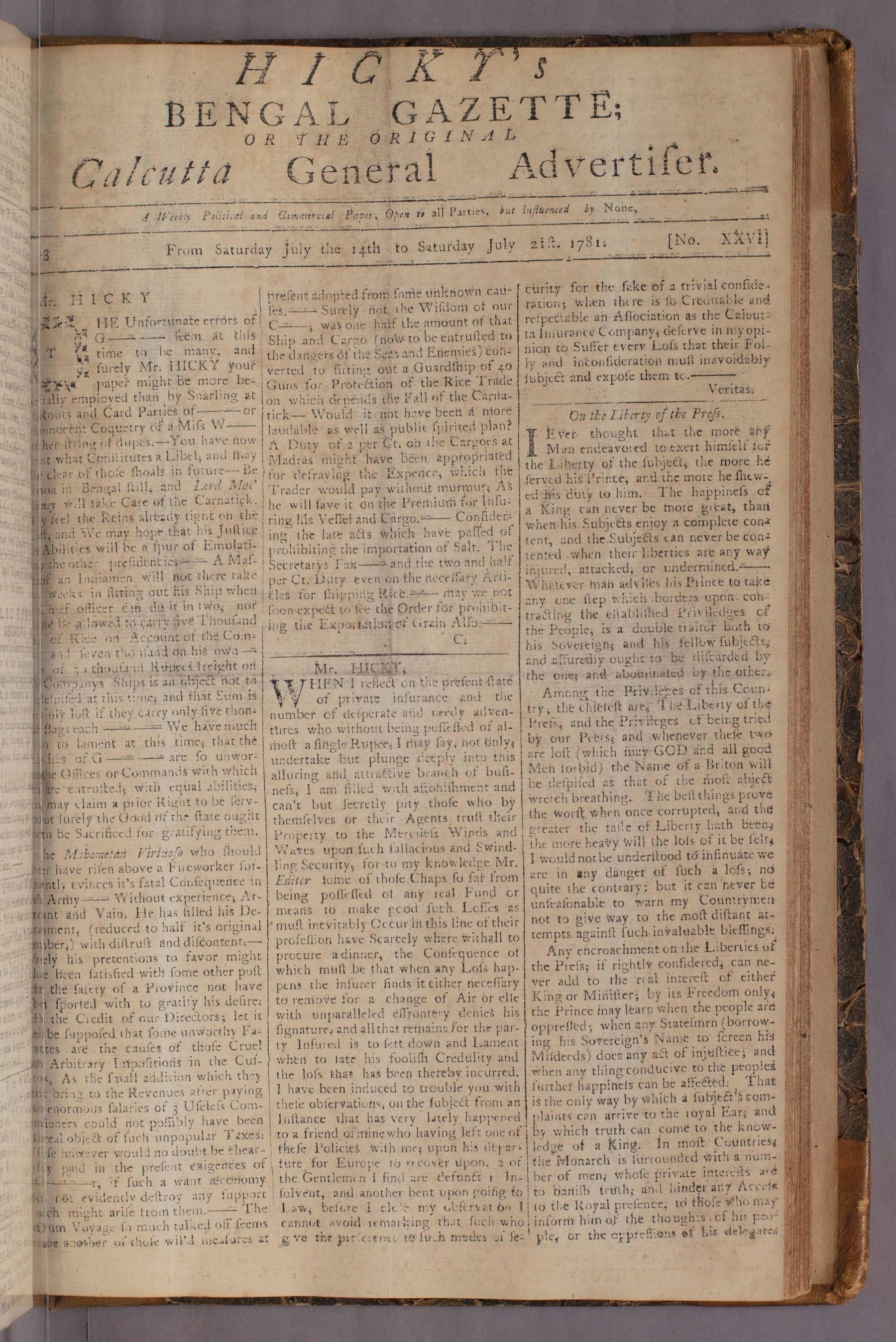
HICKY'S
BENGAL GAZETTE;
OR THE ORIGINAL
Calcutta General Advertiser.
A Weekly Political and Commercial Paper, Open to all Parties, but influenced by None.
78 From Saturday July the 14th to Saturday July 21st. 1781. [No. XXVI]
Mr. HICKY
THE Unfortunate errors of G— — seem at this time to be many, and surely Mr. HICKY your paper might be more beneficially employed than by Snarling at the Routs and Card Parties of — or the innocent Coquetry of a Miss W— and her string of dupes.—You have now learnt what Constitutes a Libel, and may steer clear of those shoals in future—Be CENSOR in Bengal still, and Lord MacCartney will take Care of the Carnatick. They feel the Reins already tight on the Coast, and We may hope that his Justice and Abilities will be a spur of Emulation to the other presidencies—A Master of an Indiamen will not there take four weeks in fitting out his Ship when his Chief officer can do it in two, nor will he be allowed to carry five Thousand Bags of Rice on Account of the Company and seven thousand on his own— a loss of 30 thousand Rupees freight on two Companys Ships is an object not to be despised at this time, and that Sum is certainly lost if they carry only five thousand Bags each— We have much reason to lament at this time, that the Favorites of G— — are so unworthy the Offices or Commands with which they are entrusted, with equal abilities, they may claim a prior Right to be served but surely the Good of the state ought not to be Sacrificed for gratifying them. The Mahometan Virtuoso who should never have risen above a Fireworker sufficiently evinces it's fatal Consequence in the Army—Without experience, Arrogant and Vain. He has filled his Detachment, (reduced to half it's original number,) with distrust and discontent.— Surely his pretentions to favor might have been satisfied with some other post and the safety of a Province not have been sported with to gratify his desire. For the Credit of our Directors; let it also be supposed that some unworthy Favorites are the causes of those Cruel and Arbitrary Impositions—in the Customs. As the small addition which they must bring to the Revenues after paying the enormous salaries of 3 Useless Commissioners could not possibly have been the real object of such unpopular Taxes. These however would no doubt be chearfully paid in the present exigences of G—r, if such a want æconomy did not evidently destroy any support which might arise from them.— The Opium Voyage so much talked off seems to be another of those wil'd measures at present adopted from some unknown causes.—Surely not the Wisdom of our C—, was one half the amount of that Ship and Cargo (now to be entrusted to the dangers of the Seas and Enemies) converted to fitting out a Guardship of 40 Guns for Protection of the Rice Trade on which depends the Fall of the Carnatick— Would it not have been a more laudable as well as public spirited plan? A Duty of 2 per Ct. on the Cargoes at Madras might have been appropriated for defraying the Expence, which the Trader would pay without murmur, As he will save it on the Premium for Insuring his Vessel and Cargo,— Considering the late acts which have passed of prohibiting the importation of Salt. The Secretarys Tax—and the two and half per Ct. Duty even on the necessary Articles for shipping Rice.— may we not soon expect to see the Order for prohibiting the Exportation of Grain Also.— C.
Mr. HICKY,
WHEN I reflect on the present state of private insurance and the number of desperate and needy adventurers who without being possessed of almost a single Rupee, I may say, not only, undertake but plunge deeply into this alluring and attractive branch of business, I am filled with astonishment and can't but secretly pity those who by themselves or their Agents trust their Property to the Merciless Winds and Waves upon such fallacious and Swindling Security; for to my knowledge Mr. Editor some of those Chaps so far from being possessed of any real Fund or means to make good such Losses as must inevitably Occur in this line of their profession have Scarcely where withall to procure a dinner, the Consequence of which must be that when any Loss happens the insurer finds it either necessary to remove for a change of Air or else with unparalleled effrontery denies his signature, and all that remains for the party Insured is to sett down and Lament when to late his foolish Credulity and the loss that has been thereby incurred. I have been induced to trouble you with these observations, on the subject from an Instance that has very lately happened to a friend of mine who having left one of these Policies with me, upon his departure for Europe to recover upon, 2 of the Gentlemen I find are defunct 1 Insolvent, and another bent upon going to Law, before I close my observation I cannot avoid remarking that such who give the preference to such modes of security for the sake of a trivial consideration; when there is so Creditable and respectable an Association as the Calcutta Insurance Company, deserve in my opinion to Suffer every Loss that their Folly and inconsideration must inavoidably subject and expose them to.— Veritas.
On the Liberty of the Press.
I Ever thought that the more any Man endeavored to exert himself for the Liberty of the subject, the more he served his Prince, and the more he shewed his duty to him. The happiness of a King, can never be more great, than when his Subjects enjoy a complete content, and the Subjects can never be contented when their liberties are any way injured, attacked, or undermined.— Whatever man advises his Prince to take any one step which borders upon contracting the established Priviledges of the People, is a double traitor both to his Sovereign, and his fellow subjects, and assuredly ought to be discarded by the one, and abominated by the other. Among the Privileges of this Country, the chiefest are, The Liberty of the Press, and the Privileges of being tried by our Peers, and whenever these two are lost (which may GOD and all good Men forbid) the Name of a Briton will be despised as that of the most abject wretch breathing. The best things prove the worst when once corrupted, and the greater the taste of Liberty hath been, the more heavy will the loss of it be felt, I would not be understood to insinuate we are in any danger of such a loss; no quite the contrary: but it can never be unseasonable to warn my Countrymen not to give way to the most distant attempts against such invaluable blessings. Any encroachment on the Liberties of the Press, if rightly considered, can never add to the real interest of either King or Minister; by its Freedom only, the Prince may learn when the people are oppressed; when any Statesmen (borrowing his Sovereign's Name to screen his Misdeeds) does any act of injustice; and when any thing conducive to the peoples further happiness can be affected.... That is the only way by which a subject's complaints can arrive to the royal Ear; and by which truth can come to the knowledge of a King. In most Countries, the Monarch is surrounded with a number of men, whose private interests are to banish truth, and hinder any Access to the Royal presence, to those who may inform him of the thoughts of his people, or the oppressions of his delegates.
Page 2
AI transcription (Google Gemini, 2026)
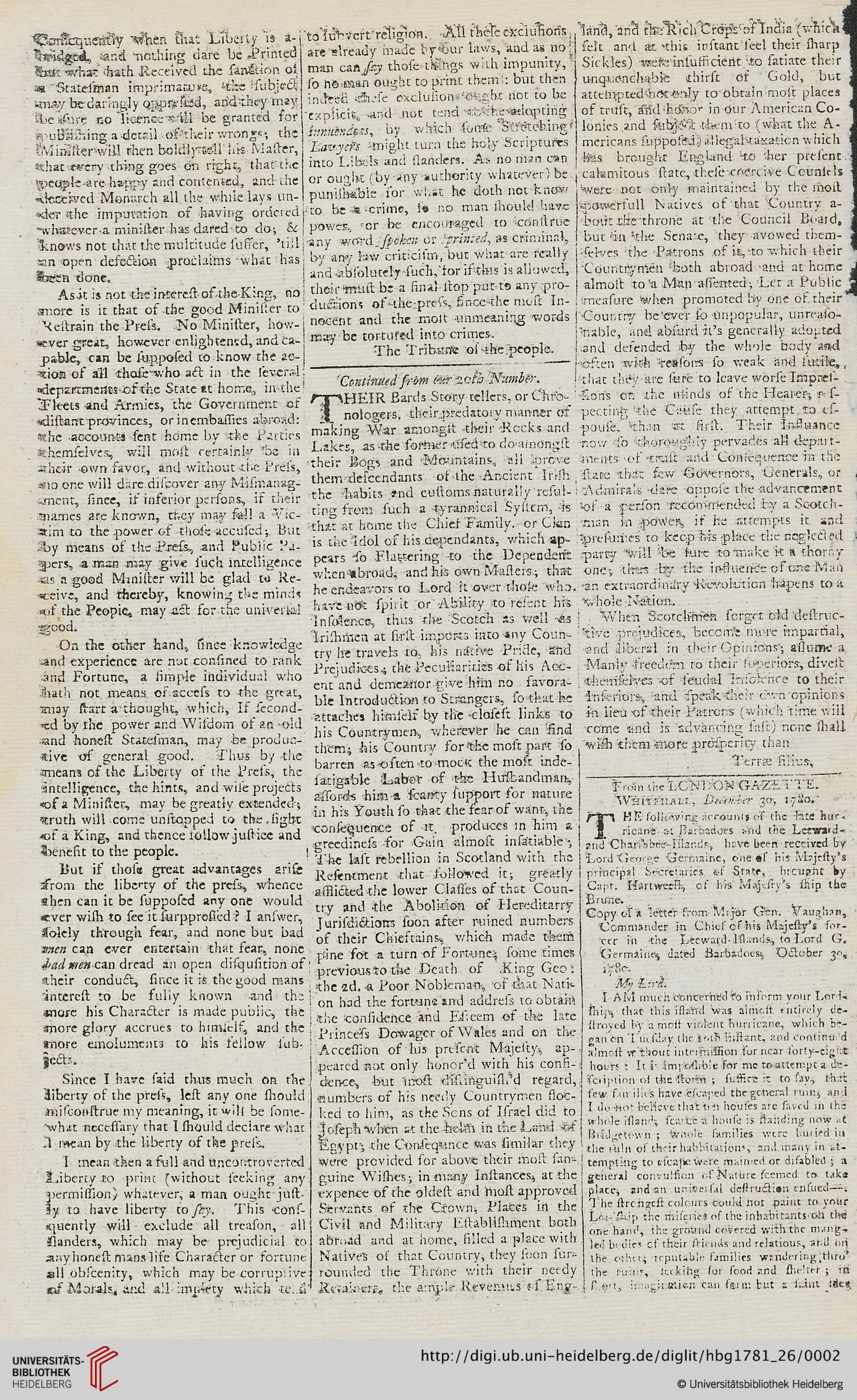
Confequently when that Liberty is abridged, and nothing dare be Printed but what hath Received the fanction of a Statefman imprimatur, the fubject may be daringly oppreffed, and they may be fure no licence will be granted for publifhing a detail of their wrongs; the Minifter will then boldly tell his Mafter, that every thing goes on right, that the people are happy and contented, and the deceived Monarch all the while lays under the imputation of having ordered whatever a minifter has dared to do; & knows not that the multitude fuffer, 'till an open defection proclaims what has been done.
As it is not the intereft of the King, no more is it that of the good Minifter to Reftrain the Prefs. No Minifter, however great, however enlightened, and capable, can be fuppofed to know the action of all thofe who act in the feveral departments of the State at home, in the Fleets and Armies, the Government of diftant provinces, or in embaffies abroad: the accounts fent home by the Parties themfelves, will moft certainly be in their own favor, and without the Prefs, no one will dare difcover any Mifmanagement, fince, if inferior perfons, if their names are known, they may fall a Victim to the power of thofe accufed; But by means of the Prefs, and Public Papers, a man may give fuch intelligence as a good Minifter will be glad to Receive, and thereby, knowing the minds of the People, may act for the univerfal good.
On the other hand, fince knowledge and experience are not confined to rank and Fortune, a fimple individual who hath not means of accefs to the great, may ftart a thought, which, If feconded by the power and Wifdom of an old and honeft Statefman, may be productive of general good. Thus by the means of the Liberty of the Prefs, the intelligence, the hints, and wife projects of a Minifter, may be greatly extended; truth will come unftopped to the fight of a King, and thence follow juftice and benefit to the people.
But if thofe great advantages arife from the liberty of the prefs, whence then can it be fuppofed any one would ever wifh to see it furppreffed? I anfwer, folely through fear, and none but bad men can ever entertain that fear, none but bad men can dread an open difquifition of their conduct, fince it is the good mans intereft to be fully known and the more his Character is made public, the more glory accrues to himfelf, and the more emoluments to his fellow fubjects.
Since I have faid thus much on the liberty of the prefs, left any one should mifconftrue my meaning, it will be fomewhat neceffary that I should declare what I mean by the liberty of the prefs.
I mean then a full and uncontroverted Liberty to print (without feeking any permiffion) whatever, a man ought juftly to have liberty to fay. This confequently will exclude all treafon, all flanders, which may be prejudicial to any honeft mans life, Character or fortune, all obfcenity, which may be corruptive of Morals, and all impiety which tend to fubvert religion. All thefe exclufions are already made by our laws, and as no man can fay thofe things with impunity, fo no man ought to print them: but then indeed thefe exclufions ought not to be explicit, and not tend to the adopting innuendoes, by which fome Stretching Lawyers might turn the holy Scriptures into Libels and flanders. As no man can or ought (by any authority whatever) be punishable for what he doth not know to be a crime, fo no man should have power, or be encouraged to conftrue any word fpoken or printed, as criminal, by any law criticifm, but what are really and abfolutely such, for if this is allowed, there muft be a final ftop put to any productions of the prefs, fince the moft Innocent and the moft unmeaning words may be tortured into crimes.
The Tribune of the people.
---
Continued from our 20th Number.
THEIR Bards Story tellers, or Chronologers, their predatory manner of making War amongft their Rocks and Lakes, as the former ufed to do amongft their Bogs and Mountains, all prove them defcendants of the Ancient Irifh the habits and cuftoms naturally refulting from fuch a tyrannical Syftem, is that at home the Chief Family, or Clan is the Idol of his dependants, which appears so Flattering to the Dependent when abroad, and his own Mafters; that he endeavors to Lord it over thofe who have not fpirit or Ability to refent his Infolence, thus the Scotch as well as Irifhmen at firft imports into any Country he travels to, his native Pride, and Prejudices; the Peculiarities of his Accent and demeanor give him no favorable Introduction to Strangers, so that he attaches himfelf by the clofeft links to his Countrymen, wherever he can find them; his Country for the moft part so barren as often to mock the moft indefatigable Labor of the Hufbandman, affords him a fcanty fupport for nature in his Youth fo that the fear of want, the confequence of it, produces in him a greedinefs for Gain almoft infatiable; The laft rebellion in Scotland with the Refentment that followed it; greatly afflicted the lower Claffes of that Country and the Abolition of Hereditarry Jurifdictions foon after ruined numbers of their Chieftains, which made them pine for a turn of Fortune; fome times previous to the Death of King Geo: the 2d. a Poor Nobleman, of that Nation had the fortune and addrefs to obtain the confidence and Efteem of the late Princefs Dowager of Wales and on the Acceffion of his prefent Majefty, appeared not only honor'd with his confidence, but moft diftinguifh'd regard, numbers, of his needy Countrymen flocked to him, as the Sons of Ifrael did to Jofeph when at the helm in the Land of Egypt; the Confequence was fimilar they were provided for above their moft fanguine Wifhes, in many Inftances, at the expence of the oldeft and moft approved Servants of the Crown, Places in the Civil and Military Eftablifhment both abroad and at home, filled apace with Natives of that Country, they foon furrounded the Throne with their needy Retainers, the ample Revenues of England, and the Rich Crops of India (which felt and at this inftant feel their fharp Sickles) were infufficient to fatiate their unquenchable thirft of Gold, but attempted not only to obtain moft places of truft, and honor in our American Colonies and fubject them to (what the Americans fuppofed) illegal taxation which has brought England to her prefent calamitous ftate, thefe coercive Counfels were not only maintained by the moft powerfull Natives of that Country about the throne at the Council Board, but in the Senate, they avowed themfelves the Patrons of it, to which their Countrymen both abroad, and at home almoft to a Man affented, Let a Public meafure when promoted by one of their Country be'ever fo unpopular, unreafonable, and abfurd it's generally adopted and defended by the whole body and often with reafons so weak and futile, that they are fure to leave worfe Impreffions on the minds of the Hearer; refpecting the Caufe they attempt to efpoufe, than at firft. Their Influance now so thoroughly pervades all departments of truft and Confequence in the ftate that few Governors, Generals, or Admirals dare oppofe the advancement of a perfon recommended by a Scotchman in power, if he attempts it and prefumes to keep his place the neglected party will be sure to make it a thorny one; thus by the influence of one Man an extraordinary Revolution hapens to a whole Nation.
When Scotchmen forget old deftructive prejudices, become more impartial, and liberal in their Opinions; affume a Manly freedom to their fuperiors, diveft themfelves of feudal Infolence to their Inferiors, and fpeak their own opinions in lieu of their Patrons (which time will come and is advancing faft) none fhall wifh them more profperity than
Terræ filius.
---
From the LONDON GAZETTE.
WHITEHALL, December 30, 1780.
THE following accounts of the late hurricane at Barbadoes and the Leeward- and Charibbee-Iflands, have been received by Lord George Germaine, one of his Majefty's principal Secretaries of State, brought by Capt. Hartwell, of his Majefty's fhip the Brune.
Copy of a letter from Major Gen. Vaughan, Commander in Chief of his Majefty's forces in the Leeward Iflands, to Lord G. Germaine, dated Barbadoes, October 30, 1780.
My Lord.
I AM much concerned to inform your Lordfhip, that this ifland was almoft entirely deftroyed by a moft violent hurricane, which began on Tuefday the 10th inftant, and continued almoft without intermiffion for near forty-eight hours: It is impoffible for me to attempt a defcription of the ftorm; fuffice it to say, that few families have efcaped the general ruin, and I do not believe that ten houfes are faved in the whole ifland, fcarce a houfe is ftanding now at Bridgetown; whole families were buried in the ruin of their habbitations, and many in attempting to efcape were maimed or difabled; a general convulfion of Nature feemed to take place, and an univerfal deftruction enfued—
Page 3
AI transcription (Google Gemini, 2026)
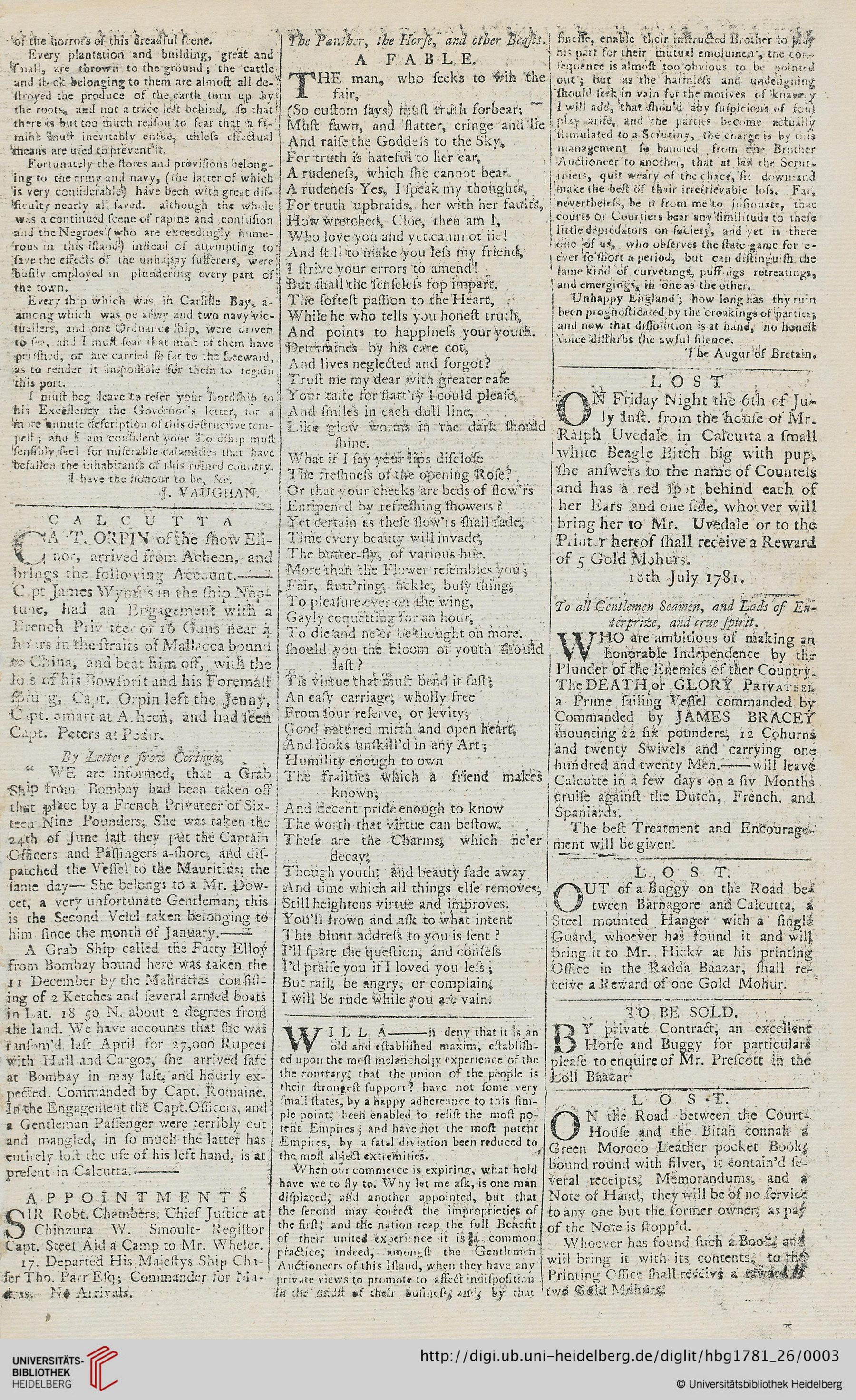
of the horrors of this dreadful scene.
Every plantation and building, great and small, are thrown to the ground; the cattle and stock belonging to them are almost all destroyed the produce of the earth torn up by the roots, and not a trace left behind, so that there is but too much reason to fear that a famine must inevitably ensue, unless effectual means are used to prevent it.
Fortunately the stores and provisions belonging to the army and navy, (the latter of which is very considerable) have been with great difficulty nearly all saved. although the whole was a continued scene of rapine and confusion and the Negroes (who are exceedingly numerous in this island) instead of attempting to save the effects of the unhappy sufferers, were busily employed in plundering every part of the town.
Every ship which was in Carlisle Bay, among which was ne army and two navy victuallers, and one Ordnance ship, were driven to sea, and I must fear that most of them have perished, or are carried so far to the Leeward, as to render it impossible for them to regain this port.
I must beg leave to refer your Lordship to his Excellency the Governor's letter, for a more minute description of this destructive tempest; and I am confident your Lordship must sensibly feel for miserable calamities that have befallen the inhabitants of this ruined country.
I have the honour to be, &c.
J. VAUGHAN.
C A L C U T T A
CAPT. ORPIN of the snow Elinor, arrived from Acheen, and brings the following Account. — Capt James Wynnis in the ship Neptune, had an Engagement with a French Privateer of 16 Guns near 2 hours in the straits of Mallacca bound to China, and beat him off, with the loss of his Bowsprit and his Foremast sprung, Capt. Orpin left the Jenny, Capt. smart at Acheen, and had seen Capt. Peters at Pedir.
By Letters from Coringa,
WE are informed, that a Grab Ship from Bombay had been taken off that place by a French Privateer of Sixteen Nine Pounders; She was taken the 24th of June last they put the Captain Officers and Passengers a-shore, and dispatched the Vessel to the Mauritius the same day— She belongs to a Mr. Dowcet, a very unfortunate Gentleman; this is the Second Vessel taken belonging to him since the month of January.—
A Grab Ship called the Fatty Eloy from Bombay bound here was taken the 11 December by the Mahrattas consisting of 2 Ketches and several armed boats in Lat. 18 50 N. about 2 degrees from the land. We have accounts that she was ransom'd last April for 27,000 Rupees with Hall and Cargoe, she arrived safe at Bombay in may last, and hourly expected. Commanded by Capt. Romaine. In the Engagement the Capt. Officers, and a Gentleman Passenger were terribly cut and mangled, in so much the latter has entirely lost the use of his left hand, is at present in Calcutta.—
A P P O I N T M E N T S
SIR Robt. Chambers: Chief Justice at Chinzura W. Smoult- Registor Capt. Steet Aid a Camp to Mr. Wheler.
17. Departed His Majestys Ship Chaser Tho. Parr Esq; Commander for Madras. No Arrivals.
The Panther, the Horse, and other Beasts.
A F A B L E.
THE man, who seeks to win the fair,
(So custom says) must truth forbear;
Must fawn, and flatter, cringe and lie
And raise the Goddess to the Sky,
For truth is hateful to her ear,
A rudeness, which she cannot bear.
A rudeness Yes, I speak my thoughts,
For truth upbraids, her with her faults,
How wretched, Cloe, then am I,
Who love you and yet cannot lie!
And still to make you less my friend,
I strive your errors to amend!
But shall the senseless fop impart.
The softest passion to the Heart,
While he who tells you honest truth,
And points to happiness your youth.
Determines by his care cot,
And lives neglected and forgot?
Trust me my dear with greater ease
Your taste for flatt'ry I could please,
And smiles in each dull line,
Like glow worms in the dark should shine.
What if I say your lips disclose
The freshness of the opening Rose?
Or that your cheeks are beds of flow'rs
Enripened by refreshing showers?
Yet certain as these flow'rs shall fade,
Time every beauty will invade,
The butter-fly, of various hue.
More than the Flower resembles you;
Fair, flutt'ring, fickle, busy thing,
To pleasure ever on the wing,
Gayly coquetting for an hour,
To die and ne'er bethought on more.
should you the bloom of youth should last?
Tis virtue that must bend it fast;
An easy carriage, wholly free
From sour reserve, or levity,
Good natured mirth and open heart,
And looks unskill'd in any Art;
Humility enough to own
The frailties which a friend makes known,
And decent pride enough to know
The worth that virtue can bestow.
These are the Charms, which ne'er decay;
Though youth, and beauty fade away
And time which all things else removes,
Still heightens virtue and improves.
You'll frown and ask to what intent
This blunt address to you is sent?
I'll spare the question, and confess
I'd praise you if I loved you less;
But rail, be angry, or complain,
I will be rude while you are vain.
WILL A—n deny that it is an old and established maxim, established upon the most melancholy experience of the the contrary; that the union of the people is their strongest support? have not some very small states, by a happy adhereance to this simple point, been enabled to resist the most potent Empires; and have not the most potent Empires, by a fatal diviation been reduced to the most abject extremities.
When our commerce is expiring, what held have we to fly to. Why let me ask, is one man displaced, and another appointed, but that the second may correct the improprieties of the first; and the nation reap the full Benefit of their united experience it is a common practice; indeed, amongst the Gentlemen Auctioneers of this Island, when they have any private views to promote to affect indisposition in the midst of their business and by that
finesse, enable their instructed Brother to play his part for their mutual emolument, the consequence is almost too obvious to be pointed out; but as the harmless and undesigning should seek in vain for the motives of knavery I will add, that should any suspicions of foul play arise, and the parties become actually stimulated to a Scrutiny, the charge is by this management so bandied from one Brother Auctioneer to another, that at last the Scrutiniers, quit weary of the chace, sit down and make the best of their irretrievable loss. Far, nevertheless, be it from me to insinuate, that courts or Courtiers bear any similitude to these little depredators on society, and yet is there one of us, who observes the state game for ever so short a period, but can distinguish the same kind of curvetings, puffings retreatings, and emergings, in one as the other.
Unhappy England; how long has thy ruin been prognosticated by the croakings of parties; and now that dissolution is at hand, no honest voice disturbs the awful silence.
The Augur of Bretain.
L O S T
ON Friday Night the 6th of July Inst. from the house of Mr. Ralph Uvedale in Calcutta a small white Beagle Bitch big with pup, she answers to the name of Countess and has a red spot behind each of her Ears and one side, whoever will bring her to Mr. Uvedale or to the Printer hereof shall receive a Reward of 5 Gold Mohurs.
18th July 1781.
To all Gentlemen Seamen, and Lads of Enterprize, and true spirit.
WHO are ambitious of making an honorable Independence by the Plunder of the Enemies of ther Country. The DEATH or GLORY Privateer a Prime sailing Vessel commanded by Commanded by JAMES BRACEY mounting 22 six pounders, 12 Cohurns and twenty Swivels and carrying one hundred and twenty Men. — will leave Calcutta in a few days on a siv Months cruise against the Dutch, French. and Spaniards.
The best Treatment and Encouragement will be given.
L O S T.
OUT of a Buggy on the Road between Barnagore and Calcutta, a Steel mounted Hanger with a single Guard, whoever has found it and will bring it to Mr. Hicky at his printing Office in the Radda Baazar, shall receive a Reward of one Gold Mohur.
TO BE SOLD.
BY private Contract, an excellent Horse and Buggy for particulars please to enquire of Mr. Prescott in the Loll Baazar
L O S T.
ON the Road between the Court House and the Bitah connah a Green Moroco Leather pocket Book, bound round with silver, it contain'd several receipts, Memorandums, and a Note of Hand, they will be of no service to any one but the former owner, as pay of the Note is stopp'd.
Whoever has found such a Book, and will bring it with its contents, to the Printing Office shall receive a reward of two Gold Mohurs.
Page 4
AI transcription (Google Gemini, 2026)
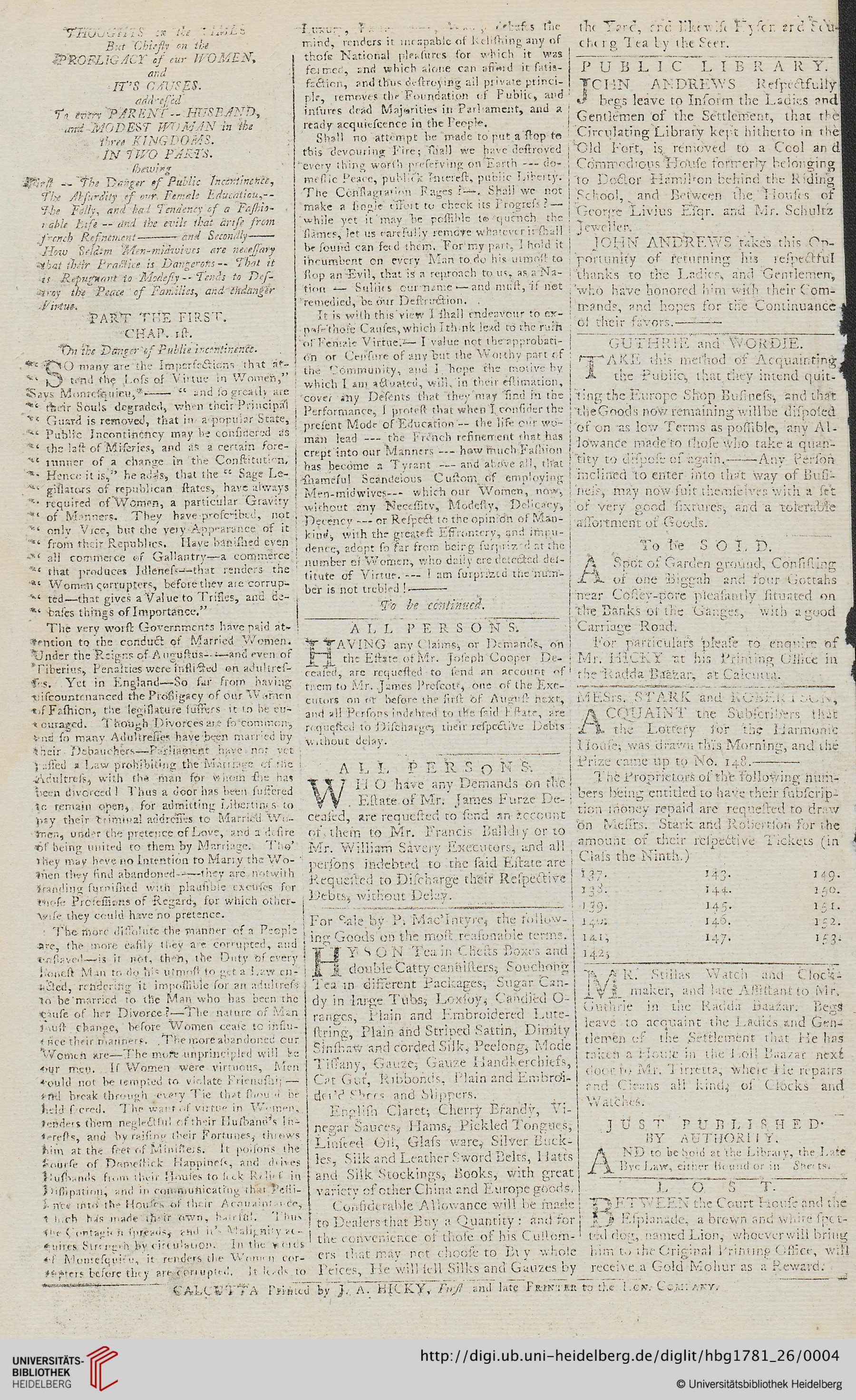
THOUGHTS on the TIMES.
But Chiefly on the
PROFLIGACY of our WOMEN,
and
IT'S CAUSES.
addressed
To every PARENT—HUSBAND,
and MODEST WOMAN in the
three KINGDOMS.
IN TWO PARTS.
shewing
First.—The Danger of Public Incontinence, The Absurdity of our Female Education.—The Folly, and bad Tendency of a Fashionable Life—and the evils that arise from french Refinement——and Secondly——How Seldom Men-midwives are necessary—that their Practice is Dangerous—That it is Repugnant to Modesty—Tends to Destroy the Peace of Families, and endanger Virtue.
PART THE FIRST.
CHAP. 1st.
On the Danger of Public incontinence.
"SO many are the Imperfections that attend the Loss of Virtue in Women," Says Montesquieu,*—"and so greatly are their Souls degraded, when their Principal Guard is removed, that in a popular State, Public Incontinency may be considered as the last of Miseries, and as a certain forerunner of a change in the Constitution. Hence it is," he adds, that the "Sage Legislators of republican states, have always required of Women, a particular Gravity of Manners. They have proscribed, not only Vice, but the very Appearance of it from their Republics. Have banished even all commerce of Gallantry—a commerce that produces Idleness—that renders the Women corrupters, before they are corrupted—that gives a Value to Trifles, and debases things of Importance."
The very worst Governments have paid attention to the conduct of Married Women. Under the Reigns of Augustus—and even of Tiberius, Penalties were inflicted on adultresses. Yet in England—So far from having discountenanced the Profligacy of our Women of Fashion, the legislature suffers it to be encouraged. Though Divorces are so common, and so many Adultresses have been married by their Debauchers—Parliament have not yet passed a Law prohibiting the Marriage of the Adultress, with the man for whom she has been divorced. Thus a door has been suffered to remain open, for admitting Libertines to pay their criminal addresses to Married Women, under the pretence of Love, and a desire of being united to them by Marriage. Tho' they may have no Intention to Marry the Women they find abandoned—they are notwithstanding furnished with plausible excuses for those Professions of Regard, for which otherwise they could have no pretence.
The more dissolute the manner of a People are, the more easily they are corrupted, and enslaved—is it not, then, the Duty of every honest Man to do his utmost to get a Law enacted, rendering it impossible for an adultress to be married to the Man who has been the cause of her Divorce?—The nature of Man must change, before Women cease to influence their manners. The more abandoned our Women are—The more unprincipled will be our men. If Women were virtuous, Men could not be tempted to violate Friendship—and break through every Tie that should be held sacred. The want of virtue in Women, renders them neglectful of their Husband's Interest, and by raising their Fortunes, throws him at the feet of Ministers. It poisons the Sourse of Domestick Happiness, and drives Husbands from their Houses to seek Relief in Dissipation, and in communicating that Pestilence into the Houses of their Acquaintance, which has made their own, hateful. Thus the Contagion spreads, and it's Malignity acquires Strength by circulation. In the words of Montesquieu, it renders the Women corrupters before they are corrupted. It leads to Luxury, Pride, and Effeminacy of mind, renders it incapable of Relishing any of those National pleasures for which it was formed, and which alone can afford it satisfaction, and thus destroying all private principle, removes the Foundation of Public, and insures dead Majorities in Parliament, and a ready acquiescence in the People.
Shall no attempt be made to put a stop to this devouring Fire; shall we see destroyed every-thing worth preserving on Earth — domestic Peace, publick interest, public Liberty. The Conflagration Rages — Shall we not make a single effort to check its Progress?—while yet it may be possible to quench the flames, let us carefully remove whatever it shall be found can feed them. For my part, I hold it incumbent on every Man to do his utmost to stop an Evil, that is a reproach to us, as a Nation— Sullies our name— and must, if not remedied, be our Destruction.
It is with this view I shall endeavour to expose those Causes, which I think lead to the ruin of Female Virtue.— I value not the approbation or Censure of any but the Worthy part of the Community, and I hope the motive by which I am actuated, will, in their estimation, cover any Defects that they may find in the Performance, I protest that when I consider the present Mode of Education — the life our women lead — the French refinement that has crept into our Manners — how much Fashion has become a Tyrant — and above all, that shameful Scandelous Custom of employing Men-midwives— which our Women, now, without any Necessity, Modesty, Delicacy, Decency - - - or Respect to the opinion of Mankind, with the greatest Effrontery, and impudence, adopt so far from being surprized at the number of Women, who daily are detected destitute of Virtue. — I am surprized the number is not trebled!—
To be continued.
---
ALL PERSONS.
HAVING any Claims, or Demands, on the Estate of Mr. Joseph Cooper Deceased, are requested to send an account of them to Mr. James Prescott, one of the Executors on or before the first of August next, and all Persons indebted to the said Estate, are requested to Discharge, their respective Debts without delay.
---
ALL PERSONS.
WHO have any Demands on the Estate of Mr. James Furze Deceased, are requested to send an account of them to Mr. Francis Balldry or to Mr. William Savery Executors, and all persons indebted to the said Estate are Requested to Discharge their Respective Debts, without Delay.
---
For Sale by P. Mac’Intyre, the following Goods on the most reasonable terms.
HYSON Tea in Chests Boxes and double Catty cannisters, Souchong Tea in different Packages, Sugar Candy in large Tubs, Loxsoy, Candied Oranges, Plain and Embroidered Lutestring, Plain and Striped Sattin, Dimity Sinshaw and corded Silk, Peelong, Mode Tiffany, Gauze, Gauze Handkerchiefs, Cat Gut, Ribbonds, Plain and Embroider'd Shoes and Slippers.
English Claret; Cherry Brandy, Vinegar Sauces, Hams, Pickled Tongues, Linseed Oil, Glass ware, Silver Buckles, Silk and Leather Sword Belts, Hatts and Silk Stockings, Books, with great variety of other China and Europe goods.
Considerable Allowance will be made to Dealers that Buy a Quantity: and for the convenience of those of his Customers that may not choose to Buy whole Peices, He will sell Silks and Gauzes by the Yard, and likewise Hyson and Souchong Tea by the Seer.
---
PUBLIC LIBRARY.
JOHN ANDREWS Respectfully begs leave to Inform the Ladies and Gentlemen of the Settlement, that the Circulating Library kept hitherto in the Old Fort, is removed to a Cool and Commodious House formerly belonging to Doctor Hamilton behind the Riding School, and Between the Houses of George Livius Esqr. and Mr. Schultz Jeweller.
JOHN ANDREWS takes this Opportunity of returning his respectful thanks to the Ladies, and Gentlemen, who have honored him with their Commands, and hopes for the Continuance of their favors.—
---
GUTHRIE and WORDIE.
TAKE this method of Acquainting the Public, that they intend quitting the Europe Shop Business, and that the Goods now remaining will be disposed of on as low Terms as possible, any Allowance made to those who take a quantity to dispose of again.—Any Person inclined to enter into that way of Business, may now suit themselves with a set of very good fixtures, and a tolerable assortment of Goods.
---
To be SOLD.
A Spot of Garden ground, Consisting of one Biggah and four Gottahs near Coffey-pore pleasantly situated on the Banks of the Ganges, with a good Carriage Road.
For particulars please to enquire of Mr. HICKY at his Printing Office in the Radda Baazar, at Calcutta.
---
MESsrs. STARK and ROBERTSON,
ACQUAINT the Subscribers that the Lottery for the Harmonic House, was drawn this Morning, and the Prize came up to No. 148.—
The Proprietors of the following numbers being entitled to have their subscription money repaid are requested to draw on Messrs. Stark and Robertson for the amount of their respective Tickets (in Class the Ninth.)
137. 143. 149.
138. 144. 150.
139. 145. 151.
140. 146. 152.
141. 147. 153.
142.
---
MR. Stillas Watch and Clockmaker, and late Assistant to Mr. Guthrie in the Radda Baazar. Begs leave to acquaint the Ladies and Gentlemen of the Settlement that He has taken a House in the Loll Baazar next door to Mr. Tirretta, where He repairs and Cleans all kind, of Clocks and Watches.
---
JUST PUBLISHED.
BY AUTHORITY.
AND to be Sold at the Library, the Late Bye Law, either Bound or in Sheets.
---
L O S T.
BETWEEN the Court House and the Esplanade, a brown and white spotted dog, named Lion, whoever will bring him to the Original Printing Office, will receive a Gold Mohur as a Reward.
---
CALCUTTA Printed by J. A. HICKY, First and late PRINTER to the HON. COMPANY.