Browse › 1781
Saturday 14 July 1781
Page 1
AI transcription (Google Gemini, 2026)
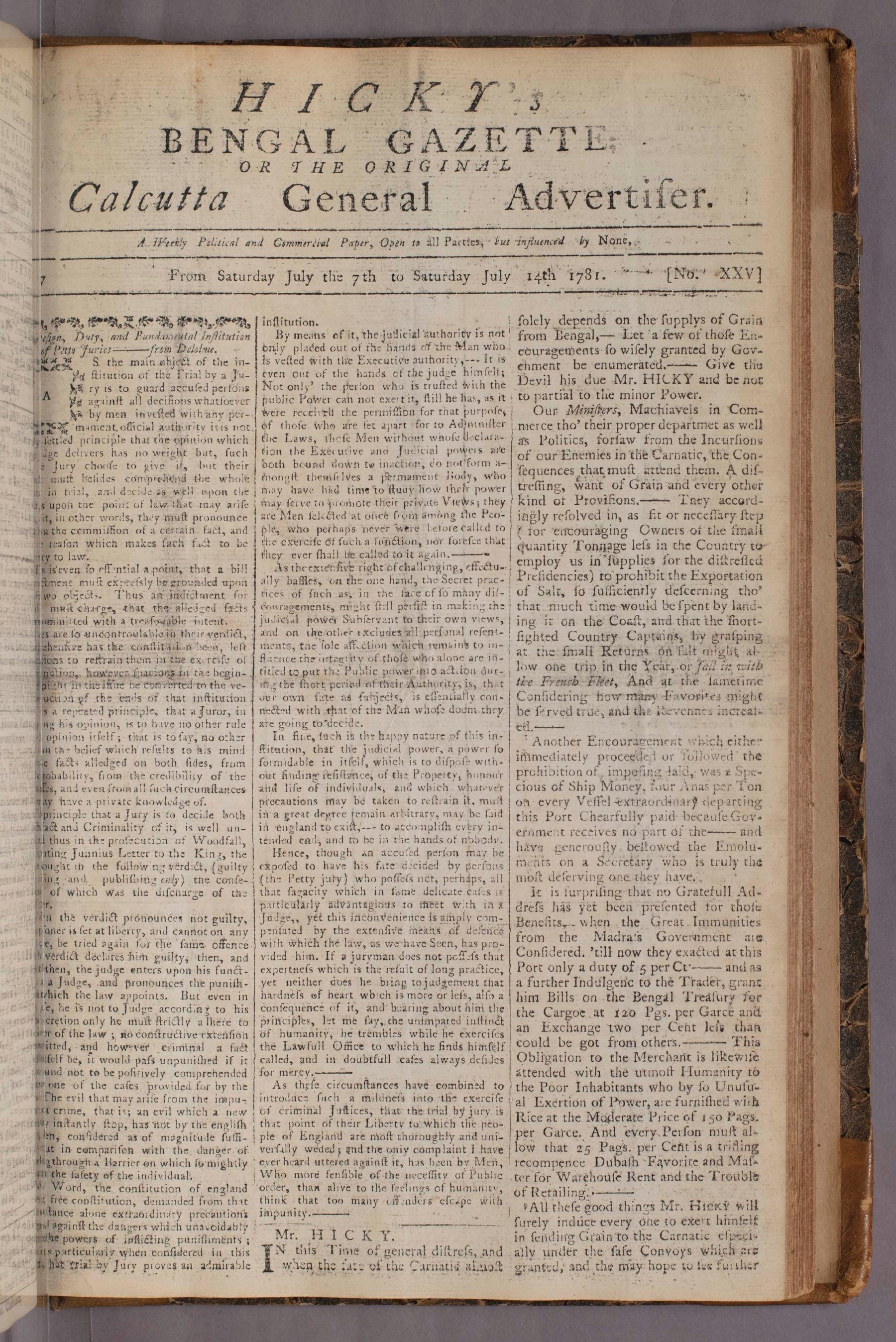
HICKY'S
BENGAL GAZETTE;
OR THE ORIGINAL
Calcutta General Advertiser.
A Weekly Political and Commercial Paper, Open to all Parties, but influenced by None.
From Saturday July the 7th to Saturday July 14th 1781. [No. XXV]
Design, Duty, and Fundamental Institution of Petty Juries—from Delolme.
AS the main object of the institution of the Trial by a Jury is to guard accused persons against all decisions whatsoever by men invested with any permanent official authority it is not only a settled principle that the opinion which the Judge delivers has no weight but, such as the Jury choose to give it, but their verdict must besides comprehend the whole matter in trial, and decide as well upon the fact, as upon the point of law that may arise out of it, in other words, they must pronounce both on the commission of a certain fact, and on the reason which makes such fact to be contrary to law.
This is even so essential a point, that a bill of indictment must expressly be grounded upon those two objects. Thus an indictment for treason must charge, that the alledged facts were committed with a treasonable intent.
Juries are so uncontroulable in their verdict, that no coercive has the constitution been, left no directions to restrain them in the exercise of their function, however spacious in the beginning, might in the issue be converted to the very destruction of the ends of that institution It is a repeated principle, that a Juror, in delivering his opinion, is to have no other rule but his opinion itself; that is to say, no other rule than the belief which results to his mind from the facts alledged on both sides, from their probability, from the credibility of the witnesses, and even from all such circumstances as he may have a private knowledge of.
This principle that a Jury is to decide both on the fact and Criminality of it, is well understood thus in the prosecution of Woodfall, for printing Junnius Letter to the King, the Jury brought in the following verdict, (guilty of printing and publishing only) the consequence of which was the discharge of the Prisoner.
When the verdict pronounces not guilty, the prisoner is set at liberty, and cannot on any pretence, be tried again for the same offence If the verdict declares him guilty, then, and not till then, the judge enters upon his function as a Judge, and pronounces the punishment which the law appoints. But even in this case, he is not to Judge according to his own discretion only he must strictly adhere to the letter of the law; no constructive extension can be admitted, and however criminal a fact may in itself be, it would pass unpunished if it were found not to be positively comprehended under some one of the cases provided for by the law. The evil that may arise from the impunity of a crime, that is; an evil which a new law may instantly stop, has not by the english constitution, considered as of magnitude sufficient to be put in comparison with the danger of breaking through a Barrier on which so mightly depends the safety of the individual.
In a Word, the constitution of england being a free constitution, demanded from that circumstance alone extraordinary precautions to guard against the dangers which unavoidably attend the powers of inflicting punishments; and it is particularly when considered in this light, that trial by Jury proves an admirable
institution.
By means of it, the judicial authority is not only placed out of the hands of the Man who is vested with the Executive authority,—It is even out of the hands of the judge himself; Not only the person who is trusted with the public Power can not exert it, still he has, as it were received the permission for that purpose, of those who are set apart for to Administer the Laws, these Men without whose declaration the Executive and Judicial powers are both bound down to inaction, do not form amongst themselves a permanent Body, who may have had time to study how their power may serve to promote their private Views; they are Men selected at once from among the People, who perhaps never were before called to the exercise of such a function, nor foresee that they ever shall be called to it again.—
As the extensive right of challenging, effectually baffles, on the one hand, the Secret practices of such as, in the face of so many discouragements, might still persist in making the judicial power Subservant to their own views, and on the other excludes all personal resentments, the sole affection which remains to influence the integrity of those who alone are intitled to put the Public power into action during the short period of their Authority, is, that our own fate as subjects, is essentially connected with that of the Man whose doom they are going to decide.
In fine, such is the happy nature of this institution, that the judicial power, a power so formidable in itself, which is to dispose without finding resistance, of the Property, honour and life of individuals, and which whatever precautions may be taken to restrain it, must in a great degree remain arbitrary, may be said in england to exist,—to accomplish every intended end, and to be in the hands of nobody.
Hence, though an accused person may be exposed to have his fate decided by persons (the Petty jury) who possess not, perhaps, all that sagacity which in some delicate cases is particularly advantageous to meet with in a Judge, yet this inconvenience is amply compensated by the extensive means of defence with which the law, as we have Seen, has provided him. If a juryman does not possess that expertness which is the result of long practice, yet neither does he bring to judgement that hardness of heart which is more or less, also a consequence of it, and bearing about him the principles, let me say, the unimpaired instinct of humanity, he trembles while he exercises the Lawfull Office to which he finds himself called, and in doubtfull cases always decides for mercy.—
As these circumstances have combined to introduce such a mildness into the exercise of criminal Justices, that the trial by jury is that point of their Liberty to which the people of England are most thoroughly and universally weded; and the only complaint I have ever heard uttered against it, has been by Men, Who more sensible of the necessity of Public order, than alive to the feelings of humanity, think that too many offenders escape with impunity.—
Mr. HICKY.
IN this Time of general distress, and when the fate of the Carnatic almost
solely depends on the supplys of Grain from Bengal,—Let a few of those Encouragements so wisely granted by Government be enumerated.—Give the Devil his due Mr. HICKY and be not to partial to the minor Power.
Our Ministers, Machiavels in Commerce tho' their proper departmet as well as Politics, foresaw from the Incursions of our Enemies in the Carnatic, the Consequences that must attend them. A distressing, want of Grain and every other kind of Provisions.—They accordingly resolved in, as fit or necessary step for encouraging Owners of the small quantity Tonnage less in the Country to employ us in supplies for the distressed Presidencies) to prohibit the Exportation of Salt, so sufficiently descerning tho' that much time would be spent by landing it on the Coast, and that the short-sighted Country Captains, by grasping at the small Returns on salt might allow one trip in the Year, or fall in with the French Fleet, And at the sametime Considering how many Favorites might be served true, and the Revenues increated.—
Another Encouragement which either immediately proceeded or followed the prohibition of, imposing laid, was a Specious of Ship Money, four Anas per Ton on every Vessel extraordinary departing this Port Chearfully paid because Government receives no part of the—and have generously bestowed the Emoluments on a Secretary who is truly the most deserving one they have.
It is surprising that no Gratefull Address has yet been presented for those Benefits, when the Great Immunities from the Madra's Government are Considered. 'till now they exacted at this Port only a duty of 5 per Ct—and as a further Indulgence to the Trader, grant him Bills on the Bengal Treasury for the Cargoe at 120 Pgs. per Garce and an Exchange two per Cent less than could be got from others.—This Obligation to the Merchant is likewise attended with the utmost Humanity to the Poor Inhabitants who by so Unusual Exertion of Power, are furnished with Rice at the Moderate Price of 150 Pags. per Garce. And every Person must allow that 25 Pags. per Cent is a trifling recompence Dubash Favorite and Master for Warehouse Rent and the Trouble of Retailing.—
All these good things Mr. Hicky will surely induce every one to exert himself in sending Grain to the Carnatic especially under the safe Convoys which are granted, and the may hope to see further
Page 2
AI transcription (Google Gemini, 2026)
Indulgences given to this Trade when the Caledonian Boards take it into Confideration.
To Mr. HICKY
SIR,
FINDING from an erronious paragraph in your paper of the 21st April, you have unintentionaly done great injustice to this Army in mentioning the Stores taken in our late Victory over Sindiah, I think it becomes the impartiality of your Paper to do Justice to Colonel Camac and his Army by insertion the inclosed copy of the official Return sent to the Board of Ordinance on that occasion.
Besides the Guns and Stores not mentioned in this Return, Vast quantities of Powder and Balls of all sizes were destroyed and thrown into the Sinde, Rockets, Gingalls, Sooter-malls, and other warlike apparatus to a great amount, with 200 Bullocks loaded with Europe Musquets just arived for Sindiah's Sepoys. Two Elephants with his grand standards, his Nagarahs and Ensigns of state, with above an hundred loaded Camels, all the [ILL] and Carriage Bullocks amounting to [ILL] hundreds.
Many Elephants and vast Treasure [ILL] have been taken, but our want of [ILL] prevented, it If we had this assistance [ILL] tory would have been complete.
I request you'd publish this letter, and [ILL] Return, and you will oblige a constant [ILL] der.
An Officer of Col. Camac's Army.
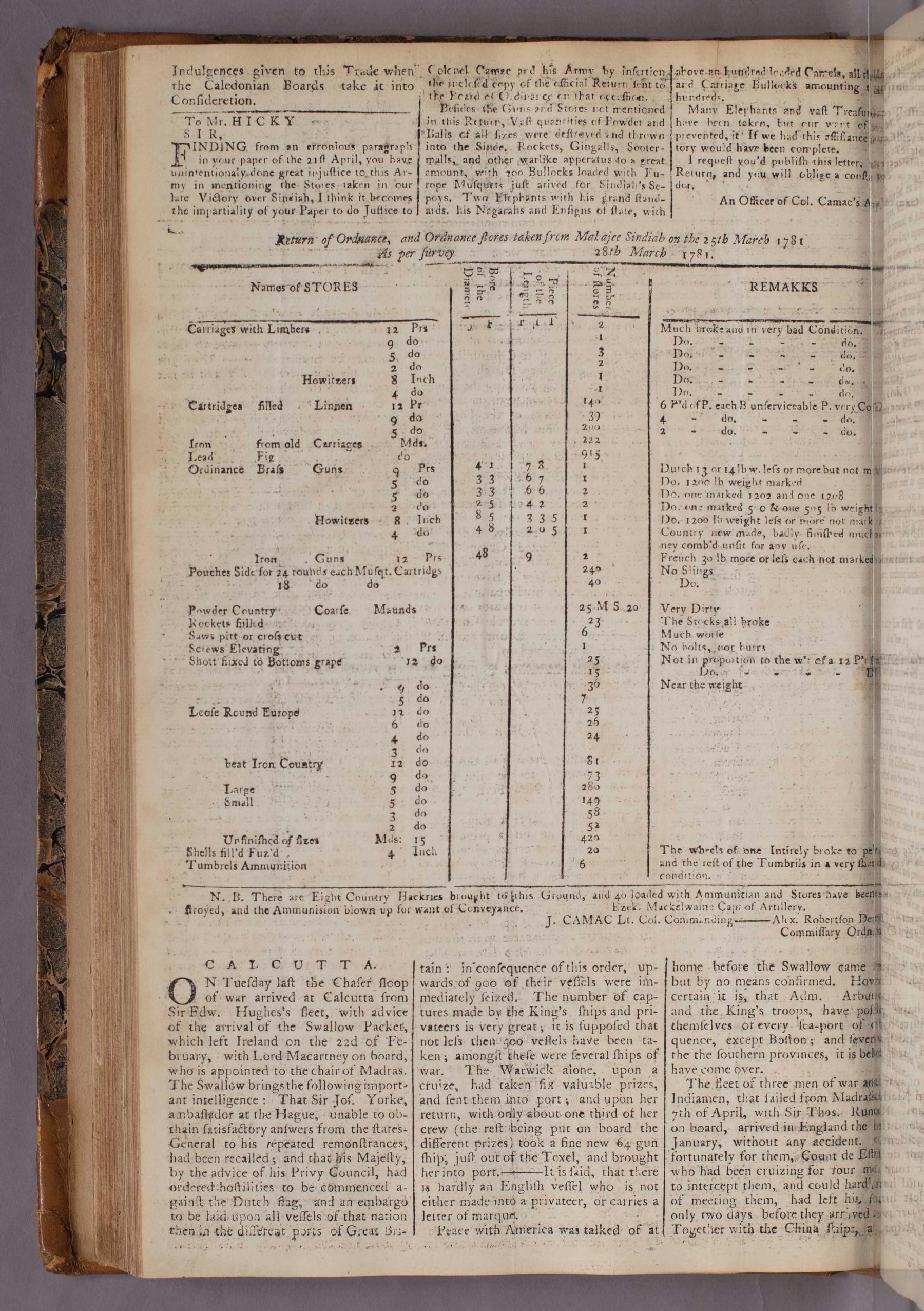
Return of Ordnance, and Ordnance stores taken from Makajee Sindiah on the 25th March 1781
As per survey 28th March 1781.
Names of STORES
Diameter of the Bore
Length of the Piece
Number of stores
REMAKKS
Carriages with Limbers 12 Prs 2 Much broke and in very bad Condition.
9 do 1 Do. - - - do.
5 do 3 Do. - - - do.
2 do 2 Do. - - - do.
Howitzers 8 Inch 1 Do. - - - do.
4 do 1 Do. - - - do.
Cartridges filled Linnen 12 Pr 140 6 P'd of P. each B unserviceable P. very Co[ILL]
9 do 39 4 - do. - - do.
5 do 200 2 - do. - - do.
Iron from old Carriages Mds. 222
Lead Fig do 915
Ordinance Brass Guns 9 Prs 4 1 7 8 1 Dutch 13 or 14 lb w. less or more but not m[ILL]
5 do 3 3 6 7 1 Do. 1200 lb weight marked
5 do 3 3 6 6 2 Do. one marked 1202 and one 1208
2 do 2 5 4 2 2 Do. one marked 510 & one 505 lb weight
Howitzers 8 Inch 8 5 3 3 5 1 Do. 1200 lb weight less or more not mark[ILL]
4 do 4 8 2 0 5 1 Country new made, badly finished much [ILL] ney comb'd unfit for any use.
Iron Guns 12 Prs 48 9 2 French 30 lb more or less each not marked
Pouches Side for 24 rounds each Musqt. Cartridgs 240 No Slings
18 do do 40 Do.
Powder Country Coarse Maunds 25 M S 20 Very Dirty
Rockets fill'd 23 The Stocks all broke
Saws pitt or cross cut 6 Much worse
Screws Elevating 2 Prs 1 No bolts, nor burrs
Shott fixed to Bottoms grape 12 do 25 Not in proportion to the w't of a 12 Pr [ILL]
15 Do. - - - D[ILL]
9 do 30 Near the weight
5 do 7
Loose Round Europe 12 do 25
6 do 26
4 do 24
3 do
beat Iron Country 12 do 81
9 do 73
Large 5 do 280
Small 5 do 149
3 do 58
2 do 52
Unfinished of sizes Mds: 15 420
Shells fill'd Fuz'd 4 Inch 20 The wheels of one Intirely broke to pe[ILL]
Tumbrels Ammunition 6 and the rest of the Tumbrils in a very shat[ILL] condition.
N. B. There are Eight Country Hackries brought to this Ground, and 40 loaded with Ammunition and Stores have been [ILL] stroyed, and the Ammunision blown up for want of Conveyance.
Ezek. Mackelwaine Capt of Artillery.
J. CAMAC Lt. Col. Commanding - Alex. Robertson Dep[ILL] Commissary Ordn[ILL]
CALCUTTA.
ON Tuesday last the Chaser sloop of war arrived at Calcutta from Sir Edw. Hughes's fleet, with advice of the arrival of the Swallow Packet, which left Ireland on the 22d of February, with Lord Macartney on board, who is appointed to the chair of Madras. The Swallow brings the following important intelligence: That Sir Jos. Yorke, ambassador at the Hague, unable to obtain satisfactory answers from the states-General to his repeated remonstrances, had been recalled; and that his Majesty, by the advice of his Privy Council, had ordered hostilities to be commenced against the Dutch flag, and an embargo to be laid upon all vessels of that nation then in the different ports of Great Britain: in consequence of this order, upwards of 900 of their vessels were immediately seized. The number of captures made by the King's ships and privateers is very great; it is supposed that not less then 300 vessels have been taken; amongst these were several ships of war. The Warwick alone, upon a cruize, had taken six valuable prizes, and sent them into port; and upon her return, with only about one third of her crew (the rest being put on board the different prizes) took a fine new 64 gun ship, just out of the Texel, and brought her into port. - It is said, that there is hardly an English vessel who is not either made into a privateer, or carries a letter of marque.
Peace with America was talked of at home before the Swallow came [ILL] but by no means confirmed. How[ILL] certain it is, that Adm. Arbut[ILL] and the King's troops, have poss[ILL] themselves of every sea-port of c[ILL] quence, except Boston; and sever[ILL] the the southern provinces, it is bel[ILL] have come over.
The fleet of three men of war and [ILL] Indiamen, that sailed from Madras [ILL] 7th of April, with Sir Thos. Rumb[ILL] on board, arrived in England the b[ILL] January, without any accident. [ILL] fortunately for them, Count de Est[ILL] who had been cruizing for four mo[ILL] to intercept them, and could hard[ILL] of meeting them, had left his st[ILL] only two days before they arrived [ILL] Together with the China ships, a[ILL]
Page 3
AI transcription (Google Gemini, 2026)
joined them at the Cape of Good Hope, the number of Indiamen amounting to sixteen, all of whom were safely arrived.
Admiral Rodney had returned from the West Indies, to take command of the Grand Fleet, in the room of Adm. Geary, who was to take command in the West Indies.
Three ships of the line, one fifty gun ship, and 2 frigates, with sixteen Indiamen under the command of Admiral Kepenfelt, with two King's regiments, and about 1000 Company's recruits, were ready to sail in January, but were detained, and would not sail till March. The reason assigned for detaining this fleet, was the rupture with the Dutch, in order that it might be reinforced with ships and troops. Mr. McPherson, appointed a member of the Supreme Council, is on board one of the Indiamen.
The King of Prussia, it is reported, has threatened to march an army of 60,000 men into the Provinces, to punish the Dutch for their perfidy and ingratitude to their old allies the English. The French, on the other hand, have an army of the same number ready to oppose him.
Since the commencement of hostilities against the Dutch, the spirit of Privateering is so great, that almost every person in England possessed of a small sum of money, purchasing shares in vessels to cruize against the Dutch merchantmen.
Extract of a letter from Fort St. George dated June 13.
The army marched from Cudalore the 26th ult. and has returned with 1100 bullocks, and a quantity of grain, taken from the enemy. Hyder's people raised the siege of Tiagar, on hearing of the march of the army. It was supposed the army marched again from Cudalore on the 10th inst. for Chillimbrum, where Hyder is posted with the main body of his army; but we don't expect to hear of a general engagement, as we are told for certain he does no mean to come to action in any other way than by harassing us with his cavalry. Had Sir Eyre Coote sufficient bullocks and provisions, he would soon possess himself of Arcot, or oblige Hyder to fight. We are anxiously wishing for the arrival of Col. Pearse's detachment. Sir Edw Hughes will sail to-morrow, to cruize for the expected Europe fleet; he takes with him some 24-pounders for the use of the army.
Advices from Madras mention, that Sir Eyre Coote had actually marched against Chillibrum on the the 17th. That place is very strongly fortified, and is Hyder's principal magazine.
Letters received from Col. Pearse's detachment, dated the 18th June, mention that he was about five days march from Nellore; that he had not as yet met with the smallest interruption in his march.
Accounts received from Col. Muir's detachment mention another engagement with Scindia, in which the Mahrattas had 100 men killed; our loss is reckoned 20 Sepoys killed and wounded.
Capt. Smith, of the George, brought
with him as prisoners from Madras, 30 of Hyder's troops, and an old man a servant of the Nabob's, who had been discovered carrying on a traiterous correspondence with the enemy. One of his letters to Hyder had been intercepted, and the Harcarrah who carried it was hung up directly. It is supposed that he will be compelled to make discoveries of great consequence. He is now confined in the Fort.
Cap. Parr, who commands his Majesty's sloop the Chacer, took all the Dutch pilot Vessels that were in Ballasore Roads. They had been down to lay the Buoys for the Dutch Ships which generally arrive about this Time. And on Tuesday Morning, one of our Pilot Schooners, with 40 Seamen well armed, and under the Command of a King's lieutenant, went up to Chinsurah, to take the Pilot and other Dutch Vessels at that place. In the Evening the Lieutenant with 14 Seamen, went on shore, and demanded the Keys of the Fort in his Majesty's name; But Mr. Ross, the chief, refused to deliver them, and immediately ordered the Bridges to be drawn up, till the arrival of the Regiment of Seapoys from Chandernagore, to the Commandant of which Mr. Ross surrendered the Fort.
Mess. Purlin, Heatly, Adair, and Ramus, are appointed Commissaries at Chinsurah. Mr. John David Paterson is appointed Commissary of Barnagore, and Mr. Spottiswood, his Deputy.
It is reported, that upwards of thirty lacks in specie, and Dutch Company's property to a great amount, was in the fort when it was given up.
The Dutch Bankshall at Fulta was taken possession of by part of the Chacer's crew and yesterday the town of Bernagore was invested by 300 of the Calcutta militia sepoys, who took it without the least opposition.
On Wednesday evening all the Dutch seamen belonging to the pilot sloops, were sent into the New Fort, under a a guard of sepoys.
A subscription paper is going about Calcutta for fitting out a privateer of considerable force to cruize against the Dutch to the Eastward. It is much to be hoped that the plan will succeed, but expedition is absolutely necessary.
Friday the 6th the Swallow Packet arrived at Calcutta; Capt Mitchell of the Coventry frigate came up to town in her, having left his Ship safe at Kedgiree.
While the Swallow was at home she remained in Ireland; Lord Macartney left London privately, and went on board her in Cork Harbour.
The Harmonic house, put up to Lottery by Mess. Stark and Robertson, and drawn on Monday last, was won by the Hon. Mr. Justice Hyde.
PROMOTIONS.
Revenue Department,
Mr. James Collie, is appointed surgeon at Burdwan, vice Mr. Hunter.
Military Promotions.
Ensigns promoted to the rank of lieutenants, viz.
M. Falvey, H. Cummings, Thomas Hare, ---- Cox, P. Young, John Mitchie, Thomas Shouldham, Wil. Toone Anthony Robinson, William Cuswell
Hugh A. Atkinson, Jo. Campbell Will. Evans, Charles Wyatt, Robert Mitchell, Rich. Maurice, Ja. Crockatt, W Muncrieffe, Alex. Kinloch, Abel Payton, Cha. Fraser, John D'Coursey, John Shakesoft, Tho. Townsend, Rob. Pine. George Gillespie, Ellis St John, Henry A. O'Donnell, John W. Adams, Mich. Symes, Will. Snead, Henry Worsley, Jeremiah Parker, Howel, J. R. Pierce, William Austwick, Arch. Armstrong, Edmund Field, Henry Rochford, Richd. Adams, Christopher Cleobury, Thomas Alcock, Edmund Wells, Allex. Munro, Thomas Arnold, William Smith, Robert Watts, David Haldane, Robert Nairne, Edwd. Dawson, Jas. Hatchett, Thos. Winyates, Thos Salkeld, Thomas Chauner, John Rankin, Thos. Slaughter, John Staples, Alex. Orme, John Eade, Will. M. Marston, Walter Mayberry, James Atkinson, Thos. Anderson.
July 1st. Arrived the Royal Charlotta, Faulkner, Madras, ballast. ---- Mary, Chew, Madras, ballast. ---- 4, George Smith, Madras, Ballast. ---- His Majesty's Ship Chaser, Capt Parr, Madras. ---- Free Mason, French, Madras, ballast. ---- 6th Swallow Packet, Hall, Madras ---- His Majesty's ship Coventry, Capt. Mitchel, Madras, 10th snow Venus John Shobroke from Madras, and Snow Elinor, Capt. Orpin, from Acheen.
DIED Monday July 9th, Lieutenant Samuel Eyre belonging to His Majestys Sloop Nymptn, the Honour of War paid to the Corps going over the side by the Mariens, and seemingly was much lamented by the Ships Company.
MESrs. STARK and ROBERTSON,
ACQUAINT the Subscribers that the Lottery for the Harmonic House, was drawn this Morning, and the Prize came up to No. 148.
The Proprietors of the following numbers being entitled to have their subscription money repaid are requested to draw on Messrs. Stark and Robertson for the amount of their respective Tickets (in Class the Ninth.)
137. 143. 149.
138. 144. 150.
139. 145. 151.
140. 146. 152.
141, 147. 153.
142,
MR. Stillas Watch and Clockmaker, and late Assistant to Mr. Guthrie in the Radda Baazar. Begs leave to acquaint the Ladies and Gentlemen of the Settlement that He has taken a House in the Loll Baazar next door to Mr. Tirretta, where He repairs and Cleans all kind, of Clocks and Watches.
JUST PUBLISHED BY AUTHORITY.
AND to be Sold at the Library, the Late Bye Law, either Bound or in Sheets.
Acknowledgments to Correspondents.
A Letter Signed C is received and will be inserted in our next. A Letter from patna Signed a subscriber is also received, but cannot be inserted, without the Author will support what he sets forth in his Letter (he having mentioned a Gentlemans name at that place, as a party Concerned in the transaction. Awell wisher to thy Labours is received, but as it abounds with National reflections, Mr. HICKY must decline complying with the Authors request. That part relative to the Proclamation shall be inserted in our Next.
Page 4
AI transcription (Google Gemini, 2026)
LONDON PACKET
Wednesday November 15, 1769.
S I R,
I will tell you a Story, which I transcribed from a fragment of an old Book of Voyages. The name of the Island, on which the Author was cast away, happens to be torn out, nor is there any thing remaining that might enable me to form a probable conjecture. in what part of the Globe it is situated.
We were then, says the Author, conducted to the Market place, where we observed a Man, tolerably well dressed, confined in a Cage, and a prodigious concourse of People dancing round him, Shouting, Liberty! Liberty! on asking the meaning of all this, "That Man in the Cage, said our conducter, is the genius of Liberty, our chief Idol: contradiction is our primum mobile, the spring of all our Actions, and therefore we always worship liberty in a Cage."—And pray, Sir, I replied does the genius submit to his confinement Voluntarily! No, I was Answered, we accused him of singing a ballad, which we proved he did not sing, and, therefore according to our first principle of contradiction, we condemned him to the Cage." We then quitted the Market place, and proceeded to take a view of the other parts of the Town.---As we walked along, I had the following conversation with our conductor, which, to avoid Repetition, I shall set down in the way of dialogue.
B. I suppose you feed the genius on Bread and Water.
C. No, I told you that we are guided in all our Actions by contradiction.-----We feed him better than our King; whom, for the same reason, we constantly abuse, and endeavored to make as Miserable as we can.
I understand then you are Governed by a King.
C. No, we have a King whom we govern. Our constitution is the first in the World. It is neither Monarchical, Aristocratical, nor democratical, but an incomprehensible mixture of all three
B. Incomprehensible! what, do you not understand your own form of Government.
C. No: but we like it the better for that.
B, What is the chief prerogatives of your King?
C. To beg his Bread, and be denied the priviledge of choosing his own servants.
B. And what is the peculiar business of the Aristocratical part of your legislature.
C. To poize the ballance between the other two branches, by always leaping into one Scale.
B. The Democratical part?
C. O, they are the chief guardians of our Liberty, which they religiously preserve by leaping into one Scale with the other.
B. But how do you elect these guardians of your Liberty!
C. Free Elections, Sir, all free Elections; that is, we sell them our Votes as dear as possible.
B. And so then you are overgned by these three branches, as you call them.
C. No: we constitute them our Governors, and then we govern them, they are our Servants.
B. Do you pay them Wages?
C. No: they pay us, and we pay another to pay them.
B. Strange system? If I understand your right, these legislative Servants have no power at all.
C. Very great power. They have the power to take from us all our Money, & to break our heads with it for diversion. If any of us, their Masters, snap his finger at one of their slaves, they have the power to fine, imprison, and even condemn him to Worship on his knees the Idol which they have set up.
B. And who are the Judges of his Offence.
C. They themselves.
B. What! Themselves the Judges in offences committed against themselves! Monstrous.
C. It is even so. But what you will think a still greater proof of the excellence of our constitution, when these servants of our's are assembled, and employed in transacting our business, we suffer them to shut the Door against their Masters at the instigation of the most insignificant and weakest of their Members, and this we suffer, because it is the most effectual way to destroy our constitution, which we endeavour to destroy, because it is the happiest constitution in the World.
B. Well, and how do you treat your King?
C When we do not like what he says, we tell him he is a damned liar. We call him the father of his people and the best of Kings because we dislike every action of his life.
B. how do you agree among one another are you unanimous in your political opinions.
C. By no means we are divided into parties, called Wigs and Night-caps.
B. Pray what are those.
C. By wigs, we mean friends to the king, and the present royal family, by the latter, are understood friends to another family, that pretend to a prior right to the Crown.
C. So that the wigs have all the lucratives employments and are the kings particular favourites.
C. There again you are mistaken he prefers the night-caps.
B. You astonish me! and are these night caps about his person.
C. They are.
B. Why so.
C. Because they have been always the inveterate enemies of his family. This, Sir, is all I can recover of the strange Fragment and am.
Your humble Servant.
Blank.
ALL PERSONS.
HAVING any Claims, or Demands, on the Estate of Mr. Joseph Cooper Deceased, are requested to send an account of them to Mr. James Prescott, one of the Executors on or before the first of August next, and all Persons indebted to the said Estate, are requested to Discharge, their respective Debts without delay.
ALL PERSONS
WHO have any Demands on the Estate of Mr. James Fuller Deceased, are requested to send an account of them to Mr. Francis Balldin and Mr. William Savery Executors, and all persons indebted to the said Estate, are Requested to Discharge their Respective Debts, without Delay.
For Sale by P. Mac’Intyre, the following Goods on the most reasonable terms.
HYSON Tea in Chests Bohea, double Catty cannisters, Souchong Tea in different Packages, Sugar Candy in large Tubs, Loxtoy, Canton ranges, Plain and Embroidered mustring, Plain and Striped Sattin, Sinslaw and corded Silk, Peelong, Tiffany, Gauze, Gauze Handkerchiefs, Cat Gut, Ribbonds, Plain and Embroidered Shoes and Slippers.
English Claret, Cherry Brandy, Vinegar Sauces, Hams, Pickled Tongues, Linseed Oil, Glass ware, Silver buckles, Silk and Leather Sword Belts, and Silk Stockings, Books, with a variety of other China and European Goods.
Considerable Allowance will be made to Dealers that Buy a Quantity: for the convenience of those of his Customers that may not choose to Buy whole Peices, He will sell Silks and Gauze by the Yard, and likewise Hyson and Souchong Tea by the Seer.
PUBLIC LIBRARY
JOHN ANDREWS Respectfully begs leave to Inform the Ladies and Gentlemen of the Settlement, that the Circulating Library kept hitherto in the Old Fort, is removed to a Commodious House formerly belonging to Doctor Hamilton behind the Free School, and Between the Houses of George Livius Esqr. and Mr. Samuel Jeweller.
JOHN ANDREWS takes this opportunity of returning his respectful thanks to the Ladies, and Gentlemen who have honored him with their commands, and hopes for the Continuance of their favors.
GUTHRIE and WORDIE
TAKE this method of Acquainting the Public, that they intend quitting the Europe Shop Business, and that the Goods now remaining will be disposed of on as low Terms as possible, and a lowance made to those who take a quantity to dispose of again.—Any Persons inclined to enter into that way of Business, may now suit themselves with a set of very good fixtures, and a tolerable assortment of Goods.
To be SOLD.
A Spot of Garden ground, Consisting of one Biggah and four Gottahs near Coffey-pore pleasantly situated on the Banks of the Ganges, with a Carriage Road.
For particulars please to enquire of Mr. HICKY at his Printing Office in the Radda Baazar, at Calcutta.
TO BE SOLD.
JUST Imported, An Elegant European Chariot. Enquire of Mr. Sherburne at whose House It may be seen.
CALCUTTA Printed by J. A. HICKY, Post and late PRINTER to the HON. COMPANY.