Browse › 1782
Saturday 30 March 1782
Page 1
AI transcription (Google Gemini, 2026)
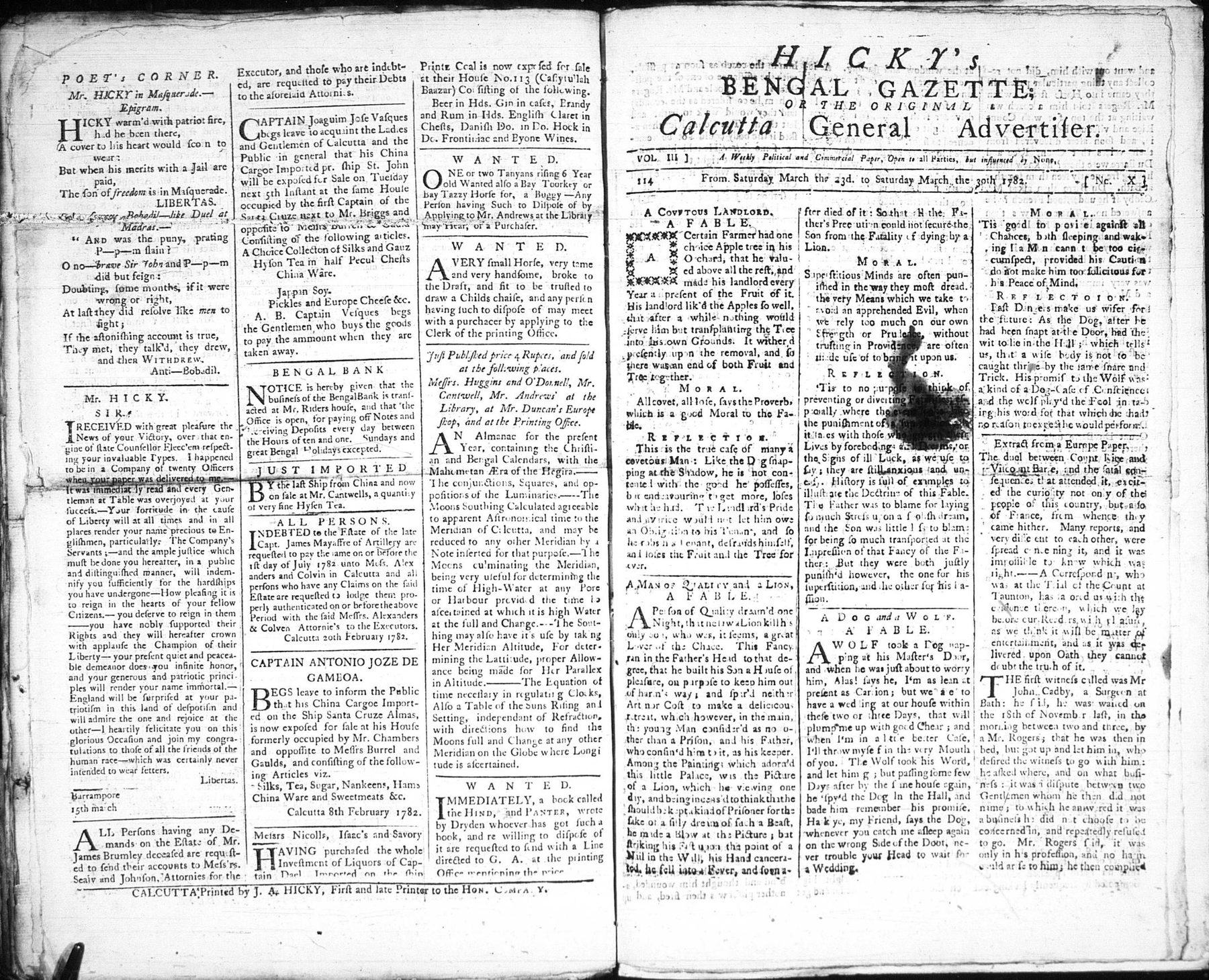
POET'S CORNER.
Mr. HICKY in Masquerade.—
Epigram.
HICKY warm'd with patriot fire,
Had he been there,
A cover to his heart would soon to wear:
But when his merits with a Jail are paid,
The son of freedom is in Masquerade.
LIBERTAS.
A Bobadil-like Duel at Madras.—
"AND was the puny, prating P—p—m slain?
O no—brave Sir John and P—p—m did but feign:
Doubting, some months, if it were wrong or right,
At last they did resolve like men to fight;
If the astonishing account is true,
They met, they talk'd, they drew, and then WITHDREW.
Anti—Bobadil.
Mr. HICKY.
SIR.
I RECEIVED with great pleasure the News of your Victory, over that engine of state Counsellor Fleece'em respecting your invaluable Types. I happened to be in a Company of twenty Officers when your paper was delivered to me.—It was immediately read and every Gentleman at Table was overjoyed at your success.—Your fortitude in the cause of Liberty will at all times and in all places render your name precious to Englishmen, particularly The Company's Servants;—and the ample justice which must be done you hereafter, in a public and distinguished manner, will indemnify you sufficiently for the hardships you have undergone—How pleasing it is to reign in the hearts of your fellow Citizens.—you deserve to reign in them—you have nobly supported their Rights and they will hereafter crown with applause the Champion of their Liberty—your present quiet and peaceable demeanor does you infinite honor, and your generous and patriotic principles will render your name immortal.—England will be surprised at your patriotism in this land of despotism and will admire the one and rejoice at the other—I heartily felicitate you on this glorious Occasion and join my congratulations to those of all the friends of the human race—which was certainly never intended to wear fetters.
Libertas.
Barrampore
15th march
ALL Persons having any Demands on the Estate of Mr. James Brumley deceased are requested to send their accounts to Messrs. Sealy and Johnson, Attornies for the Executor, and those who are indebted, are requested to pay their Debts to the aforesaid Attornies.
CAPTAIN Joaquim Jose Vasques begs leave to acquaint the Ladies and Gentlemen of Calcutta and the Public in general that his China Cargoe Imported pr. ship St. John will be exposed for Sale on Tuesday next 5th Instant at the same House occupied by the first Captain of the Santa Cruze next to Mr. Briggs and opposite to Messrs Burrell & Gaulds Consisting of the following articles.
A Choice Collection of Silks and Gauz
Hyson Tea in half Pecul Chests
China Ware.
Jappan Soy.
Pickles and Europe Cheese &c.
A. B. Captain Vasques begs the Gentlemen who buys the goods to pay the ammount when they are taken away.
BENGAL BANK
NOTICE is hereby given that the business of the BengalBank is transacted at Mr. Riders house, and that the Office is open, for paying off Notes and receiving Deposits every day between the Hours of ten and one. Sundays and great Bengal Holidays excepted.
JUST IMPORTED
BY the last Ship from China and now on sale at Mr. Cantwells, a quantity of very fine Hyson Tea.
ALL PERSONS,
INDEBTED to the Estate of the late Capt. James Mayaffre of Artillery are requested to pay the same on or before the 1st day of July 1782 unto Messrs. Alexander and Colvin in Calcutta and all persons who have any Claims on the said Estate are requested to lodge them properly authenticated on or before the above Period with the said Messrs. Alexanders & Colvin Attornie's to the Executors.
Calcutta 20th February 1782.
CAPTAIN ANTONIO JOZE DE GAMEOA.
BEGS leave to inform the Public that his China Cargoe Imported on the Ship Santa Cruze Almas, is now exposed for sale at his House formerly occupied by Mr. Chambers and opposite to Messrs Burrel and Gaulds, and consisting of the following Articles viz.
Silks, Tea, Sugar, Nankeens, Hams China Ware and Sweetmeats &c.
Calcutta 8th February 1782.
Messrs Nicolls, Isaac's and Savory
HAVING purchased the whole Investment of Liquors of Captain Dael Imported on the ship Printz Ceal is now exposed for sale at their House No. 113 (Casyfullah Baazar) Consisting of the following.
Beer in Hds. Gin in cases, Brandy and Rum in Hds. English Claret in Chests, Danish Do. in Do. Hock in Do. Frontiniac and Byone Wines.
WANTED.
ONE or two Tanyans rising 6 Year old Wanted also a Bay Toorkey or bay Tazzy Horse for, a Buggy—Any Person having Such to Dispose of by Applying to Mr. Andrews at the Library may hear, of a Purchaser.
WANTED.
A VERY small Horse, very tame and very handsome, broke to the Draft, and fit to be trusted to draw a Childs chaise, and any person having such to dispose of may meet with a purchaser by applying to the Clerk of the printing Office.
Just Published price 4 Rupees, and sold at the following places.
Messrs. Huggins and O'Donnell, Mr. Cantwell, Mr. Andrews' at the Library, at Mr. Duncan's Europe shop, and at the Printing Office.
AN Almanac for the present Year, containing the Christian and Bengal Calendars, with the Mahometan Æra of the Hegira.—The conjunctions, Squares, and oppositions of the Luminaries.—The Moons Southing Calculated agreeable to apparent Astronomical time to the Meridian of Calcutta, and may be reduced to any other Meridian by a Note inserted for that purpose.—The Moons culminating the Meridian, being very useful for determining the time of High-Water at any Port or Harbour provided the time is ascertained at which it is high Water at the full and Change.—The Southing may also have its use by taking Her Meridian Altitude, For determining the Lattitude, proper Allowance being made for Her Parallex in Altitude.—The Equation of time necessary in regulating Clocks, Also a Table of the Suns Rising and Setting, independant of Refraction, with directions how to find the Moons full and Change at any other Meridian on the Globe where Longitude is ascertained.
WANTED.
IMMEDIATELY, a book called the HIND, and PANTER, wrote by Dryden whoever has got such a book, and re willing to dispose of it are requested to send with a Line directed to G. A. at the printing Office mentioning the price
HICKY'S
BENGAL GAZETTE;
OR THE ORIGINAL
Calcutta General Advertiser.
VOL. III.] A Weekly Political and Commercial Paper, Open to all Parties, but influenced by None.
114 From Saturday March the 23d. to Saturday March the 30th 1782. [No. X]
A COVETOUS LANDLORD.
A FABLE.
A Certain Farmer had one choice Apple tree in his Orchard, that he valued above all the rest, and made his landlord every Year a present of the Fruit of it. His landlord lik'd the Apples so well, that after a while nothing would serve him but transplanting the Tree into his own Grounds. It wither'd presently upon the removal, and so there was an end of both Fruit and Tree together.
MORAL.
All covet, all lose, says the Proverb, which is a good Moral to the Fable.
REFLECTION.
This is the true case of many a covetous Man: Like the Dog snapping at the Shadow, he is not content with the good he possesses, but endeavouring to get more, loses what he had. The Landlord's Pride and avarice would not let him owe an Obligation to his Tenant, and so he robs his Tenant, defrauds himself, and loses the Fruit and the Tree for ever.
A MAN of QUALITY and a LION,
A FABLE.
A Person of Quality dream'd one Night, that he saw a Lion kill his only Son, who was, it seems, a great Lover of the Chace. This Fancy ran in the Father's Head to that degree, that he built his Son a House of pleasure, on purpose to keep him out of harm's way; and spar'd neither Art nor Cost to make a delicious retreat, which however, in the main, the young Man consider'd as no other than a Prison, and his Father, who confin'd him to it, as his keeper. Among the Paintings which adorn'd this little Palace, was the Picture of a Lion, which he viewing one day, and being incens'd to think that he should be kept a kind of Prisoner for the sake of a silly dream of such a Beast, he made a Blow at the Picture; but striking his Fist upon the point of a Nail in the Wall, his Hand cancerated, he fell into a Fever, and soon after died of it: So that all the Father's Precaution could not secure the Son from the Fatality of dying by a Lion.
MORAL.
Superstitious Minds are often punished in the way they most dread: the very Means which we take to avoid an apprehended Evil, when we rely too much on our own strength or Prudence, without trusting in Providence, are often made use of to bring it upon us.
REFLECTION.
'Tis to no purpose to think of preventing or diverting Fatality, especially where the event is to be the punishment of a fault, as often it is, as with those who shorten their Lives by forebodings and dreams, or the Signs of ill Luck, as we use to say; they are still anxious and uneasy. History is full of examples to illustrate the Doctrine of this Fable. The Father was to blame for laying so much Stress upon a foolish dream, and the Son was little less to blame for being so much transported at the Impression of that Fancy of the Father: But they were both justly punish'd however, the one for his superstition, and the other for his Passion.
A DOG and a WOLF.
A FABLE.
A WOLF took a Dog napping at his Master's Door, and when he was just about to worry him, Alas! says he, I'm as lean at present as Carrion; but we are to have a wedding at our house within these two or three Days, that will plump me up with good Chear; and when I'm in a little better Case, I'll throw myself in the very Mouth of you. The Wolf took his Word, and let him go; but passing some few Days after by the same house again, he spy'd the Dog in the Hall, and bade him remember his promise. Hark ye, my Friend, says the Dog, whenever you catch me asleep again on the wrong Side of the Door, never trouble your Head to wait for a Wedding.
MORAL.
'Tis good to provide against all Chances, both sleeping and waking if a Man cannot be too circumspect, provided his Caution do not make him too solicitous for his Peace of Mind.
REFLECTION.
Past Dangers make us wiser for the future: As the Dog, after he had been snapt at the Door, had the wit to lie in the Hall; which tells us, that a wise body is not to be caught twice by the same snare and Trick. His promise to the Wolf was a kind of a Dog-Case of Conscience; and the wolf play'd the Fool in taking his word for that which he had no reason to expect he would perform.
Extract from a Europe Paper.
The duel between Count Rice and Viscount Barre, and the fatal consequences that attended it, excited the curiosity not only of the people of this country, but also of France, from whence they came hither. Many reports, and very different to each other, were spread concerning it, and it was impossible to know which was right.—A Correspondent, who was at the Trial of the Count at Taunton, has favored us with the evidence thereon, which we lay before our Readers, with pleasure, as we think it will be matter of entertainment, and as it was delivered upon Oath they cannot doubt the truth of it.
THE first witness called was Mr John Cadby, a Surgeon at Bath: he said, he was waited on the 18th of November last, in the morning between two and three, by a Mr. Rogers; that he was then in bed, but got up and let him in, who desired the witness to go with him: he asked where, and on what business: it was a dispute between two Gentlemen whom he then did not name; to which he answered it was a business he did not choose to be concerned in, and repeatedly refused to go. Mr. Rogers said, it was only in his profession, and no harm could arise to him; he then complied
CALCUTTA Printed by J. A. HICKY, First and late Printer to the Hon. COMPA. Y.
Page 2
AI transcription (Google Gemini, 2026)
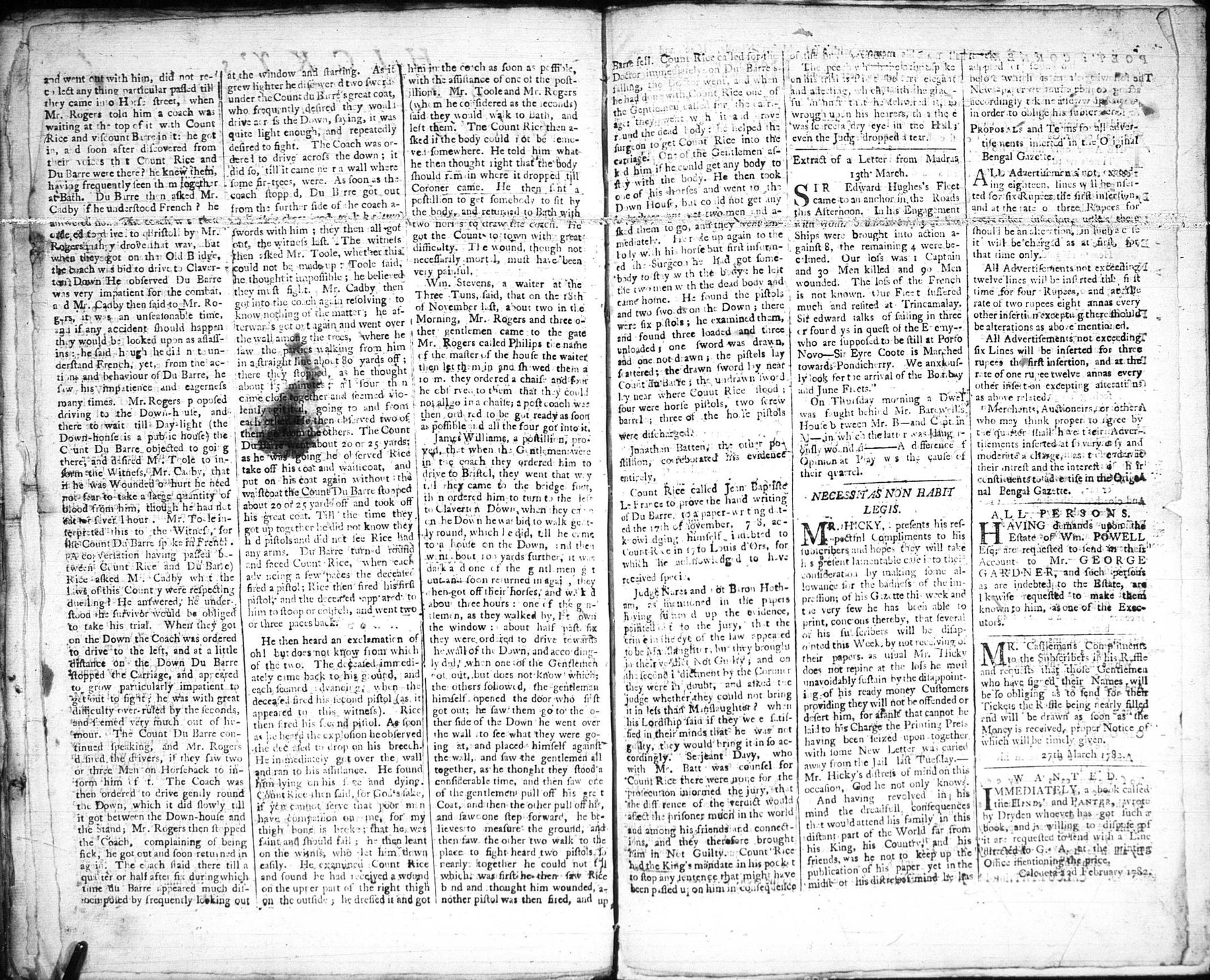
and went out with him, did not re-collect any thing particular passed till they came into Horse street, when Mr. Rogers told him a coach was waiting at the top of it with Count Rice and viscount Burean in: he got in, and soon after discovered from their voices that Count Rice and Du Barre were there? he knew them, having frequently seen them together at Bath. Du Barre then asked Mr. Cadby if he understood French? he answered no. The coach was then ordered to drive to Bristol by Mr. Rogers; they drove that way, but when they got on the Old Bridge, the coach was bid to drive to Claverton Down He observed Du Barre was very impatient for the combat, and Mr. Cadby then said to Mr. Rogers, it was an unseasonable time, and if any accident should happen they would be looked upon as assassins: he said though he did not understand French, yet, from the actions and behaviour of Du Barre, he saw his impatience and eagerness many times. Mr. Rogers proposed driving to the Down-house, and there to wait till Day-light (the Down-house is a public house) the Count Du Barre objected to going there, and desired Mr. Toole to inform the Witness, Mr. Cadby, that if he was Wounded or hurt he need not fear to take a large quantity of blood from him, though he had not eat for over 1 hour. Mr. Toole interpreted this to the Witness, for the Count Du Barre spoke in French. A conversation having passed between Count Rice and Du Barre) Rice asked Mr. Cadby what the laws of this Country were respecting dueling? He answered, he understood the survivor would be obliged to take his trial. When they got on the Down the Coach was ordered to drive to the left, and at a little distance on the Down Du Barre stopped the Carriage, and appeared to grow particularly impatient to get out to fight; he was with great difficulty over-ruled by the seconds, and seemed very much out of humour. The Count Du Barre continued speaking, and Mr. Rogers desired the drivers, if they saw two or three Men on Horseback to inform him of it. The Coach was then ordered to drive gently round the Down, which it did slowly till it got between the Down-house and the Stand; Mr. Rogers then stopped the Coach, complaining of being sick, he got out and soon returned in again. The coach staid there till a quarter or half after six during which time du Barre appeared much discomposed by frequently looking out
at the window and starting. As it grew lighter he discovered two swords under the Count du Barre's great coat, who frequently desired they would drive across the Down, saying, it was quite light enough, and repeatedly desired to fight. The Coach was ordered to drive across the down; it did so, till it came near a wall where some fir-trees, were. As soon as the coach stopped, Du Barre got out from the further side of the coach a- [ILL] swords with him; they then all got out, the witness last. The witness then asked Mr. Toole, whether this could not be made up: Toole said, he thought it impossible; he believed they must fight. Mr. Cadby then got into the coach again resolving to know nothing of the matter; he afterwards got out again and went over the wall among the trees, where he saw the parties walking from him in a straight line about 80 yards off; there they stopped, as he thought about 15 minutes; all four then came close together and seemed violently agitated, going to and from each other; he then observed two of them go from the others. The Count Du Barre went about 20 or 25 yards; as he was going he observed Rice take off his coat and waistcoat, and put on his coat again without the waistcoat the Count Du Barre stopped about 20 or 25 yards off and took off his great coat. Till the time they got up together he did not know they had pistols and did not see Rice had any arms. Du Barre turned round and faced Count Rice, when each advancing a few paces the deceased fired a pistol; Rice then fired his first pistol; and the deceased appeared to him to stoop or crouch, and went two or three paces back.
He then heard an exclamation of oh! but does not know from which of the two. The deceased immediately came back to his ground, and each seemed advancing; when the deceased fired his second pistol (as it appeared to this witness). Rice then fired his second pistol. As soon as he heard the explosion he observed the deceased to drop on his breech. He immediately got over the wall and ran to his assistance. He found him lying on his face and dying. Count Rice then said, for God's sake, if you cannot serve that poor man have compassion on me, for my thigh bone is broke; that he was faint and should fall; he then leant on the witness, who let him down easily. He examined Count Rice and found he had received a wound on the upper part of the right thigh on the outside; he dressed it and got him in the coach as soon as possible, with the assistance of one of the postillions. Mr. Toole and Mr. Rogers (whom he considered as the seconds) said they would walk to Bath, and left them. The Count Rice then asked if the body could not be removed somewhere. He told him what he then thought right that the body should remain where it dropped till Coroner came. He then sent a postillion to get somebody to sit by the body, and returned to Bath with two horses to draw the coach. He got the Count to town with great difficulty. The wound, though not necessarily mortal, must have been very painful.
Wm. Stevens, a waiter at the Three Tuns, said, that on the 18th of November last, about two in the Morning, Mr. Rogers and three other gentlemen came to the gate Mr. Rogers called Philips the name of the master of the house the waiter then let them in and shewed them a room. they ordered a chaise and four he observed to them that they could not all go in a chaise; a post coach was then ordered to be got ready as soon as possible and all the four got into it.
James Williams, a postillion, proved, that when the Gentlemen were in the coach they ordered him to drive to Bristol, they went that way till they came to the bridge foot, then ordered him to turn to the left to Claverton Down, when they came on the Down he was bid to walk gently round, which he did, till he came to a house on the Down, and then went about 100 yards further, it was dark and one of the gentlemen got out and soon returned in again, they then got off their horses, and walk'd about three hours: one of the gentlemen, as they walked by, let down the window: about half past six they were ordered to drive towards the wall of the Down, and accordingly did; when one of the Gentlemen got out, but does not know which; the others followed, the gentleman himself opened the door who first got out; he saw them go to the other side of the Down he went over the wall to see what they were going at, and placed himself against the wall, and saw the gentlemen all together, as he thought they stood a considerable time, and then saw one of the gentlemen pull off his great Coat, and then the other pull off his, and saw one step forward, he believes to measure the ground, and then saw the other two walk to the place to fight heard two pistols go nearly together he could not tell which was first he then saw Rice bend and thought him wounded, another pistol was then fired, and up
Barre fell. Count Rice called for the Doctor immediately on Du Barre's falling, the Doctor went, and when he had done with Count Rice one of the Gentlemen called for the carriage; they went with it and drove round the dead body: he helped the surgeon to get Count Rice into the carriage. One of the Gentlemen asked him if he could get any body to stay with the body. He then took one of his horses and went to the Down House, but could not get any body there but two women and asked them to go, and they went immediately. He rode up again to the body with his horse but first informed the Surgeon he had got somebody to stay with the body: he left the two men with the dead body and came home. He found the pistols and two swords on the Down; there were six pistols; he examined them, and found three loaded and three unloaded; one sword was drawn, and one not drawn; the pistols lay scattered; the drawn sword lay near Count du Barre; the undrawn sword lay near where Count Rice stood; four were horse pistols, two screw barrel; three of the horse pistols were discharged.
Jonathan Batten, the other postillion, corroborated his evidence entirely.
Count Rice called Jean Baptiste Le France to prove the hand writing of Du Barre, to a paper-writing dated the 17th of November, 1778, acknowledging himself indebted to Count Rice in 1710 Louis d'Ors, for which he acknowledged to have received speci.
Judge Nares and not Baron Hotham, as mentioned in the papers having summed up the evidence, pointed out to the Jury, that the crime in the eye of the law appeared to be Manslaughter, but they brought in their verdict Not Guilty; and on the second indictment by the Coroner they were in doubt, and asked the Judge whether they could not bring it in less than Manslaughter? when his Lordship said if they were satisfied in their minds that he was not guilty, they would bring it in so accordingly. Serjeant Davy, who with Mr. Batt was counsel for Count Rice there were none for the prosecution informed the jury, that the difference of the verdict would affect the prisoner much in the world and among his friends and connections, and they therefore brought him in Not Guilty. Count Rice had the King's mandate in his pocket to stop any sentence that might have been passed upon him in consequence of the [ILL] he [ILL] on his trial is said to be very elegant and affecting, which with the graceful manner that he delivered it, so wrought upon his hearers, that there was scarce a dry eye in the Hall; even the Judge dropped a tear.
Extract of a Letter from Madras 13th March.
SIR Edward Hughes's Fleet came to an anchor in the Roads this Afternoon. In his Engagement with [ILL] Ships were brought into action against 8, the remaining 4 were becalmed. Our loss was 1 Captain and 30 Men killed and 90 Men wounded. The loss of the French is not known. Our Fleet suffered much and refited at Trincamalay. Sir edward talks of sailing in three or four days in quest of the Enemy who are supposed to be still at Porto Novo—Sir Eyre Coote is Marched towards Pondicherry. We anxiously look for the arrival of the Bombay and June Fleets.
On Thursday morning a Duel was fought behind Mr. Barwell's House between Mr. B—and Capt in M—in which the latter was dangerously wounded—A difference of Opinion at Play was the cause of their quarrel.
NECESSITAS NON HABET LEGIS.
MR. HICKY, presents his respectful Compliments to his subscribers and hopes they will take his present lamentable case into their consideration by making some allowance for the badness of the impression of his Gazette this week and the very few he has been able to print, concions thereby, that several of his subscribers will be disappointed this Week, by not receiving of their papers, as usual Mr. Hicky does not repine at the loss he must unavoidably sustain by the disappointing of his ready money Customers providing they will not be offended or desert him, for a fault that cannot be laid to his Charge the Printing Press having been seized upon together with some New Letter was caried away from the Jail last Tuesday.—Mr. Hicky's distress of mind on this occasion, God he not only knows. And having revolved in his mind the dreadfull consequences that would attend his family in this distant part of the World far from his King, his Country, and his friends, was he not to keep up the publication of his paper yet in the midst of his distress of mind he has
[ILL] below which is [ILL] Newspaper [ILL] accordingly taken [ILL] in order to oblige his subscribers.
PROPOSALS and TERMS for all Advertisements inserted in the Original Bengal Gazette.
ALL Advertisements not exceeding eighteen lines will be inserted for six Rupees the first insertion, and at the rate of three Rupees for every other insertion, unless there should be an alteration, in such case it will be charged as at first, for that time only.
All Advertisements not exceeding twelve lines will be inserted the first time for four Rupees, and at the rate of two rupees eight annas every other insertion except as there should be alterations as above mentioned.
All Advertisements not exceeding six Lines will be inserted for three rupees the first insertion, and at the rate of one rupee twelve annas every other insertion excepting alterations as above related.
Merchants, Auctioneers, or others who may think proper to agree by the quarter shall have their Advertisements inserted at so very easy and moderate a charge, as to render it their interest and the interest of their constituents to advertise in the Original Bengal Gazette.
ALL PERSONS.
HAVING demands upon the Estate of Wm. POWELL Esq; are requested to send in their Account to Mr. GEORGE GARDNER, and such persons as are indebted to the Estate, are likewise requested to make them known to him, as one of the Executors.
MR. Cassleman's Compliments to the Subscribers in his Raffle and requests that those Gentlemen who have signed their Names, will be so obliging as to send for their Tickets the Raffle being nearly filled and will be drawn as soon as the Money is received, proper Notice of which will be timely given.
27th March 1782.
WANTED.
IMMEDIATELY, a book called the HIND, and PANTER, wrote by Dryden whoever has got such a book, and is willing to dispose of it are requested to send with a Line directed to G. A. at the printing Office mentioning the price.
Calcutta 22d February 1782.
Page 3
AI transcription (Google Gemini, 2026)
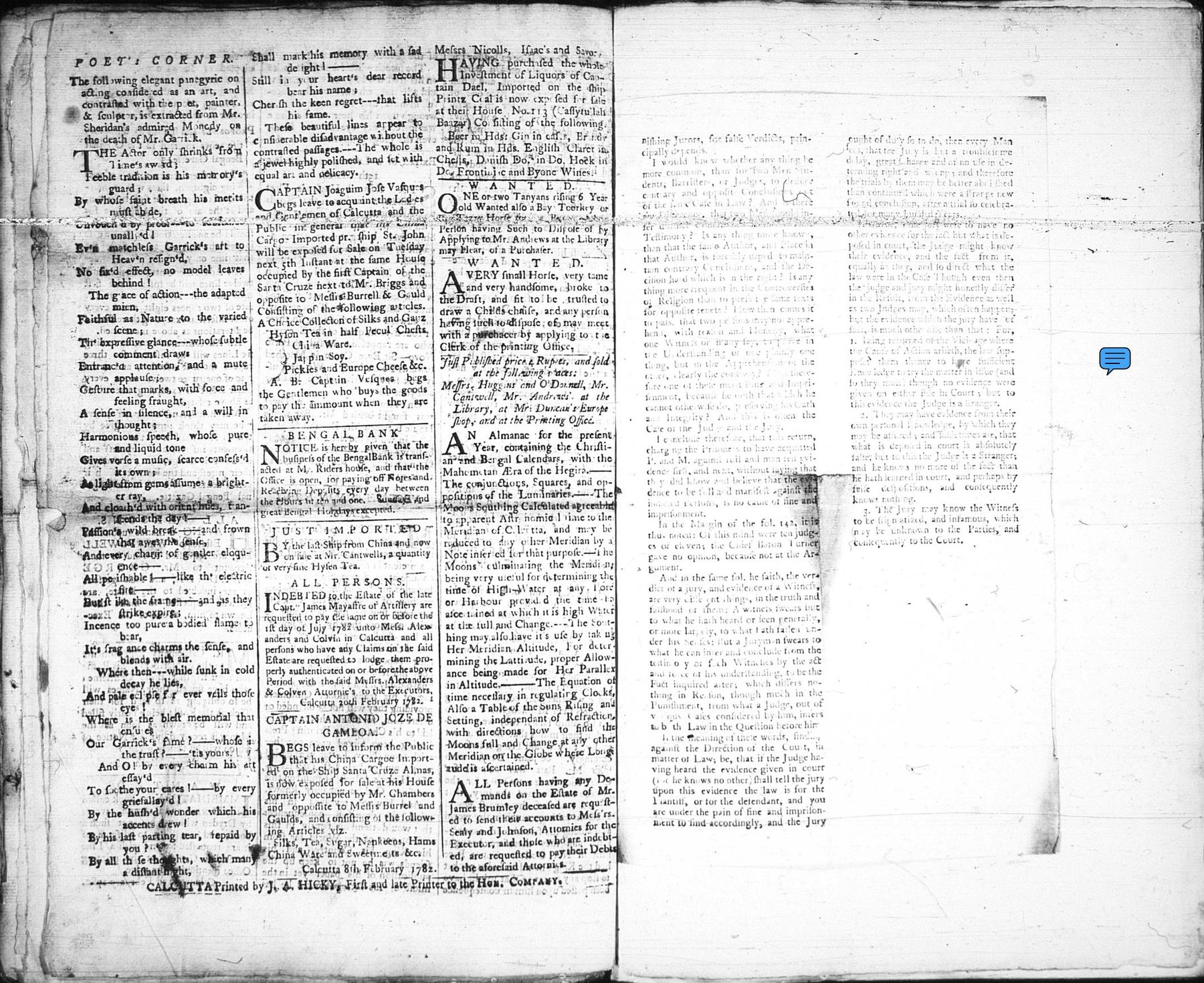
POET'S CORNER.
The following elegant panegyric on acting considered as an art, and contrasted with the poet, painter, & sculptor, is extracted from Mr. Sheridan's admired Monody on the death of Mr. Garrick.
THE Actor only shrinks from Time's award;
Feeble tradition is his memory's guard;
By whose faint breath his merits must abide,
Unvouch'd by proof---to substance unally'd!
Ev'n matchless Garrick's art to Heav'n resign'd,
No fix'd effect, no model leaves behind!
The grace of action---the adapted mien,
Faithful as Nature to the varied scene;
Th' expressive glance---whose subtle comment draws
Entranc'd attention, and a mute applause;
Gesture that marks, with force and feeling fraught,
A sense in silence, and a will in thought;
Harmonious speech, whose pure and liquid tone
Gives verse a music, scarce confess'd its own;
As light from gems assumes a brighter ray,
And cloath'd with orient hues, transcends the day!
Passion's wild break---and frown that awes the sense,
And every charm of gentler eloquence---
All perishable!---like th' electric fire
But strike the frame---and as they strike expire;
Incense too pure a bodied flame to bear,
It's fragrance charms the sense, and blends with air.
Where then---while sunk in cold decay he lies,
And pale eclipse for ever veils those eyes!
Where is the blest memorial that ensures
Our Garrick's fame?---whose is the trust?---'tis yours!
And O! by every charm his art essay'd
To soothe your cares!---by every grief allay'd!
By the hush'd wonder which his accents drew!
By his last parting tear, repaid by you?
By all those thoughts, which many a distant night,
Shall mark his memory with a sad delight!
Still in your heart's dear record bear his name;
Cherish the keen regret---that lifts his fame.
These beautiful lines appear to considerable disadvantage without the contrasted passages.---The whole is a jewel highly polished, and set with equal art and delicacy.
CAPTAIN Joaquim Jose Vasques begs leave to acquaint the Ladies and Gentlemen of Calcutta and the Public in general that his China Cargo Imported pr. ship St. John will be exposed for Sale on Tuesday next 5th Instant at the same House occupied by the first Captain of the Santa Cruze next to Mr. Briggs and opposite to Messrs Burrell & Gauld Consisting of the following articles.
A Choice Collection of Silks and Gauz
Hyson Tea in half Pecul Chests.
China Ware.
Japan Soy.
Pickles and Europe Cheese &c.
N. B. Captain Vasques begs the Gentlemen who buys the goods to pay the ammount when they are taken away.
BENGAL BANK
NOTICE is hereby given that the business of the Bengal Bank is transacted at Mr. Riders house, and that the Office is open, for paying off Notes and Receiving Deposits every day between the Hours of ten and one. Sundays and great Bengal Holidays excepted.
JUST IMPORTED
BY the last Ship from China and now on sale at Mr. Cantwells, a quantity of very fine Hyson Tea.
ALL PERSONS.
INDEBTED to the Estate of the late Capt. James Mayaffre of Artillery are requested to pay the same on or before the 1st day of July 1782 unto Messrs Alexanders and Colvin in Calcutta and all persons who have any Claims on the said Estate are requested to lodge them properly authenticated on or before the above Period with the said Messrs. Alexanders & Colvin Attornie's to the Executors.
Calcutta 20th February 1782.
CAPTAIN ANTONIO JOZE DE GAMEON
BEGS leave to Inform the Public that his China Cargoe Imported on the Ship Santa Cruze Almas, is now exposed for sale at his House formerly occupied by Mr. Chambers and opposite to Messrs Burrel and Gaulds, and consisting of the following Articles viz.
Silks, Tea, Sugar, Nankeens, Hams China Ware and Sweetmeats &c.
Calcutta 8th February 1782.
Messrs Nicolls, Isaac's and Savor.
HAVING purchased the whole Investment of Liquors of Captain Dael, Imported on the ship Printz Cral is now exposed for sale at their House No. 113 (Cassyttullah Baazar) Consisting of the following.
Beer in Hds. Gin in cases, Brandy and Rum in Hds. English Claret in Chests, Danish Do. in Do. Hock in Do. Frontiniac and Byone Wines.
WANTED.
ONE or two Tanyans rising 6 Year old Wanted also a Bay Toorkey or Serassey Horse for a Phaton, any Person having Such to Dispose of by Applying to Mr. Andrews at the Library may Hear, of a Purchaser.
WANTED.
A VERY small Horse, very tame and very handsome, broke to the Draft, and fit to be trusted to draw a Childs chaise, and any person having such to dispose of may meet with a purchaser by applying to the Clerk of the printing Office.
Just Published price 4 Rupees, and sold at the following places:
Messrs. Huggins and O'Donnell, Mr. Cantwell, Mr. Andrews's at the Library, at Mr. Duncan's Europe shop, and at the Printing Office.
AN Almanac for the present Year, containing the Christian and Bengal Calendars, with the Mahometan Æra of the Hegira.---The conjunctions, Squares, and oppositions of the Luminaries.---The Moon's Southing Calculated agreeable to apparent Astronomical Time to the Meridian of Calcutta, and may be reduced to any other Meridian by a Note inserted for that purpose.---The Moons culminating the Meridian, being very useful for determining the time of High-Water at any Port or Harbour provided the time is ascertained at which it is high Water at the full and Change.---The southing may also have it's use by taking Her Meridian Altitude, For determining the Latitude, proper Allowance being made for Her Parallax in Altitude.---The Equation of time necessary in regulating Clocks, Also a Table of the Suns Rising and Setting, independant of Refraction, with directions how to find the Moons full and Change at any other Meridian on the Globe where Longitude is ascertained.
ALL Persons having any Demands on the Estate of Mr. James Brumley deceased are requested to send their accounts to Messrs. Sealy and Johnson, Attornies for the Executor, and those who are indebted, are requested to pay their Debts to the aforesaid Attornies.
[The right-hand page of this photograph is the Supplement of 7 July 1781, bound into the British Library volume at this point. Its text is with that issue.]