Browse › 1781
Saturday 3 November 1781
Page 1
AI transcription (Google Gemini, 2026)
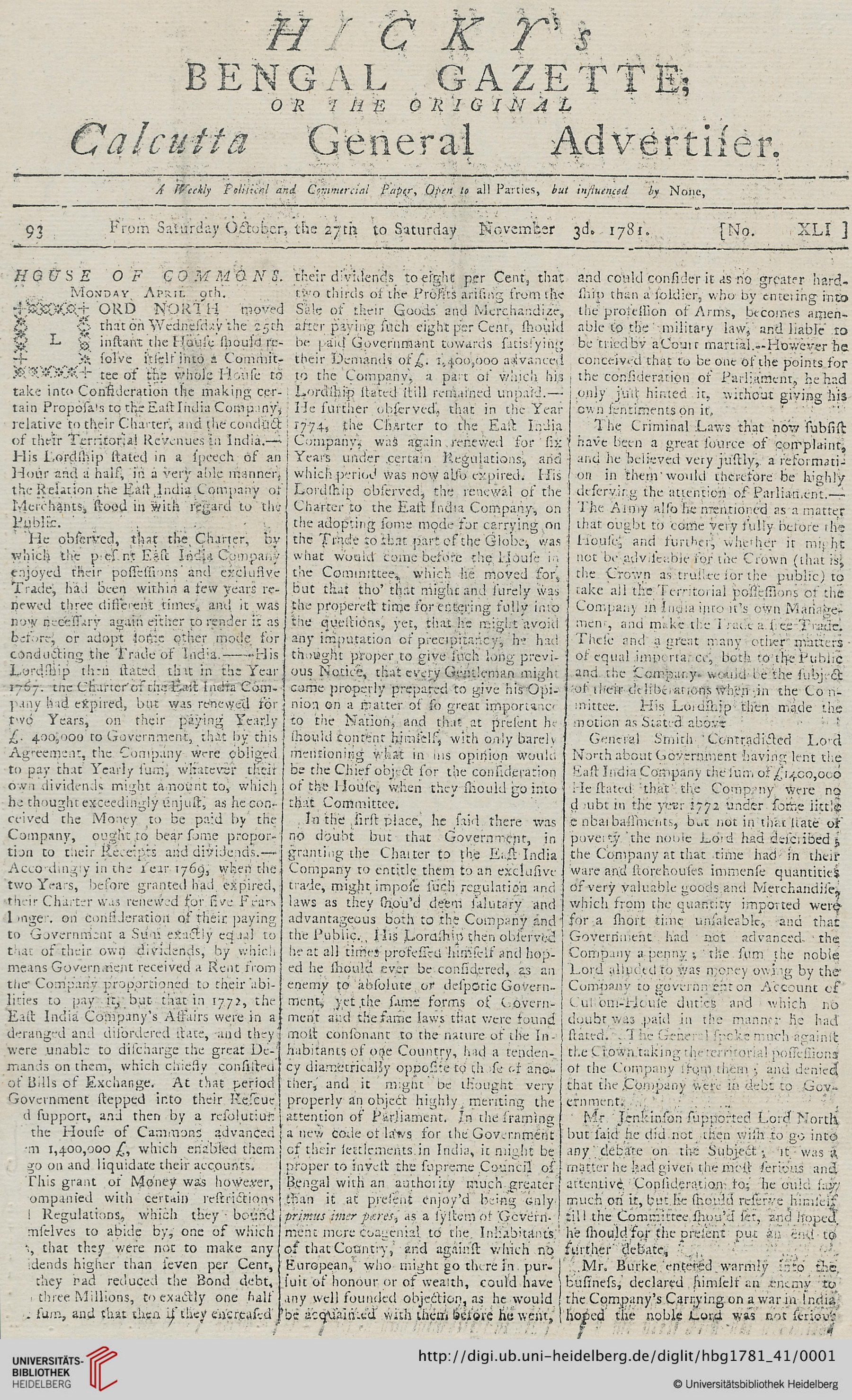
H I C K Y's
BENGAL GAZETTE;
OR THE ORIGINAL
Calcutta General Advertiser.
A Weekly Political and Commercial Paper, Open to all Parties, but influenced by None.
93 From Saturday October, the 27th to Saturday November 3d. 1781. [No. XLI]
HOUSE OF COMMONS.
MONDAY APRIL 9th.
LORD NORTH moved that on Wednesday the 25th instant the House should resolve itself into a Committee of the whole House to take into Consideration the making certain Proposals to the East India Company, relative to their Charter, and the conduct of their Territorial Revenues in India.— His Lordship stated in a speech of an Hour and a half, in a very able manner, the Relation the East India Company of Merchants, stood in with regard to the Public.
He observed, that the Charter, by which the present East India Company enjoyed their possessions and exclusive Trade, had been within a few years renewed three different times, and it was now necessary again either to render it as before, or adopt some other mode for conducting the Trade of India.—His Lordship then stated that in the Year 1767, the Charter of the East India Company had expired, but was renewed for two Years, on their paying Yearly £. 400,000 to Government, that by this Agreement, the Company were obliged to pay that Yearly sum, whatever their own dividends might amount to, which he thought exceedingly unjust, as he conceived the Money to be paid by the Company, ought to bear some proportion to their Receipts and dividends.— Accordingly in the Year 1769, when the two Years, before granted had expired, their Charter was renewed for five Years longer, on consideration of their paying to Government a Sum exactly equal to that of their own dividends, by which means Government received a Rent from the Company proportioned to their abilities to pay it, but that in 1772, the East India Company's Affairs were in a deranged and disordered state, and they were unable to discharge the great Demands on them, which chiefly consisted of Bills of Exchange. At that period Government stepped into their Rescue and support, and then by a resolution of the House of Commons advanced them 1,400,000 £, which enabled them to go on and liquidate their accounts.
This grant of Money was however, accompanied with certain restrictions and Regulations, which they bound themselves to abide by, one of which was, that they were not to make any dividends higher than seven per Cent, till they had reduced the Bond debt, of three Millions, to exactly one half that sum, and that then if they encreased their dividends to eight per Cent, that two thirds of the Profits arising from the Sale of their Goods and Merchandize, after paying such eight per Cent, should be paid Government towards satisfying their Demands of £. 1,400,000 advanced to the Company, a part of which his Lordship stated still remained unpaid.— He further observed, that in the Year 1774, the Charter to the East India Company, was again renewed for six Years under certain Regulations, and which period was now also expired. His Lordship observed, the renewal of the Charter to the East India Company, on the adopting some mode for carrying on the Trade to that part of the Globe, was what would come before the House in the Committee, which he moved for, but that tho' that might and surely was the properest time for entering fully into the questions, yet, that he might avoid any imputation of precipitancy, he had thought proper to give such long previous Notice, that every Gentleman might come properly prepared to give his Opinion on a matter of so great importance to the Nation, and that at present he should content himself, with only barely mentioning what in his opinion would be the Chief object for the consideration of the House, when they should go into that Committee.
In the first place, he said there was no doubt but that Government, in granting the Charter to the East India Company to entitle them to an exclusive trade, might impose such regulation and laws as they shou'd deem salutary and advantageous both to the Company and the Public. His Lordship then observed he at all times professed himself and hoped he should ever be considered, as an enemy to absolute or despotic Government, yet the same forms of Government and the same laws that were found most consonant to the nature of the Inhabitants of one Country, had a tendency diametrically opposite to those of another, and it might be thought very properly an object highly meriting the attention of Parliament. In the framing a new code of laws for the Government of their settlements in India, it might be proper to invest the supreme Council of Bengal with an authority much greater than it at present enjoy'd being only primus inter pares, as a system of Government more coagenial to the Inhabitants of that Country, and against which no European, who might go there in pursuit of honour or of wealth, could have any well founded objection, as he would be acquainted with them before he went, and could consider it as no greater hardship than a soldier, who by entering into the profession of Arms, becomes amenable to the military law, and liable to be tried by a Court martial.—However he conceived that to be one of the points for the consideration of Parliament, he had only just hinted it, without giving his own sentiments on it.
The Criminal Laws that now subsist have been a great source of complaint, and he believed very justly, a reformation in them would therefore be highly deserving the attention of Parliament.— The Army also he mentioned as a matter that ought to come very fully before the House, and further, whether it might not be adviseable for the Crown (that is, the Crown as trustee for the public) to take all the Territorial possessions of the Company in India into it's own Management, and make the Trade a free Trade. These and a great many other matters of equal importance, both to the Public and the Company would be the subject of their deliberations when in the Committee. His Lordship then made the motion as Stated above
General Smith Contradicted Lord North about Government having lent the East India Company the sum of £1400,000 He stated that the Company were no doubt in the year 1772 under some little embarrassments, but not in that state of poverty the noble Lord had described; the Company at that time had in their ware and storehouses immense quantities of very valuable goods and Merchandize, which from the quantity imported were for a short time unsaleable, and that Government had not advanced the Company a penny; the sum the noble Lord alluded to was money owing by the Company to government on Account of Custom-House duties and which no doubt was paid in the manner he had stated. The General spoke much against the Crown taking the territorial possessions of the Company from them; and denied that the Company were in debt to Government.
Mr Jenkinson supported Lord North but said he did not then wish to go into any debate on the Subject; it was a matter he had given the most serious and attentive Consideration to, he could say much on it, but he should reserve himself till the Committee shou'd set, and hoped he should for the present put an end to further debate.
Mr. Burke entered warmly into the business, declared himself an enemy to the Company's Carrying on a war in India hoped the noble Lord was not serious
Page 2
AI transcription (Google Gemini, 2026)
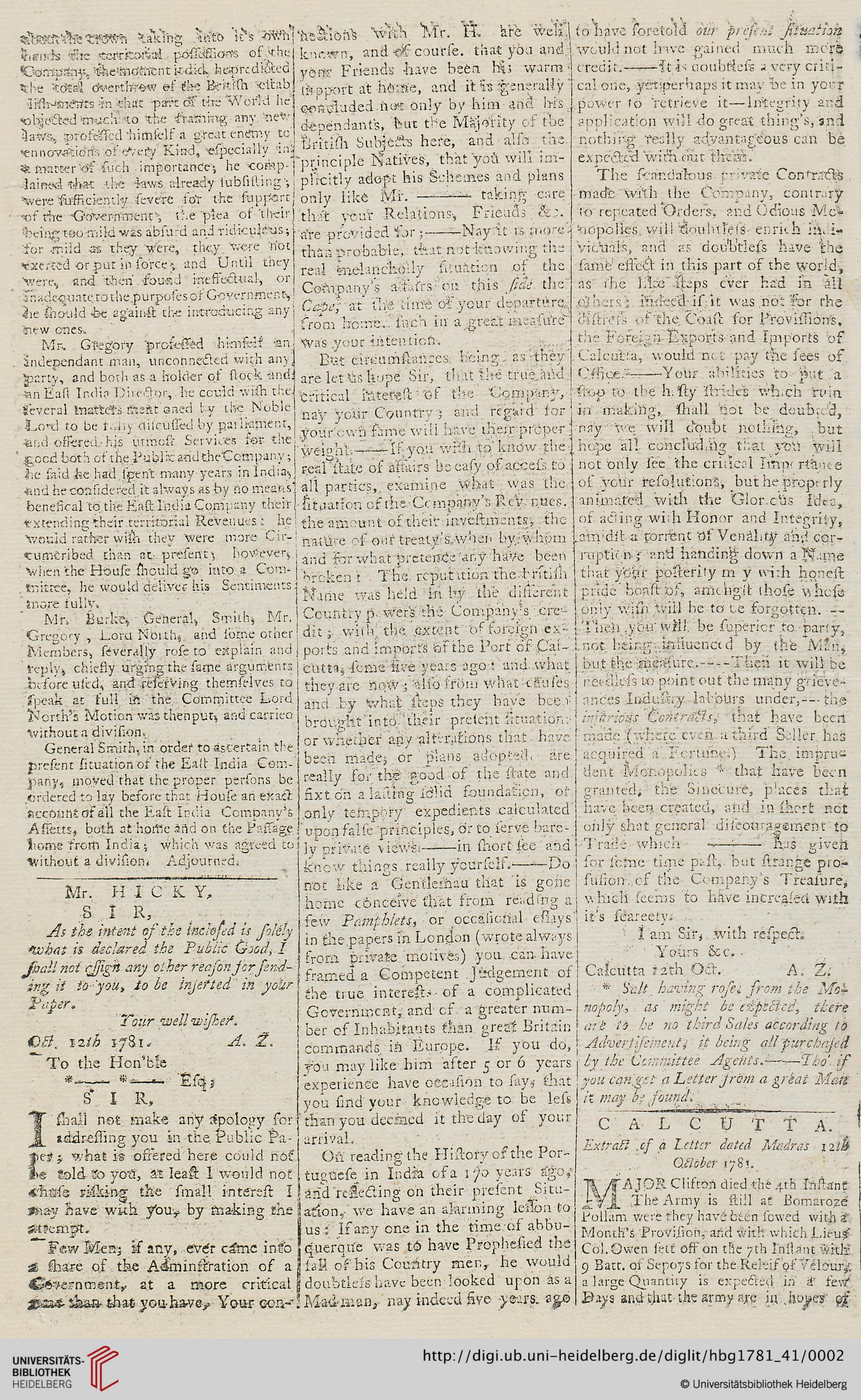
about the crown taking into it's own hands the territorial possessions of the Company, the moment it did, he predicted the total overthrow of the British establishments in that part of the World he objected much to the framing any new laws, professed himself a great enemy to ennovations of every Kind, especially in a matter of such importance; he complained that the laws already subsisting, were sufficiently severe for the support of the Government, the plea of their being too mild was absurd and ridiculous; for mild as they were, they were not exerted or put in force; and Until they were, and then found ineffectual, or inadequate to the purposes of Government, he should be against the introducing any new ones.
Mr. Gregory professed himself an Independant man, unconnected with any party, and both as a holder of stock and an East India Director, he could wish the several matters mentioned by the Noble Lord to be fully discussed by parliament, and offered his utmost Services for the good both of the Public and the Company; he said he had spent many years in India, and he considered it always as by no means benefical to the East India Company their extending their territorial Revenues: he would rather wish they were more Circumcribed than at present; however, when the House should go into a Committee, he would deliver his Sentiments more fully.
Mr. Burke, General, Smith, Mr. Gregory, Lord North, and some other Members, severally rose to explain and reply, chiefly urging the same arguments before used, and reserving themselves to speak at full in the Committee Lord North's Motion was then put, and carried without a division.
General Smith, in order to ascertain the present situation of the East India Company, moved that the proper persons be ordered to lay before that House an exact account of all the East India Company's Assetts, both at home and on the Passage home from India; which was agreed to without a division. Adjourned.
Mr. HICKY,
SIR,
As the intent of the inclosed is solely what is declared the Public Good, I shall not assign any other reason for sending it to you, to be inserted in your Paper.
Your well wisher.
Oct. 12th 1781. A. Z.
To the Hon'ble
*———*———Esq;
SIR,
I shall not make any apology for addressing you in the Public Paper; what is offered here could not be told to you, at least I would not chuse risking the small interest I may have with you, by making the attempt.
Few Men; if any, ever came into a share of the Administration of a Government, at a more critical time than that you have, Your connections with Mr. H. are well known, and of course, that you and your Friends have been his warm support at home, and it is generally concluded not only by him and his dependants, but the Majority of the British Subjects here, and also the principle Natives, that you will implicitly adopt his Schemes and plans only like Mr. ——— taking care that your Relations, Friends &c. are provided for;—Nay it is more than probable, that not knowing the real melancholly situation of the Company's affairs on this side the Cape, at the time of your departure from home, such in a great measure was your intention.
But circumstances being as they are let us hope Sir, that the true and critical interest of the Company, nay your Country; and regard for your own fame will have their proper weight.—If you wish to know the real state of affairs be easy of access to all parties, examine what was the situation of the Company's Revenues, the amount of their investments; the nature of our treaty's when by whom and for what pretence any have been broken: The reputation the british Name was held in by the different Country powers the Company's credit; with the extent of foreign exports and imports of the Port of Calcutta, some five years ago: and what they are now; also from what causes and by what steps they have been brought into their present situation: or whether any alterations that have been made, or plans adopted, are really for the good of the state and fixt on a lasting solid foundation, or only tempory expedients calculated upon false principles, or to serve barely private views.—in short see and know things really yourself.—Do not like a Gentleman that is gone home conceive that from reading a few Pamphlets, or occasional essays in the papers in London (wrote always from private motives) you can have framed a Competent Judgement of the true interests of a complicated Government, and of a greater number of Inhabitants than great Britain commands in Europe. If you do, you may like him after 5 or 6 years experience have occasion to say, that you find your knowledge to be less than you deemed it the day of your arrival.
On reading the History of the Portuguese in India of a 170 years ago, and reflecting on their present Situation, we have an alarming lesson to us: If any one in the time of abbuquerque was to have Prophesied the fall of his Country men, he would doubtless have been looked upon as a Mad man, nay indeed five years ago to have foretold our present situation would not have gained much more credit.—It is doubtless a very critical one, yet perhaps it may be in your power to retrieve it—Integrity and application will do great thing's, and nothing really advantageous can be expected with out them.
The scandalous private Contracts made with the Company, contrary to repeated Orders, and Odious Monopolies, will doubtless enrich individuals, and as doubtless have the same effect in this part of the world, as the like steps ever had in all others; indeed if it was not for the distress of the Coast for Provissions, the Foreign Exports and Imports of Calcutta, would not pay the fees of Office.—Your abilities to put a stop to the hasty strides which ruin in making, shall not be doubted, nay we will doubt nothing, but hope all concluding that you will not only see the critical Importance of your resolutions, but be properly animated with the Glorious Idea, of acting with Honor and Integrity, amidst a torrent of Venality and corruption, and handing down a Name that your posterity may with honest pride boast of, amongst those whose only wish will be to be forgotten.—Then you will be superior to party, not being influenced by the Man, but the measure.—Then it will be needless to point out the many grievances Industry labours under,—the injurious Contracts, that have been made (where even a third Seller has acquired a Fortune.) The imprudent Monopolies * that have been granted, the Sinecure, places that have been created, and in short not only that general discouragement to Trade which ——— has given for some time past, but strange profusion of the Company's Treasure, which seems to have increased with it's scarcety.
I am Sir, with respect.
Yours &c.
Calcutta 12th Oct. A. Z.
* Salt having rose, from the Monopoly, as might be expected, there are to be no third Sales according to Advertisement, it being all purchased by the Committee Agents.—Tho' if you can get a Letter from a great Man it may be found.
CALCUTTA.
Extract of a Letter dated Madras 12th October 1781.
MAJOR Clifton died the 4th Instant The Army is still at Bomaroze Pollam were they have been sowed with a Month's Provision, and with which Lieut Col. Owen sett off on the 7th Instant with 9 Batt. of Sepoys for the Releif of Velour, a large Quantity is expected in a few Days and that the army are in hopes of
Page 3
AI transcription (Google Gemini, 2026)
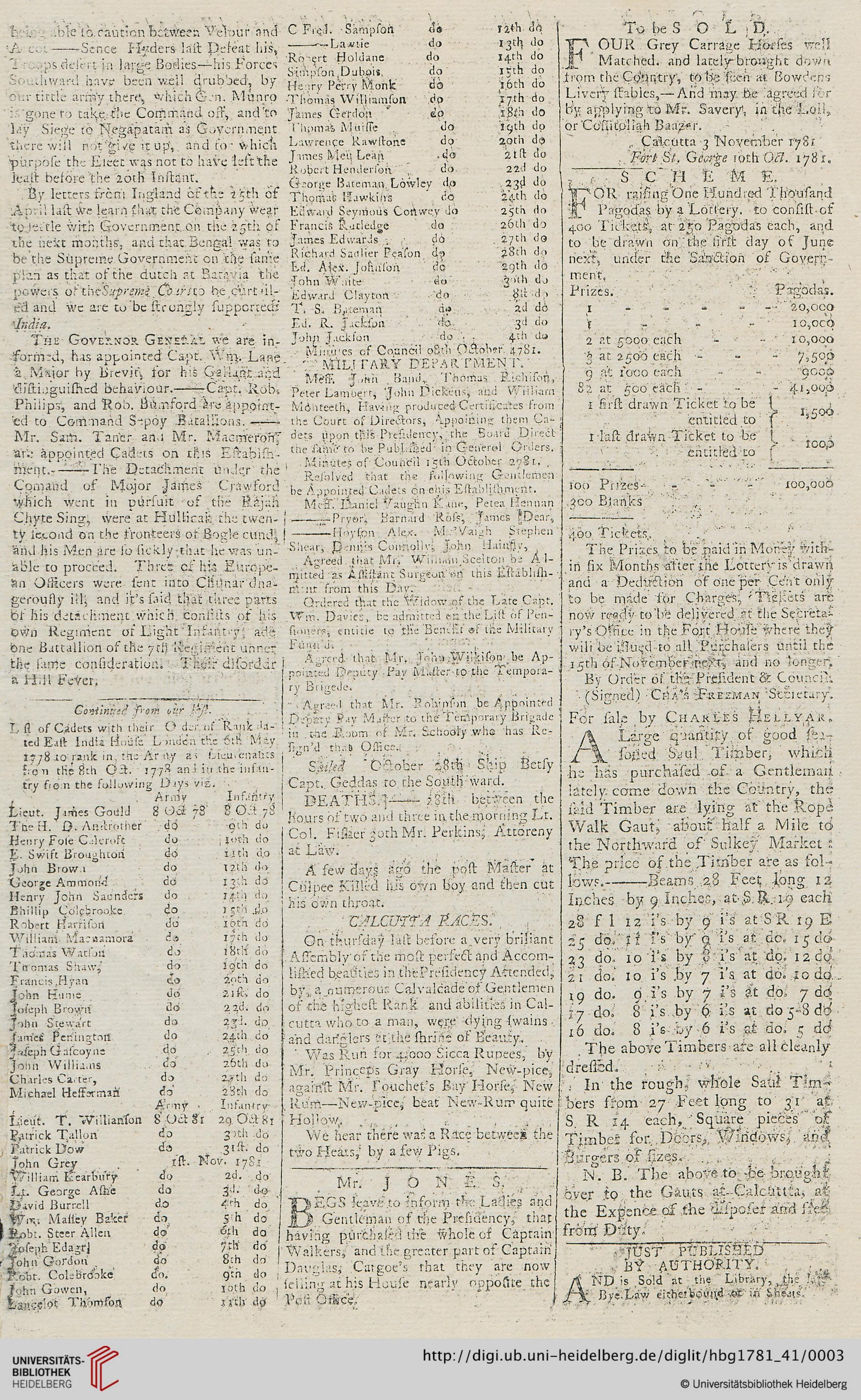
being able to caution between Velour and A cot - Sence Hyders last Defeat his Troops desert in large Bodies - his Forces Southward have been well drubbed, by our little army there, which Gen. Munro is gone to take the Command off, and to lay Siege to Negapatam as Government there will not give it up, and for which purpose the Fleet was not to have left the least before the 20th Instant.
By letters from Ingland of the 25th of April last we learn that the Company wear to jestle with Government on the 25th of the next months, and that Bengal was to be the Supreme Government on the same plan as that of the dutch at Batavia the powers of the Supreme Court to be curtailed and we are to be strongly supported India.
The GOVERNOR GENERAL we are informed, has appointed Capt. Wm. Lane a Major by Brevit, for his Gallant and distinguished behaviour. - Capt. Rob. Philips, and Rob. Bumford are appointed to Command Sepoy Batallions. - Mr. Sam. Taner and Mr. Macmeron are appointed Cadets on this Establishment. - The Detachment under the Comand of Major James Crawford which went in pursuit of the Rajah Chyte Sing, were at Hullicak the twenty second on the fronteers of Bogle cund, and his Men are so sickly that he was unable to proceed. Three of his European Officers were sent into Chunar dangerously ill, and it's said that three parts of his detachment which consists of his own Regiment of Light Infantry, and one Battallion of the 7th Regiment unner the same consideration. Their disordar a Hill Fever.
Continued from our last.
List of Cadets with their Order of Rank dated East India House London the 6th May 1778 to rank in the Army as Lieutenants from the 8th Oct. 1778 and in the infantry from the following Days viz.
Army Infantry
Lieut. James Gould 8 Oct 78 8 Oct 78
The H. D. Anstrother do 9th do
Henry Fole Calcroft do 10th do
E. Swift Broughton do 11th do
John Brown do 12th do
George Ammond do 13th do
Henry John Saenders do 14th do
Phillip Colebrooke do 15th do
Robert Harrison do 16th do
William Macnamora do 17th do
Thomas Watson do 18th do
Thomas Shaw do 19th do
Francis Hyan do 20th do
John Hume do 21st do
Joseph Brown do 22d do
John Stewart do 23d do
James Penington do 24th do
Joseph Gascoyne do 25th do
John Williams do 26th do
Charles Carter do 27th do
Michael Hefferman do 28th do
Army Infantry
Lieut. T. Williamson 8 Oct 81 29 Oct 81
Patrick Tallon do 30th do
Patrick Dow do 31st do
John Grey 1st Nov. 1781
William Kearbury do 2d do
Lt. George Ashe do 3d do
David Burrell do 4th do
Wm. Massey Baker do 5th do
Robt. Steer Allen do 6th do
Joseph Edagr do 7th do
John Gordon do 8th do
Robt. Colebrooke do 9th do
John Gowen do 10th do
Lancelot Thomson do 11th do
C Fred. Sampson do 12th do
---- Lawtie do 13th do
Robert Holdane do 14th do
Simpson Dubois do 15th do
Henry Perry Monk do 16th do
Thomas Williamson do 17th do
James Gordon do 18th do
Thomas Muisse do 19th do
Lawrence Rawstone do 20th do
James Mc. Lean do 21st do
Robert Henderson do 22d do
George Bateman Lowley do 23d do
Thomas Hawkins do 24th do
Edward Seymous Conwey do 25th do
Francis Rutledge do 26th do
James Edwards do 27th do
Richard Sadler Peason do 28th do
Ed. Alex. Johnson do 29th do
John Waite do 30th do
Edward Clayton do 1st do
T. S. Bateman do 2d do
Ed. R. Jackson do 3d do
John Jackson do 4th do
Minutes of Council 08th October 1781.
MILITARY DEPARTMENT.
Mess. John Band, Thomas Richison, Peter Lambert, John Dickens, and William Monteeth, Having produced Certificates from the Court of Directors, Appointing them Cadets upon this Presidency, the Board Direct the same to be Published in General Orders.
Minutes of Council 15th October 1781.
Resolved that the following Gentlemen be Appointed Cadets on this Establishment.
Mess. Daniel Vaughn Kane, Peter Hennan ---- Pryor, Barnard Rose, James Dear, ---- Hoyson Alex. Mc.Vaigh Stephen Shear, Dennis Connolly, John Hainsly,
Agreed that Mr. William Scelton be Admitted as Assistant Surgeon on this Establishment from this Day.
Ordered that the Widow of the Late Capt. Wm. Davies, be admitted on the List of Pensioners, entitle to the Benefit of the Military Fund.
Agreed that Mr. John Wilkison be Appointed Deputy Pay Master to the Temporary Brigede.
Agreed that Mr. Robinson be Appointed Deputy Pay Master to the Temporary Brigade in the Room of Mr. Schooly who has Resign'd that Office.
Sailed October 28th Ship Betsy Capt. Geddas to the South ward.
DEATHS. - 28th between the hours of two and three in the morning Lt. Col. Fissier 30th Mr. Perkins, Attoreny at Law.
A few days ago the post Master at Culpee Killed his own boy and then cut his own throat.
CALCUTTA RACES.
On thursday last before a very briliant Assembly of the most perfect and Accomlished beauties in the Presidency Attended, by, a numerous Calvalcade of Gentlemen of the highest Rank and abilities in Calcutta who to a man, were dying swains and danglers at the shrine of Beauty.
Was Run for 4,000 Sicca Rupees, by Mr. Princeps Gray Horse, New-pice, against Mr. Touchet's Bay Horse, New Rum - New-pice, beat New-Rum quite Hollow.
We hear there was a Race between the two Heats, by a few Pigs.
Mr. JONES,
BEGS leave to inform the Ladies and Gentleman of the Presidency, that having purchased the whole of Captain Walkers, and the greater part of Captain Dauglas, Cargoe's that they are now selling at his House nearly opposite the Post Office.
To be SOLD.
FOUR Grey Carrage Horses well Matched. and lately brought down from the Country, to be seen at Bowdens Livery stables, - And may be agreed for by applying to Mr. Savery, in the Loll, or Cossitoliah Baazar.
Calcutta 3 November 1781
Fort St. George 10th Oct. 1781.
S C H E M E.
FOR raising One Hundred Thousand Pagodas by a Lottery. to consist of 400 Tickets, at 250 Pagodas each, and to be drawn on the first day of June next, under the Sanction of Government.
Prizes. Pagodas.
1 20,000
1 10,000
2 at 5000 each 10,000
3 at 2500 each 7,500
9 at 1000 each 9000
82 at 500 each 41,000
1 first drawn Ticket to be entitled to 1,500
1 last drawn Ticket to be entitled to 1000
100 Prizes 100,000
300 Blanks
400 Tickets.
The Prizes to be paid in Money within six Months after the Lottery is drawn and a Deduction of one per Cent only to be made for Charges, Tickets are now ready to be delivered at the Secretary's Office in the Fort House where they will be issued to all Purchasers until the 15th of November next, and no longer.
By Order of the President & Council.
(Signed) CHA's FREEMAN Secretary.
For sale by CHARLES HELLYAR.
A Large quantity of good seasoned Saul Timber, which he has purchased of a Gentleman lately come down the Country, the said Timber are lying at the Rope Walk Gaut, about half a Mile to the Northward of Sulkey Market: The price of the Timber are as follows. - Beams 28 Feet long 12 Inches by 9 Inches, at S R 19 each
28 f l 12 i's by 9 i's at S R 19 E
25 do. 11 i's by 9 i's at do. 15 do
23 do. 10 i's by 8 i's at do. 12 do
21 do. 10 i's by 7 i's at do. 10 do
19 do. 9 i's by 7 i's at do. 7 do
17 do. 8 i's by 6 i's at do 5-8 do
16 do. 8 i's by 6 i's at do. 5 do
The above Timbers are all cleanly dressed.
In the rough, whole Saul Timbers from 27 Feet long to 31 at S R 14 each, Square pieces of Timber for Doors, Windows, and Burgers of sizes.
N. B. The above to be brought over to the Gauts at Calcutta, at the Expence of the disposer and free from Duty.
JUST PUBLISHED
BY AUTHORITY.
AND is Sold at the Library, the Bye Law either bound or in Sheats.
Page 4
AI transcription (Google Gemini, 2026)
Continued from our last.
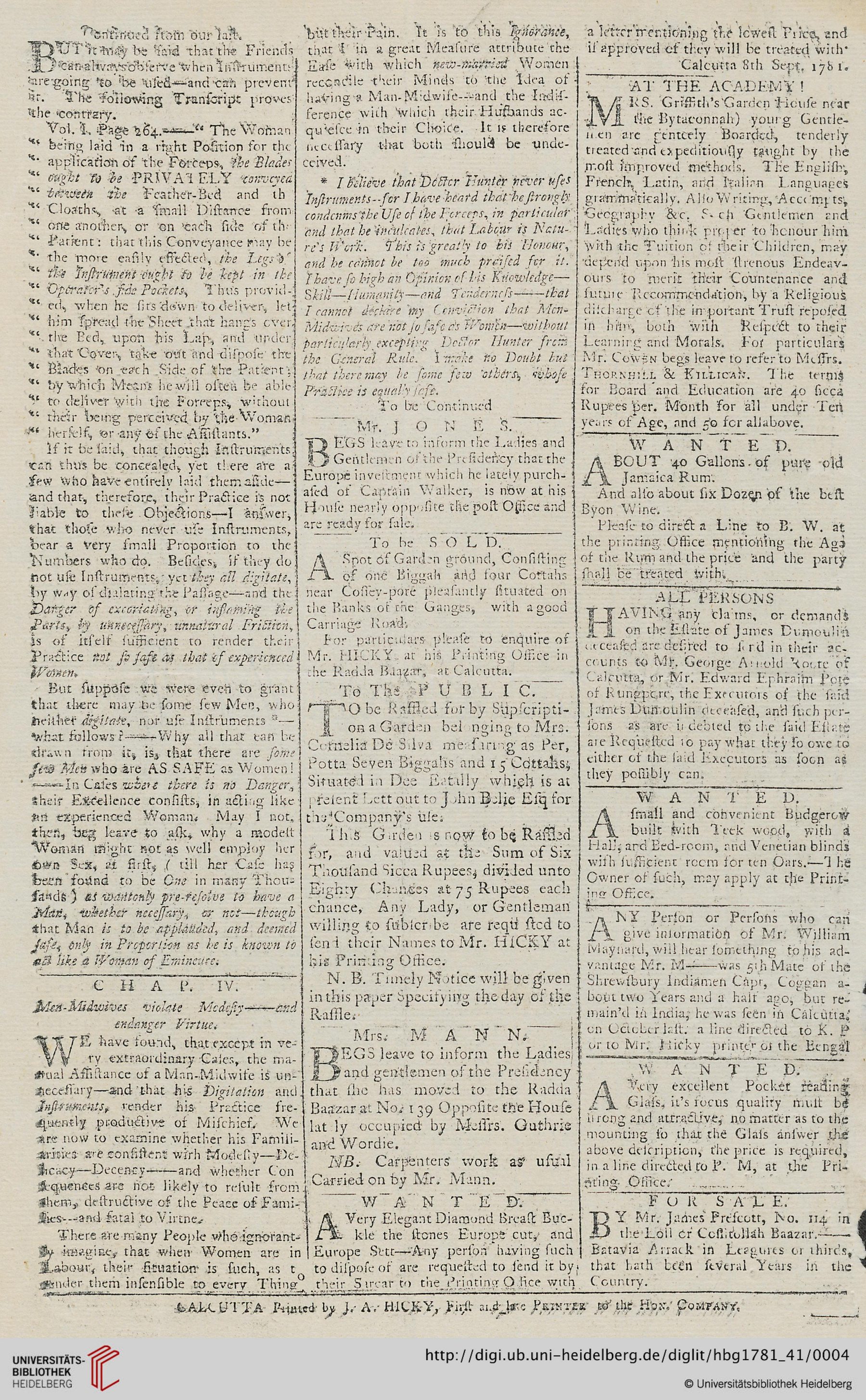
BUT it may be said that the Friends can always observe when Instruments are going to be used—and can prevent it. The following Transcript proves the contrary.
Vol. I. Page 264.—"The Woman being laid in a right Position for the application of the Forceps, the Blades ought to be PRIVATELY conveyed between the Feather-Bed and th Cloaths, at a small Distance from one another, or on each side of the Patient: that this Conveyance may be the more easily effected, the Legs of the Instrument ought to be kept in the Operator's side Pockets. Thus provided, when he sits down to deliver, let him spread the Sheet that hangs over the Bed, upon his Lap, and under that Cover, take out and dispose the Blades on each Side of the Patient; by which Means he will often be able to deliver with the Forceps, without their being perceived by the Woman herself, or any of the Assistants."
If it be said, that though Instruments can thus be concealed, yet there are a few who have entirely laid them aside—and that, therefore, their Practice is not liable to these Objections—I answer, that those who never use Instruments, bear a very small Proportion to the Numbers who do. Besides, if they do not use Instruments, yet they all digitate, by way of dialating the Passage—and the Danger of excoriating, or inflaming the Parts, by unnecessary, unnatural Friction, is of itself sufficient to render their Practice not so safe as that of experienced Women.
But suppose we were even to grant that there may be some few Men, who neither digitate, nor use Instruments *—what follows?—Why all that can be drawn from it, is, that there are some few Men who are AS SAFE as Women!—In Cases where there is no Danger, their Excellence consists, in acting like an experienced Woman. May I not, then, beg leave to ask, why a modest Woman might not as well employ her own Sex, at first, (till her Case has been found to be One in many Thousands) as wantonly pre-resolve to have a Man, whether necessary, or not—though that Man is to be applauded, and deemed safe, only in Proportion as he is known to act like a Woman of Eminence.
C H A P. IV.
Men-Midwives violate Modesty—and endanger Virtue.
WE have found, that except in very extraordinary Cases, the manual Assistance of a Man-Midwife is unnecessary—and that his Digitation and Instruments, render his Practice frequently productive of Mischief. We are now to examine whether his Familiarities are consistent with Modesty—Delicacy—Decency—and whether Consequences are not likely to result from them, destructive of the Peace of Families—and fatal to Virtue.
There are many People who ignorantly imagine, that when Women are in Labour, their situation is such, as to render them insensible to every Thing but their Pain. It is to this Ignorance, that I in a great Measure attribute the Ease with which new-married Women reconcile their Minds to the Idea of having a Man-Midwife—and the Indifference with which their Husbands acquiesce in their Choice. It is therefore necessary that both should be undeceived.
* I Believe that Doctor Hunter never uses Instruments—for I have heard that he strongly condemns the Use of the Forceps, in particular and that he inculcates, that Labour is Nature's Work. This is greatly to his Honour, and he cannot be too much praised for it. I have so high an Opinion of his Knowledge—Skill—Humanity—and Tenderness—that I cannot declare my Conviction that Men-Midwives are not so safe as Women—without particularly excepting Doctor Hunter from the General Rule. I make no Doubt but that there may be some few others, whose Practice is equally safe.
To be Continued
Mr. J O N E S.
BEGS leave to inform the Ladies and Gentlemen of the Presidency that the Europe investment which he lately purchased of Captain Walker, is now at his House nearly opposite the post Office and are ready for sale.
To be S O L D.
A Spot of Garden ground, Consisting of one Biggah and four Cottahs near Cossey-pore pleasantly situated on the Banks of the Ganges, with a good Carriage Road.
For particulars please to enquire of Mr. HICKY at his Printing Office in the Radda Baazar, at Calcutta.
To THE P U B L I C.
TO be Raffled for by Subscription on a Garden belonging to Mrs. Cornelia De Silva measuring as Per, Potta Seven Biggahs and 15 Cottahs, Situated in Dee Eatully which is at present Lett out to John Belie Esq for the Company's use.
This Garden is now to be Raffled for, and valued at the Sum of Six Thousand Sicca Rupees, divided unto Eighty Chances at 75 Rupees each Chance, Any Lady, or Gentleman willing to subscribe are requested to send their Names to Mr. HICKY at his Printing Office.
N. B. Timely Notice will be given in this paper Specifying the day of the Raffle.
Mrs. M A N N.
BEGS leave to inform the Ladies and gentlemen of the Presidency that she has moved to the Radda Baazar at No. 139 Opposite the House lately occupied by Messrs. Guthrie and Wordie.
NB. Carpenters work as usual Carried on by Mr. Mann.
W A N T E D.
A Very Elegant Diamond Breast Buckle the stones Europe cut, and Europe Sett—Any person having such to dispose of are requested to send it by their Sircar to the Printing Office with a letter mentioning the lowest Price, and if approved of they will be treated with.
Calcutta 8th Sept. 1781.
AT THE ACADEMY!
MRS. Griffith's Garden House near the Bytaconnah) young Gentlemen are genteely Boarded, tenderly treated and expeditiously taught by the most improved methods. The English, French, Latin, and Italian Languages grammatically. Also Writing, Accompts, Geography &c. Such Gentlemen and Ladies who think proper to honour him with the Tuition of their Children, may depend upon his most strenuous Endeavours to merit their Countenance and future Recommendation, by a Religious discharge of the important Trust reposed in him, both with Respect to their Learning and Morals. For particulars Mr. COWEN begs leave to refer to Messrs. THORNHILL & KILLICAN. The terms for Board and Education are 40 sicca Rupees per. Month for all under Ten years of Age, and 50 for allabove.
W A N T E D.
ABOUT 40 Gallons of pure old Jamaica Rum.
And also about six Dozen of the best Byon Wine.
Please to direct a Line to B. W. at the printing Office mentioning the Age of the Rum and the price and the party shall be treated with.
ALL PERSONS
HAVING any claims, or demands on the Estate of James Dumoulin deceased are desired to send in their accounts to Mr. George Arnold Rouse of Calcutta, or Mr. Edward Ephraim Pote of Rungpore, the Executors of the said James Dumoulin deceased, and such persons as are indebted to the said Estate are Requested to pay what they so owe to either of the said Executors as soon as they possibly can.
W A N T E D.
A small and convenient Budgerow built with Teek wood, with a Hall, and Bed-room, and Venetian blinds with sufficient room for ten Oars.—The Owner of such, may apply at the Printing Office.
ANY Person or Persons who can give information of Mr. William Maynard, will hear something to his advantage Mr. M—was 5th Mate of the Shrewsbury Indiamen Capt, Coggan about two Years and a half ago, but remain'd in India, he was seen in Calcutta on October last. a line directed to K. P or to Mr. Hicky printer of the Bengal
W A N T E D.
A Very excellent Pocket reading Glass, it's focus quality must be strong and attractive, no matter as to the mounting so that the Glass answer the above description, the price is required, in a line directed to P. M. at the Printing Office.
FOR SALE.
BY Mr. James Prescott, No. 114 in the Loll or Cossitollah Baazar.—Batavia Arrack in Leaguers or thirds, that hath been several Years in the Country.
CALCUTTA Printed by J. A. HICKY, First and late PRINTER to the HON. COMPANY.