Browse › 1781
Saturday 20 October 1781
Page 1
AI transcription (Google Gemini, 2026)
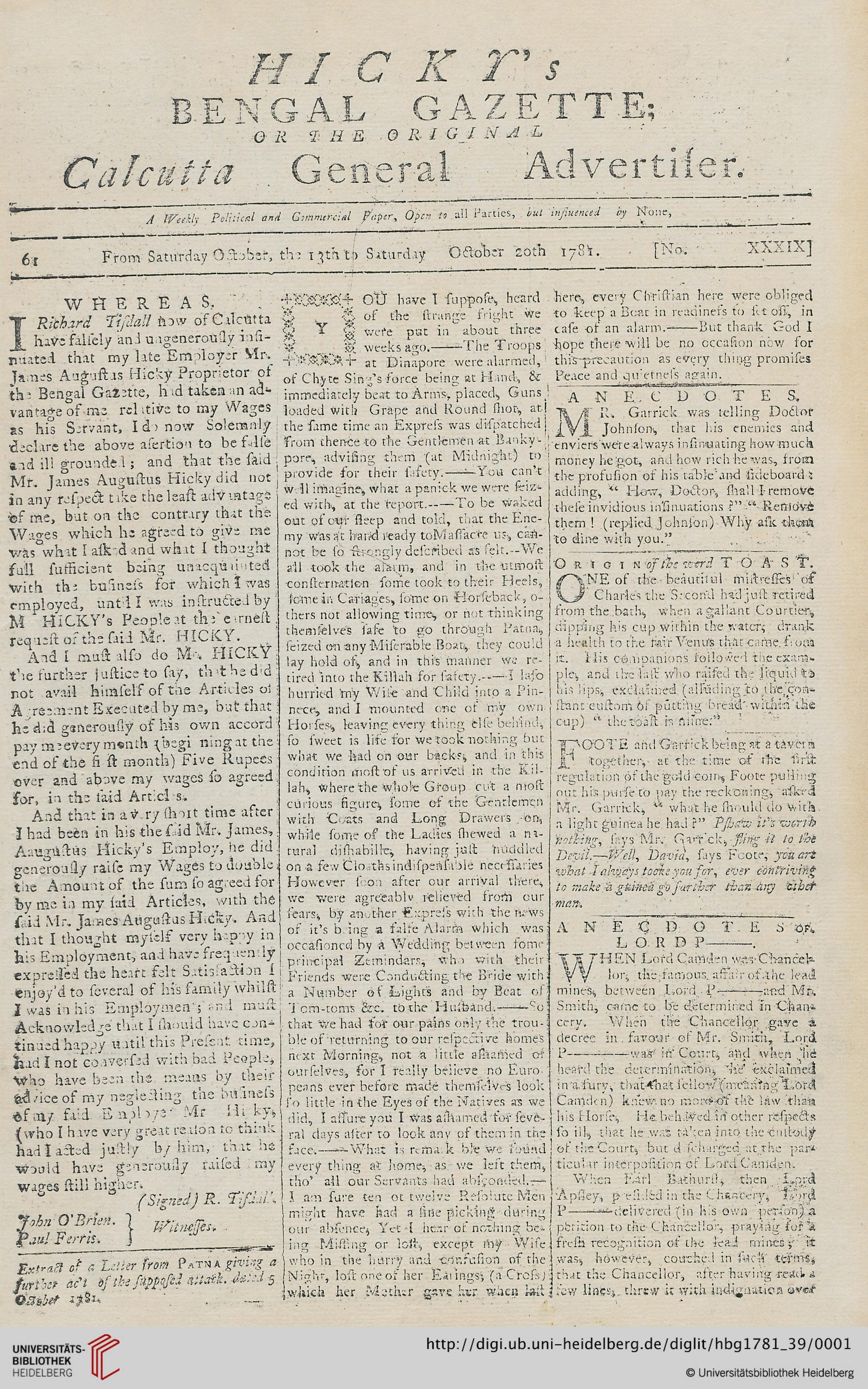
HICKY's
BENGAL GAZETTE;
OR THE ORIGINAL
Calcutta General Advertiser.
A Weekly Political and Commercial Paper, Open to all Parties, but influenced by None.
From Saturday October, the 13th to Saturday October 20th 1781. [No. XXXIX]
61
WHEREAS, I Richard Tisdall now of Calcutta have falsely and ungenerously insinuated that my late Employer Mr. James Augustus Hicky Proprietor of the Bengal Gazette, had taken an advantage of me relative to my Wages as his Servant, I do now Solemnly declare the above asertion to be false and ill grounded; and that the said Mr. James Augustus Hicky did not in any respect take the least advantage of me, but on the contrary that the Wages which he agreed to give me was what I asked and what I thought full sufficient being unacquainted with the business for which I was employed, until I was instructed by Mr. HICKY's People at the earnest request of the said Mr. HICKY.
And I must also do Mr. HICKY the further justice to say, that he did not avail himself of the Articles of Agreement Executed by me, but that he did generously of his own accord pay me every month (beginning at the end of the first month) Five Rupees over and above my wages so agreed for, in the said Articles.
And that in a very short time after I had been in his the said Mr. James, Augustus Hicky's Employ, he did generously raise my Wages to double the Amount of the sum so agreed for by me in my said Articles, with the said Mr. James Augustus Hicky. And that I thought myself very happy in his Employment, and have frequently expressed the heart felt Satisfaction I enjoy'd to several of his family whilst I was in his Employment; and must Acknowledge that I should have continued happy until this Present time, had I not conversed with bad People, who have been the means by their advice of my neglecting the business of my said Employer Mr. Hicky, (who I have very great reason to think had I acted justly by him, that he would have generously raised my wages still higher.
(Signed) R. Tisdall.
John O'Brien. } Witnesses.
Paul Ferris. }
Extract of a Letter from PATNA giving a further ac't of the supposed attack. dated 5 October 1781.
YOU have I suppose, heard of the strange fright we were put in about three weeks ago.——The Troops at Dinapore were alarmed, of Chyte Sing's force being at Hand, & immediately beat to Arms, placed, Guns loaded with Grape and Round shot, at the same time an Express was dispatched from thence to the Gentlemen at Bankypore, advising them (at Midnight) to provide for their safety.——You can't well imagine, what a panick we were seized with, at the report.——To be waked out of our sleep and told, that the Enemy was at hand ready to Massacre us, cannot be so strongly described as felt.--We all took the alarm, and in the utmost consternation some took to their Heels, some in Cariages, some on Horseback, others not allowing time, or not thinking themselves safe to go through Patna, seized on any Miserable Boat, they could lay hold of, and in this manner we retired into the Killah for safety——I also hurried my Wife and Child into a Pinnace, and I mounted one of my own Horses, leaving every thing else behind, so sweet is life for we took nothing but what we had on our backs, and in this condition most of us arrived in the Killah, where the whole Group cut a most curious figure, some of the Gentlemen with Coats and Long Drawers on, while some of the Ladies shewed a natural dishabille, having just huddled on a few Cloaths indispensable necessaries However soon after our arrival there, we were agreeably relieved from our fears, by another Express with the news of it's being a false Alarm which was occasioned by a Wedding between some principal Zemindars, who with their Friends were Conducting the Bride with a Number of Lights and by Beat of Tom-toms &c. to the Husband.——So that we had for our pains only the trouble of returning to our respective homes next Morning, not a little ashamed of ourselves, for I really believe no Europeans ever before made themselves look so little in the Eyes of the Natives as we did, I assure you I was ashamed for several days after to look any of them in the face.——What is remarkable we found every thing at home, as we left them, tho' all our Servants had absconded.— I am sure ten or twelve Resolute Men might have had a fine picking during our absence, Yet I hear of nothing being Missing or lost, except my Wife who in the hurry and confusion of the Night, lost one of her Earings; (a Cross) which her Mother gave her when last here, every Christian here were obliged to keep a Boat in readiness to set off, in case of an alarm.——But thank God I hope there will be no occasion now for this precaution as every thing promises Peace and quietness again.
ANECDOTES.
MR. Garrick was telling Doctor Johnson, that his enemies and enviers were always insinuating how much money he got, and how rich he was, from the profusion of his table and sideboard: adding, "How, Doctor, shall I remove these invidious insinuations?" "Remove them! (replied Johnson) Why ask them to dine with you."
ORIGIN of the word TOAST.
ONE of the beautiful mistresses of Charles the Second had just retired from the bath, when a gallant Courtier, dipping his cup within the water, drank a health to the fair Venus that came from it. His companions followed the example, and the last who raised the liquid to his lips, exclaimed (alluding to the constant custom of putting bread within the cup) "the toast is mine."
FOOTE and Garrick being at a tavern together, at the time of the first regulation of the gold coin, Foote pulling out his purse to pay the reckoning, asked Mr. Garrick, "what he should do with a light guinea he had?" Pshaw it's worth nothing, says Mr. Garrick, fling it to the Devil.—Well, David, says Foote, you are what I always tooke you for, ever contriving to make a guinea go farther than any other man.
ANECDOTES of LORD P——.
WHEN Lord Camden was Chancellor, the famous affair of the lead mines, between Lord P—— and Mr. Smith, came to be determined in Chancery. When the Chancellor gave a decree in favour of Mr. Smith, Lord P—— was in Court, and when he heard the determination, he exclaimed in a fury, that that fellow (meaning Lord Camden) knew no more of the law than his Horse, He behaved in other respects so ill, that he was taken into the custody of the Court, but discharged at the particular interposition of Lord Camden.
When Earl Bathurst, then Lord Apsley, presided in the Chancery, Lord P—— delivered (in his own person) a petition to the Chancellor, praying for a fresh recognition of the lead mines; it was, however, couched in such terms, that the Chancellor, after having read a few lines, threw it with indignation over
Page 2
AI transcription (Google Gemini, 2026)
[Column 1]
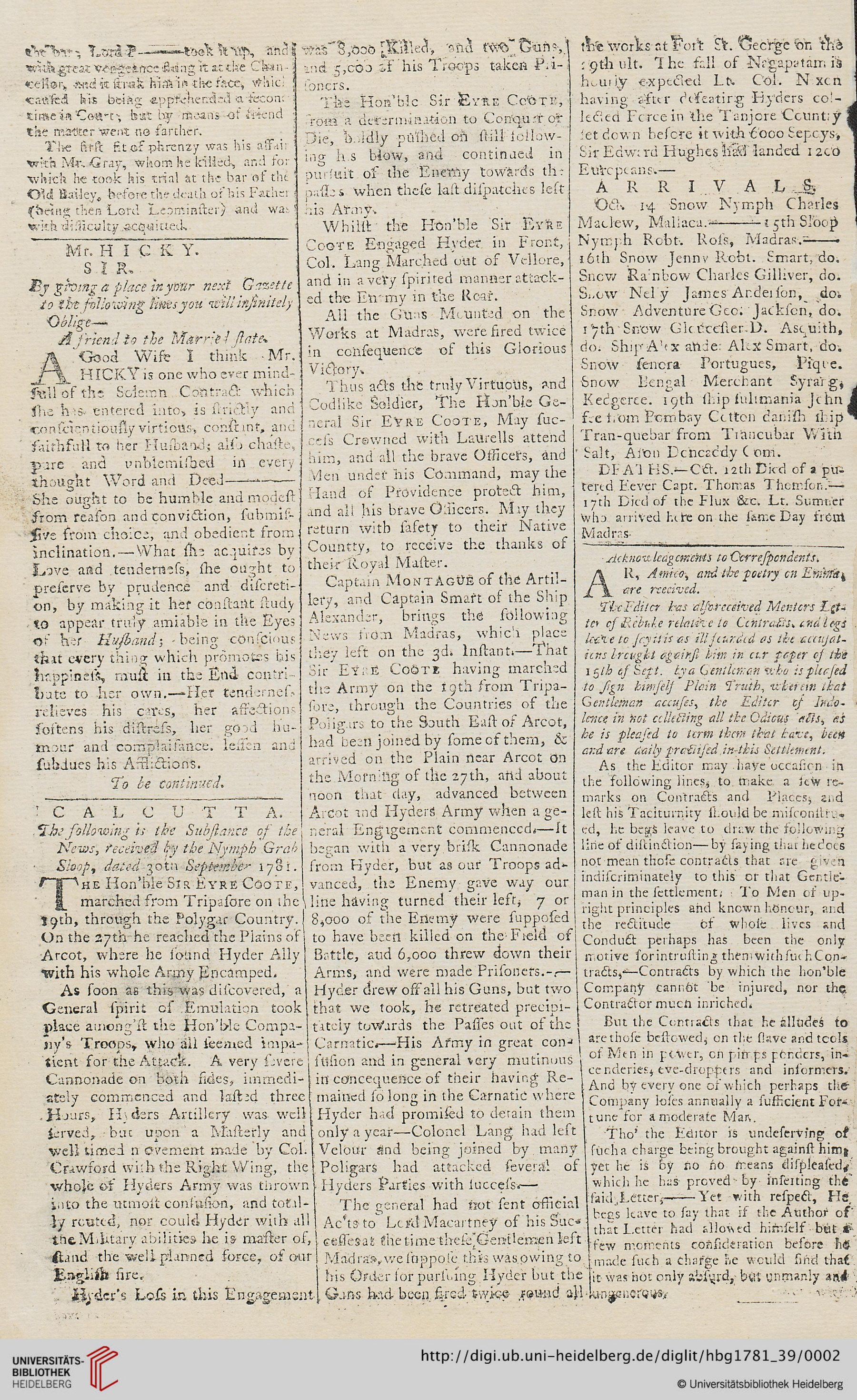
the bar, Lord P— took it up, and with great vengeance flung it at the Chancellor, and it struk him in the face, which caused his being apprehended a second time in Court, but by means of friend the matter went no farther.
The first fit of phrenzy was his affair with Mr. Gray, whom he killed, and for which he took his trial at the bar of the Old Bailey, before the death of his Father (being then Lord Leominster) and was with difficulty acquitted.
Mr. HICKY.
SIR.
By giving a place in your next Gazette to the following lines you will infinitely Oblige—
A friend to the Married state.
A Good Wife I think Mr. HICKY is one who ever mindfull of the Solemn Contract which she has entered into, is strictly and conscientiously virtious, constant, and faithfull to her Husband; also chaste, pure and unblemished in every thought Word and Deed——
She ought to be humble and modest from reason and conviction, submissive from choice, and obedient from inclination.—What she acquires by Love and tenderness, she ought to preserve by prudence and discretion, by making it her constant study to appear truly amiable in the Eyes of her Husband; being conscious that every thing which promotes his happiness, must in the End contribute to her own.—Her tenderness relieves his cares, her affections softens his distress, her good humour and complaisance, lessen and subdues his Afflictions.
To be continued.
CALCUTTA.
The following is the Substance of the News, received by the Nymph Grab Sloop, dated 30th September 1781.
THE Hon’ble SIR EYRE COOTE, marched from Tripasore on the 19th, through the Polygar Country. On the 27th he reached the Plains of Arcot, where he found Hyder Ally with his whole Army Encamped.
As soon as this was discovered, a General spirit of Emulation took place among’st the Hon’ble Company’s Troops, who all seemed impatient for the Attack. A very severe Cannonade on both sides, immediately commenced and lasted three Hours, Hyders Artillery was well served, but upon a Masterly and well timed movement made by Col. Crawford with the Right Wing, the whole of Hyders Army was thrown into the utmost confusion, and totally routed, nor could Hyder with all the Military abilities he is master of, stand the well planned force, of our English fire.
Hyder’s Loss in this Engagement was 8,000 Killed, and two Guns, and 5,000 of his Troops taken Prisoners.
[Column 2]
The Hon’ble Sir EYRE COOTE, from a determination to Conquer or Die, boldly pushed on still following his blow, and continued in pursuit of the Enemy towards the passes when these last dispatches left his Army.
Whilst the Hon’ble Sir EYRE COOTE Engaged Hyder in Front, Col. Lang Marched out of Vellore, and in a very spirited manner attacked the Enemy in the Rear.
All the Guns Mounted on the Works at Madras, were fired twice in consequence of this Glorious Victory.
Thus acts the truly Virtuous, and Godlike Soldier, The Hon’ble General Sir EYRE COOTE, May success Crowned with Laurells attend him, and all the brave Officers, and Men under his Command, may the Hand of Providence protect him, and all his brave Officers. May they return with safety to their Native Country, to receive the thanks of their Royal Master.
Captain MONTAGUE of the Artillery, and Captain Smart of the Ship Alexander, brings the following News from Madras, which place they left on the 3d. Instant.—That Sir EYRE COOTE having marched the Army on the 19th from Tripasore, through the Countries of the Poligars to the South East of Arcot, had been joined by some of them, & arrived on the Plain near Arcot on the Morning of the 27th, and about noon that day, advanced between Arcot and Hyders Army when a general Engagement commenced.—It began with a very brisk Cannonade from Hyder, but as our Troops advanced, the Enemy gave way our line having turned their left, 7 or 8,000 of the Enemy were supposed to have been killed on the Field of Battle, and 6,000 threw down their Arms, and were made Prisoners.—Hyder drew off all his Guns, but two that we took, he retreated precipitately towards the Passes out of the Carnatic.—His Army in great confusion and in general very mutinous in concequence of their having Remained so long in the Carnatic where Hyder had promised to detain them only a year—Colonel Lang had left Velour and being joined by many Poligars had attacked several of Hyders Parties with success.—
The general had not sent official Ac’ts to Lord Macartney of his Successes at the time these Gentlemen left Madras, we suppose this was owing to his Order for pursuing Hyder but the Guns had been fired twice round all the works at Fort St. George on the 29th ult. The fall of Nagapatam is hourly expected Lt. Col. Nixon having after defeating Hyders collected Force in the Tanjore County set down before it with 6000 Sepoys, Sir Edward Hughes had landed 1200 Europeans.—
[Column 3]
ARRIVALS.
Oct. 14 Snow Nymph Charles Maclew, Maliaca.—15th Sloop Nymph Robt. Ross, Madras.—16th Snow Jenny Robt. Smart, do. Snow Rainbow Charles Gilliver, do. Snow Nelly James Anderson, do. Snow Adventure Geo: Jackson, do. 17th Snow Gloucester. D. Asquith, do. Ship Alexander. Alex Smart, do. Snow senora Portugues, Pique. Snow Bengal Merchant Syrarg, Kedgeree. 19th ship sulimania John fee from Pombay Cotton danish ship Tran-quebar from Trancubar With Salt, Aron Dencaddy Com.
DEATHS.—Oct. 12th Died of a putered Eever Capt. Thomas Thomson.—17th Died of the Flux &c. Lt. Sumner who arrived here on the same Day from Madras
Acknowledgements to Correspondents.
AR, Amico, and the poetry on Emma, are received.
The Editor has also received Mentors Letter of Rebuke relative to Contracts, and legs leave to say it is as ill founded as the accusations brought against him in our paper of the 15th of Sept. by a Gentleman who is pleased to sign himself Plain Truth, wherein that Gentleman accuses, the Editor of Indolence in not collecting all the Odious acts, as he is pleased to term them that have, been and are daily practised in this Settlement.
As the Editor may have occasion in the following lines, to make a few remarks on Contracts and Places, and lest his Taciturnity should be misconstrued, he begs leave to draw the following line of distinction—by saying that he does not mean those contracts that are given indiscriminately to this or that Gentleman in the settlement. To Men of upright principles and known honour, and the rectitude of whose lives and Conduct perhaps has been the only motive for intrusting them with such Contracts,—Contracts by which the hon’ble Company cannot be injured, nor the Contractor much inriched.
But the Contracts that he alludes to are those bestowed, on the slave and tools of Men in power, on pimps ponders, incenderies, eve-droppers and informers. And by every one of which perhaps the Company loses annually a sufficient Fortune for a moderate Man.
Tho’ the Editor is undeserving of such a charge being brought against him; yet he is by no no means displeased, which he has proved by inserting the said Letter,—Yet with respect, He begs leave to say that if the Author of that Letter had allowed himself but a few moments consideration before he made such a charge he would find that it was not only absurd, but unmanly and ungenerous.
Page 3
AI transcription (Google Gemini, 2026)
He begs leave to acquaint those Gent. that no distresses that may be brought on him by a Long and illegal confinement in a filthy jail, nor the Horrors of a Dungeon! with all the united schemes of his Tyrant Enemies, Assisted by their train of informers, shall ever be able to move him from his Honourable purpose, or to un-Man him in the least.
He can safely say that in any of those situations which the Varigated Scenes of his fortune hath placed him (abstracted from his present very un-pleasing situation) he never deserved the name of an Idler. he shoud suppose that this Gentleman really ment to accuse him with pusillanimity, which from the Idea he has pictured to himself of the Editors present situation, it has taken its rise, but being delicate in sentiment he gives it a more careless and softer term,—Indolence.—However in either Case he is equally mistaken, Pusillanimity, he leaves to the Canker'd hearted; pale faced, Leering, schemeing Contractor, whose soul is absorbed in avaritious, designing study. Cursed by day, with unremitting flutterings and palpitations of the Heart,—And his nights disturbed by horrid dreams, like the frighted concious bloody Richard in Bosworth Field—who to the terror (perhaps of his delicate Lovely Wife), Starts from his bed and, in a horrid scream cries I have lost my contract! and she in the soft language of an Angel; gently rebukes him saying (my dearest love how could you fright me so).
To be Continued.
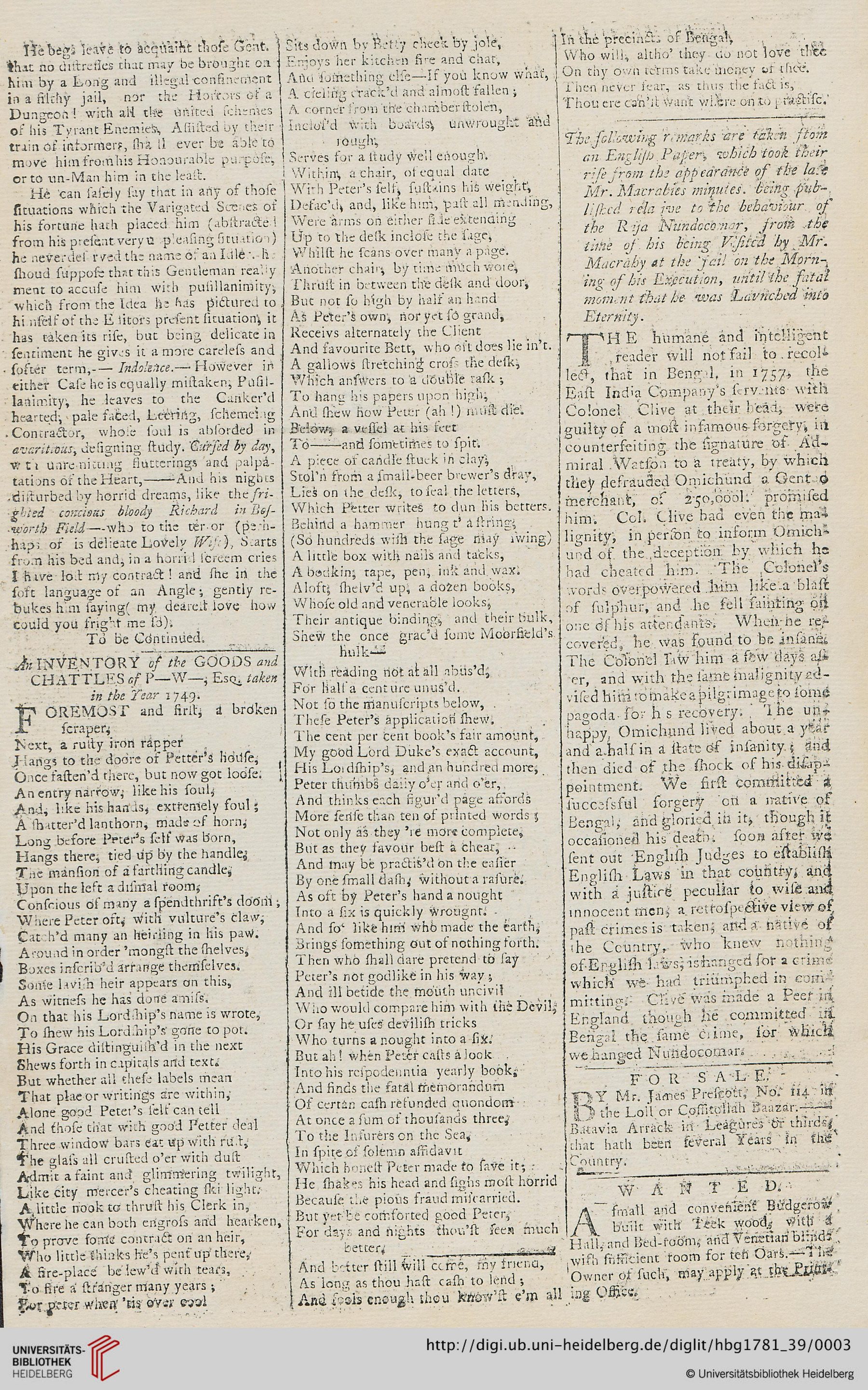
An INVENTORY of the GOODS and CHATTLES of P—W—, Esq; taken in the Year 1749.
FOREMOST and first, a broken scraper,
Next, a rusty iron rapper
Hangs to the doore of Petter's house,
Once fasten'd there, but now got loose.
An entry narrow, like his soul,
And, like his hands, extremely foul;
A shatter'd lanthorn, made of horn,
Long before Peter's self was born,
Hangs there, tied up by the handle,
The mansion of a farthing candle,
Upon the left a dismal room,
Conscious of many a spendthrift's doom;
Where Peter oft, with vulture's claw,
Catch'd many an heirling in his paw.
Around in order 'mongst the shelves,
Boxes inscrib'd arrange themselves.
Some lavish heir appears on this,
As witness he has done amiss.
On that his Lordship's name is wrote,
To shew his Lordship's gone to pot.
His Grace distinguish'd in the next
Shews forth in capitals and text,
But whether all these labels mean
That plac- or writings are within,
Alone good Peter's self can tell
And those that with good Petter deal
Three window bars eat up with rust,
The glass all crusted o'er with dust
Admit a faint and glimmering twilight,
Like city mercer's cheating ski light,
A little nook to thrust his Clerk in,
Where he can both engross and hearken,
To prove some contract on an heir,
Who little thinks he's pent up there,
A fire-place be-dew'd with tears,
To fire a stranger many years;
For peter when 'tis over cool
Sits down by Betty cheek by jole,
Enjoys her kitchen fire and chat,
And something else—If you know what,
A cieling crack'd and almost fallen;
A corner from the chamber stolen,
Inclos'd with boards, unwrought and rough,
Serves for a study well enough.
Within, a chair, of equal date
With Peter's self; sustains his weight,
Defac'd, and, like him, past all mending,
Where arms on either side extending
Up to the desk inclose the sage,
Whilst he scans over many a page.
Another chair, by time much wore,
Thrust in between the desk and door,
But not so high by half an hand
As Peter's own, nor yet so grand,
Receivs alternately the Client
And favourite Bett, who oft does lie in't.
A gallows stretching cross the desk,
Which answers to a double task;
To hang his papers upon high,
And shew how Peter (ah!) must die.
Below, a vessel at his feet
To—; and sometimes to spit.
A piece of candle stuck in clay,
Stol'n from a small-beer brewer's dray,
Lies on the desk, to seal the letters,
Which Petter writes to dun his betters.
Behind a hammer hung t' a string,
(So hundreds wish the sage may swing)
A little box with nails and tacks,
A bodkin, tape, pen, ink and wax.
Aloft, shelv'd up, a dozen books,
Whose old and venerable looks,
Their antique bindings and their bulk,
Shew the once grac'd some Moorfield's hulk—
With reading not at all abus'd,
For half a centure unus'd.
Not so the manuscripts below,
These Peter's application shew.
The cent per cent book's fair amount,
My good Lord Duke's exact account,
His Lordship's, and an hundred more,
Peter thumbs daily o'er and o'er,
And thinks each figur'd page affords
More sense than ten of printed words;
Not only as they 're more complete,
But as they favour best a cheat,
And may be practis'd on the easier
By one small dash, without a rasure.
As oft by Peter's hand a nought
Into a six is quickly wrought.
And so, like him who made the earth,
Brings something out of nothing forth.
Then who shall dare pretend to say
Peter's not godlike in his way;
And ill betide the mouth uncivil
Who would compare him with the Devil,
Or say he uses devilish tricks
Who turns a nought into a six.
But ah! when Peter casts a look
Into his respodentia yearly book,
And finds the fatal memorandum
Of certan cash refunded quondam
At once a sum of thousands three,
To the Insurers on the Sea,
In spite of solemn affidavit
Which honest Peter made to save it;
He shakes his head and sighs most horrid
Because the pious fraud miscarried.
But yet be comforted good Peter,
For days and nights thou'st seen much better,
And better still will come, my friend,
As long as thou hast cash to lend;
And fools enough thou know'st e'm all
In the precincts of Bengal,
Who will, altho' they do not love thee
On thy own terms take money of thee.
Then never fear, as thus the fact is,
Thou ere can't want where on to practise.
The following remarks are taken from an English Paper, which took their rise from the appearance of the late Mr. Macrabies minutes, being published relative to the behaviour of the Raja Nundocomar, from the time of his being Visited by Mr. Macraby at the Jail on the Morning of his Execution, until the fatal moment that he was Launched into Eternity.
THE humane and intelligent reader will not fail to recollect, that in Bengal, in 1757, the East India Company's servants with Colonel Clive at their head, were guilty of a most infamous forgery, in counterfeiting the signature of Admiral Watson to a treaty, by which they defrauded Omichund a Gentoo merchant, of 250,000l. promised him. Col. Clive had even the malignity, in person to inform Omichund of the deception by which he had cheated him. The Colonel's words overpowered him like a blast of sulphur, and he fell fainting on one of his attendants. When he recovered, he was found to be insane. The Colonel saw him a few days after, and with the same malignity advised him to make a pilgrimage to some pagoda for his recovery. The unhappy, Omichund lived about a year and a half in a state of insanity; and then died of the shock of his disappointment. We first committed a successful forgery on a native of Bengal, and gloried in it, though it occasioned his death. soon after we sent out English Judges to establish English Laws in that country, and with a justice peculiar to wise and innocent men, a retrospective view of past crimes is taken, and a native of the Country, who knew nothing of English laws, is hanged for a crime which we had triumphed in committing. Clive was made a Peer in England though he committed in Bengal the same crime, for which we hanged Nundocomar.
FOR SALE
BY Mr. James Prescott, No. 114 in the Loll or Cossitollah Baazar.— Batavia Arrack in Leagures or thirds, that hath been several Years in the Country.
WANTED.
A small and convenient Budgerow built with Teek wood, with a Hall, and Bed-room, and Venetian blinds, with sufficient room for ten Oars.—The Owner of such, may apply at the Printing Office.
Page 4
AI transcription (Google Gemini, 2026)
Continued from our Last.
VOL. II. Pages 465 and 466.—
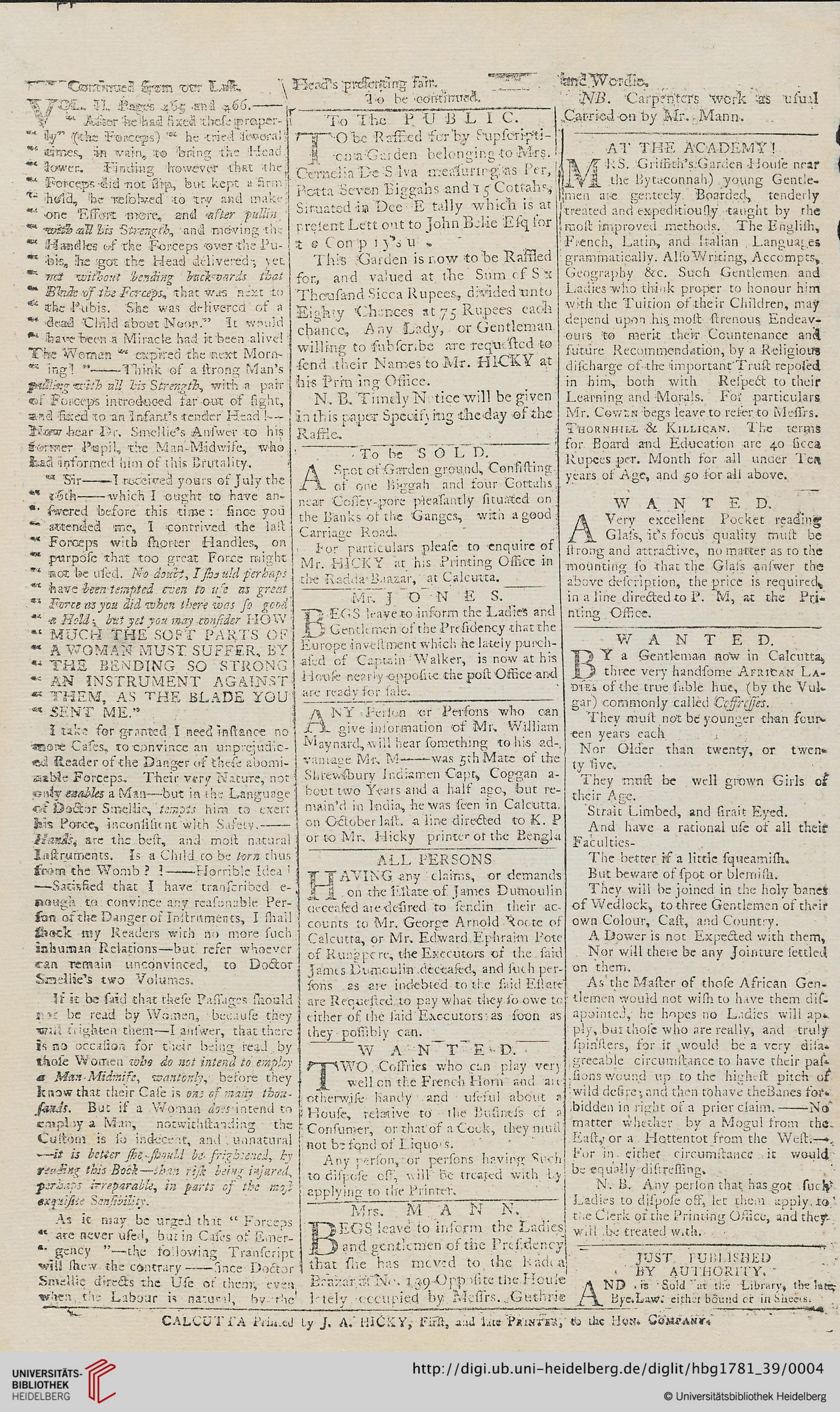
“ After he had fixed these properly” (the Forceps) “ he tried several times, in vain, to bring the Head lower. Finding however that the Forceps did not slip, but kept a firm hold, he resolved to try and make one Effort more, and after pulling with all his Strength, and moving the Handles of the Forceps over the Pubis, he got the Head delivered; yet not without bending backwards that Blade of the Forceps, that was next to the Pubis. She was delivered of a dead Child about Noon.” It would have been a Miracle had it been alive! The Woman “ expired the next Morning!”—Think of a strong Man’s pulling with all his Strength, with a pair of Forceps introduced far out of sight, and fixed to an Infant’s tender Head !—Now hear Dr. Smellie’s Answer to his former Pupil, the Man-Midwife, who had informed him of this Brutality.
“ Sir—I received yours of July the 16th—which I ought to have answered before this time: since you attended me, I contrived the last Forceps with shorter Handles, on purpose that too great Force might not be used. No doubt, I should perhaps have been tempted even to use as great Force as you did when there was so good a Hold; but yet you may consider HOW MUCH THE SOFT PARTS OF A WOMAN MUST SUFFER, BY THE BENDING SO STRONG AN INSTRUMENT AGAINST THEM, AS THE BLADE YOU SENT ME.”
I take for granted I need instance no more Cases, to convince an unprejudiced Reader of the Danger of these abominable Forceps. Their very Nature, not only enables a Man—but in the Language of Doctor Smellie, tempts him to exert his Force, inconsistent with Safety.—Hands, are the best, and most natural Instruments. Is a Child to be torn thus from the Womb? !—Horrible Idea !—Satisfied that I have transcribed enough to convince any reasonable Person of the Danger of Instruments, I shall shock my Readers with no more such inhuman Relations—but refer whoever can remain unconvinced, to Doctor Smellie’s two Volumes.
If it be said that these Passages should not be read by Women, because they will frighten them—I answer, that there is no occasion for their being read by those Women who do not intend to employ a Man-Midwife, wantonly, before they know that their Case is one of many thousands. But if a Woman does intend to employ a Man, notwithstanding the Custom is so indecent, and unnatural—it is better she should be frightened, by reading this Book—than risk being injured, perhaps irreparable, in parts of the most exquisite Sensibility.
As it may be urged that “ Forceps are never used, but in Cases of Emergency ”—the following Transcript will shew the contrary—since Doctor Smellie directs the Use of them, even when the Labour is natural, by the Head’s presenting fair.
To be continued.
To The PUBLIC.
TO be Raffled for by Subscription a Garden belonging to Mrs. Cornelia De Silva measuring as Per, Potta Seven Biggahs and 15 Cottahs, Situated in Dee E tally which is at present Lett out to John Belie Esq for t e C o m p’ y s u .
This Garden is now to be Raffled for, and valued at the Sum of Six Thousand Sicca Rupees, divided into Eighty Chances at 75 Rupees each chance, Any Lady, or Gentleman willing to subscribe are requested to send their Names to Mr. HICKY at his Printing Office.
N. B. Timely Notice will be given in this paper Specifying the day of the Raffle.
To be SOLD.
A Spot of Garden ground, Consisting of one Biggah and four Cottahs near Cossey-pore pleasantly situated on the Banks of the Ganges, with a good Carriage Road.
For particulars please to enquire of Mr. HICKY at his Printing Office in the Radda Baazar, at Calcutta.
Mr. J O N E S.
BEGS leave to inform the Ladies and Gentlemen of the Presidency that the Europe investment which he lately purchased of Captain Walker, is now at his House nearly opposite the post Office and are ready for sale.
ANY Person or Persons who can give information of Mr. William Maynard, will hear something to his advantage Mr. M—was 5th Mate of the Shrewsbury Indiamen Capt, Coggan about two Years and a half ago, but remain’d in India, he was seen in Calcutta on October last. a line directed to K. P. or to Mr. Hicky printer of the Bengla
ALL PERSONS
HAVING any claims, or demands on the Estate of James Dumoulin deceased are desired to send in their accounts to Mr. George Arnold Roote of Calcutta, or Mr. Edward Ephraim Pote of Rungpore, the Executors of the said James Dumoulin deceased, and such persons as are indebted to the said Estate are Requested to pay what they so owe to either of the said Executors as soon as they possibly can.
WANTED.
TWO Coffries who can play very well on the French Horn and are otherwise handy and useful about a House, relative to the Business of a Consumner, or that of a Cook, they must not be fond of Liquors.
Any person, or persons having Such to dispose off, will be treated with by applying to the Printer.
Mrs. M A N N.
BEGS leave to inform the Ladies and gentlemen of the Presidency that she has moved to the Radda Baazar at No. 139 Opposite the House lately occupied by Messrs. Guthrie and Wordie.
N. B. Carpenters work as usual Carried on by Mr. Mann.
AT THE ACADEMY!
MRS. Griffith’s Garden House near the Bytaconnah) young Gentlemen are genteely Boarded, tenderly treated and expeditiously taught by the most improved methods. The English, French, Latin, and Italian Languages grammatically. Also Writing, Accompts, Geography &c. Such Gentlemen and Ladies who think proper to honour him with the Tuition of their Children, may depend upon his most strenous Endeavours to merit their Countenance and future Recommendation, by a Religious discharge of the important Trust reposed in him, both with Respect to their Learning and Morals. For particulars Mr. COWEN begs leave to refer to Messrs. THORNHILL & KILLICAN. The terms for Board and Education are 40 sicca Rupees per. Month for all under Ten years of Age, and 50 for all above.
WANTED.
A Very excellent Pocket reading Glass, it’s focus quality must be strong and attractive, no matter as to the mounting so that the Glass answer the above description, the price is required, in a line directed to P. M, at the Printing Office.
WANTED.
BY a Gentleman now in Calcutta, three very handsome AFRICAN LADIES of the true sable hue, (by the Vulgar) commonly called Coffresses.
They must not be younger than fourteen years each
Nor Older than twenty, or twenty five.
They must be well grown Girls of their Age.
Strait Limbed, and strait Eyed.
And have a rational use of all their Faculties.—
The better if a little squeamish.
But beware of spot or blemish.
They will be joined in the holy banes of Wedlock, to three Gentlemen of their own Colour, Cast, and Country.
A Dower is not Expected with them,
Nor will there be any Jointure settled on them.
As the Master of those African Gentlemen would not wish to have them disappointed, he hopes no Ladies will apply, but those who are really, and truly spinsters, for it would be a very disagreeable circumstance to have their passions wound up to the highest pitch of wild desire; and then to have the Banes forbidden in right of a prior claim.—No matter whether by a Mogul from the East, or a Hottentot from the West.—For in either circumstance it would be equally distressing.
N. B. Any person that has got such Ladies to dispose off, let them apply to the Clerk of the Printing Office, and they will be treated with.
JUST PUBLISHED
BY AUTHORITY.
AND is Sold at the Library, the late Bye.Law. either bound or in Sheets.
CALCUTTA Printed by J. A. HICKY, First, and late PRINTER, to the HON. COMPANY.