Browse › 1781
Saturday 28 July 1781
Page 1
AI transcription (Google Gemini, 2026)
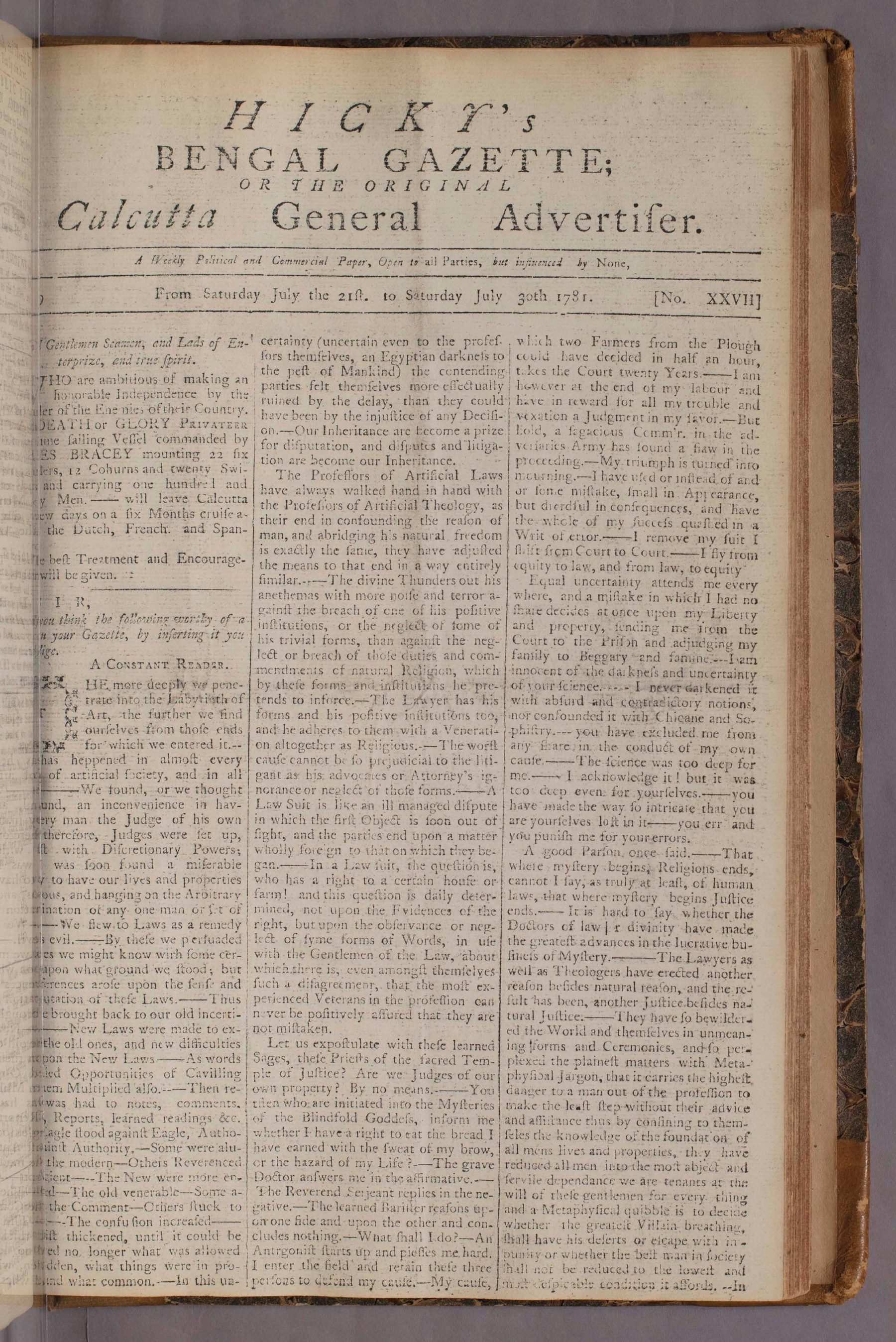
HICKY's
BENGAL GAZETTE;
OR THE ORIGINAL
Calcutta General Advertiser.
———————————————————————————————————————————————————————
A Weekly Political and Commercial Paper, Open to all Parties, but influenced by None,
———————————————————————————————————————————————————————
79 From Saturday July the 21st. to Saturday July 28th 1781. [No. XXVII]
———————————————————————————————————————————————————————
To all Gentlemen Seamen, and Lads of Enterprize, and true spirit.
WHO are ambitious of making an honorable Independence by the Plunder of the Enemies of their Country. The DEATH or GLORY PRIVATEER a Prime sailing Vessel commanded by JAMES BRACEY mounting 22 six pounders, 12 Cohurns and twenty Swivels and carrying one hundred and twenty Men.—will leave Calcutta in a few days on a six Months cruise against the Dutch, French. and Spaniards.
The best Treatment and Encouragement will be given.
—————————————————————
S I R,
If you think the following worthy of a place in your Gazette, by inserting it you will oblige.
A CONSTANT READER.
THE more deeply we penetrate into the Labyrinth of Art, the further we find ourselves from those ends for which we entered it.—This has heppened in almost every species of artificial society, and in all times.—We found, or we thought we found, an inconvenience in having every man the Judge of his own cause, therefore, Judges were set up, at first with Discretionary Powers; but it was soon found a misetable Slavery to have our lives and properties precarious, and hanging on the Arbitrary determination of any one man or set of men.—We flew to Laws as a remedy for this evil.—By these we persuaded ourselves we might know wirh some certainty upon what ground we stood; but lo, differences arose upon the sense and interpputation of these Laws.—Thus were we brought back to our old incertitude.—New Laws were made to expound the old ones, and new difficulties arose upon the New Laws—As words multiplied Opportunities of Cavilling upon them Multiplied also.—Then recourse was had to notes, comments, Glosses, Reports, learned readings &c. &c.—Eagle stood against Eagle, Authority against Authority.—Some were alured by the modern—Others Reverenced the Ancient—The New were more enlightened—The old venerable—Some adopted the Comment—Others stuck to the text—The confusion increased—The mist thickened, until it could be discovered no longer what was allowed or forbidden, what things were in property, and what common.—In this uncertainty (uncertain even to the professors themselves, an Egyptian darkness to the pest of Mankind) the contending parties felt themselves more effectually ruined by the delay, than they could have been by the injustice of any Decision.—Our Inheritance are become a prize for disputation, and disputes and litigation are become our Inheritance.
The Professors of Artificial Laws have always walked hand in hand with the Professors of Artificial Theology, as their end in confounding the reason of man, and abridging his natural freedom is exactly the same, they have adjusted the means to that end in a way entirely similar.—The divine Thunders out his anethemas with more noise and terror against the breach of one of his positive institutions, or the neglect of some of his trivial forms, than against the neglect or breach of those duties and commandments of natural Religion, which by these forms and institutions he pretends to inforce.—The Lawyer has his forms and his positive institutions too, and he adheres to them with a Veneration altogether as Religious.—The worst cause cannot be so prejudicial to the litigant as his advocates or Attorney's ignorance or neglect of those forms.—A Law Suit is like an ill managed dispute in which the first Object is soon out of sight, and the parties end upon a matter wholly foreign to that on which they began.—In a Law suit, the question is, who has a right to a certain house or farm! and this question is daily determined, not upon the Evidences of the right, but upon the observance or neglect of fyme forms of Words, in use with the Gentlemen of the Law, about which there is, even amongst themselves such a disagreement, that the most experienced Veterans in the profession can never be positively assured that they are not mistaken.
Let us expostulate with these learned Sages, these Priests of the sacred Temple of Justice? Are we Judges of our own property? By no means.—You tften who are initiated into the Mysteries of the Blindfold Goddess, inform me whether I have a right to eat the bread I have earned with the sweat of my brow, or the hazard of my Life?—The grave Doctor answers me in the affirmative.—The Reverend Serjeant replies in the negative.—The learned Barister reasons upon one side and upon the other and concludes nothing.—Wnat shall I do?—An Antrgoniist starts up and piesses me hard. I enter the field and retain these three perfors to defend my caule.—My cause, which two Farmers from the Plough could have decided in half an hour, takes the Court twenty Years.—I am however at the end of my labour and have in reward for all my trouble and vexation a Judgment in my favor.—But hold, a sagacious Comm'r. in the adversaries Army has found a fiaw in the proceeding.—My triumph is turned into mourning.—I have used or instead of and or some mistake, small in Appearance, but dyerdful in consequences, and have the whole of my success quashed in a Writ of ernor.—I remove my suit I shift from Court to Court.—I fly from equity to law, and from law, to equity Equal uncertainty attends me every where, and a mistake in which I had no share decides at once upon my Liberty and property, sending me from the Court to the Prison and adjudging my family to Beggary and famine.—I am innocent of the darkness and uncertainty of your science.—I never darkened it with absurd and contradictory notions, nor confounded it with Chicane and Sophistry.—you have excluded me from any share in the conduct of my own cause.—The science was too deep for me.—I acknowledge it! but it was too deep even for yourselves.—you have made the way so intricate that you are yourselves lost in it—you err and you punish me for your errors.
A good Parson once said.—That where mystery begins, Religions ends, cannot I say, as truly at least, of human laws, that where mystery begins Justice ends.—It is hard to say whether the Doctors of law or divinity have made the greatest advances in the lucrative business of Mystery.—The Lawyers as well as Theologers have erected another reason besides natural reason, and the result has been, another Justice besides natural Justice.—They have so bewildered the World and themselves in unmeaning forms and Ceremonies, and so perplexed the plainest matters with Metaphysioal Jargon, that it carries the highest danger to a man out of the profession to make the least step without their advice and assistance thus by confining to themseles the knowledge of the foundation of all mens lives and properties, they have reduced all men into the most abject and servile dependance we are tenants at the will of these gentlemen for every thing and a Metaphysical quibble is to decide whether the greatest Villain breathing, shall have his deserts or escape with inpunity or whether the best man in society shall not be reduced to the lowest and most despicable condition it affords.—
Page 2
AI transcription (Google Gemini, 2026)
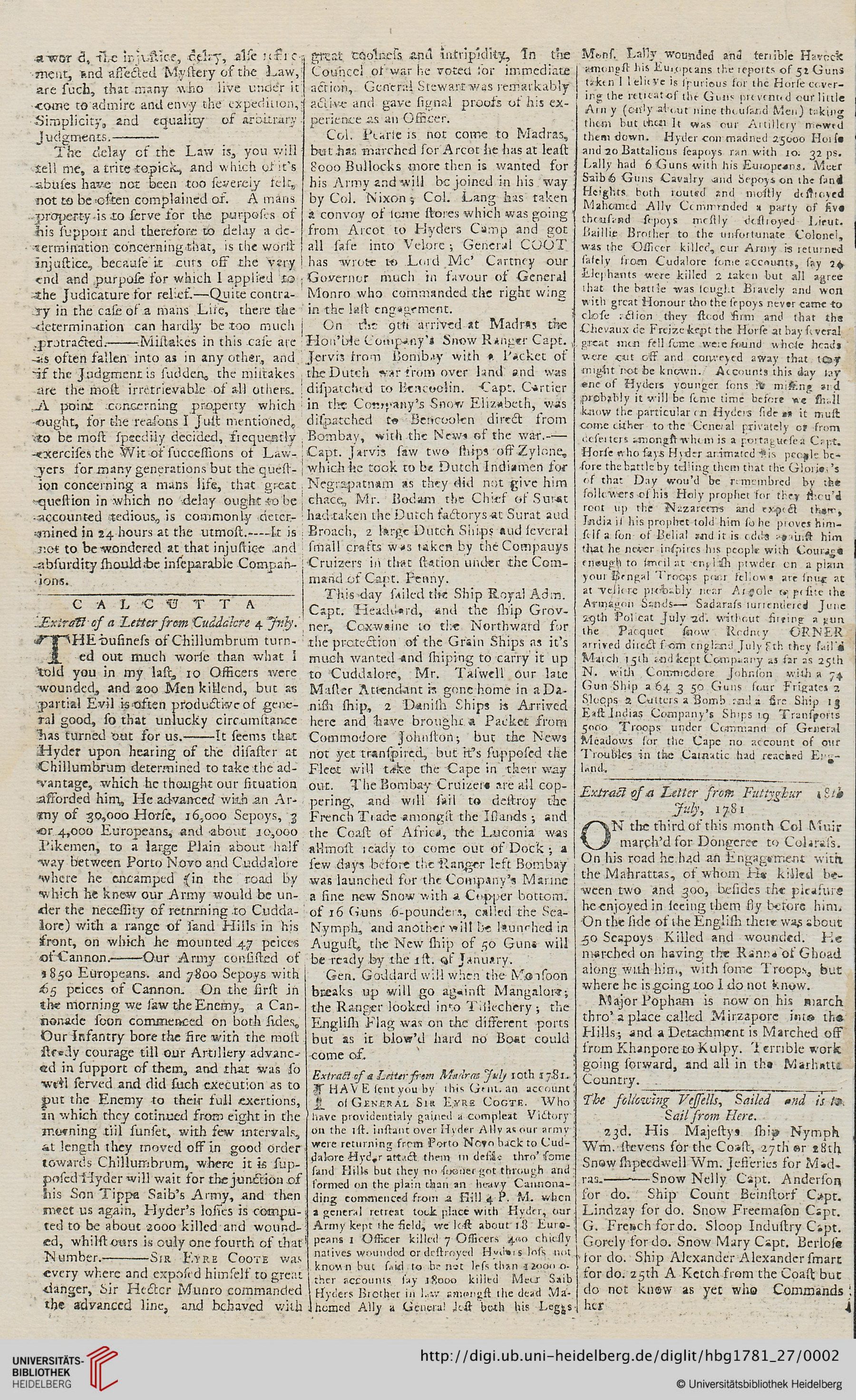
a word, the injustice, delay, assessment, and affected Mystery of the Law, are such, that many who live under it come to admire and envy the expedition, Simplicity, and equality of arbitrary Judgments.
The delay of the Law is, you will tell me, a trite topick, and which of it's abuses have not been too severely felt, not to be often complained of. A mans property is to serve for the purposes of his support and therefore to delay a determination concerning that, is the worst injustice, because it cuts off the very end and purpose for which I applied to the Judicature for relief.—Quite contrary in the case of a mans Life, there the determination can hardly be too much protracted.—Mistakes in this case are as often fallen into as in any other, and if the Judgment is sudden, the mistakes are the most irretrievable of all others. A point concerning property which ought, for the reasons I just mentioned, to be most speedily decided, frequently exercises the Wit of successions of Lawyers for many generations but the question concerning a mans life, that great question in which no delay ought to be accounted tedious, is commonly determined in 24 hours at the utmost.—It is not to be wondered at that injustice and absurdity should be inseparable Companions.
C A L C U T T A
Extract of a Letter from Cuddalore 4 July.
THE business of Chillumbrum turned out much worse than what I told you in my last, 10 Officers were wounded, and 200 Men killend, but as partial Evil is often productive of general good, so that unlucky circumstance has turned out for us.—It seems that Hyder upon hearing of the disaster at Chillumbrum determined to take the advantage, which he thought our situation afforded him, He advanced with an Army of 30,000 Horse, 16,000 Sepoys, 3 or 4,000 Europeans, and about 10,000 Pikemen, to a large Plain about half way between Porto Novo and Cuddalore where he encamped (in the road by which he knew our Army would be under the necessity of returning to Cuddalore) with a range of sand Hills in his front, on which he mounted 47 peices of Cannon.—Our Army consisted of 1850 Europeans. and 7800 Sepoys with 65 peices of Cannon. On the first in the morning we saw the Enemy, a Cannonade soon commenced on both sides, Our Infantry bore the fire with the most steady courage till our Artillery advanced in support of them, and that was so well served and did such execution as to put the Enemy to their full exertions, in which they cotinued from eight in the morning till sunset, with few intervals, at length they moved off in good order towards Chillumbrum, where it is supposed Hyder will wait for the junction of his Son Tippa Saib's Army, and then meet us again, Hyder's losses is computed to be about 2000 killed and wounded, whilst ours is only one fourth of that Number.—SIR EYRE COOTE was every where and exposed himself to great danger, Sir Hector Munro commanded the advanced line, and behaved with
great coolness and intripidity, In the Council of war he voted for immediate action, General Stewart was remarkably active and gave signal proofs of his experience as an Officer.
Col. Pearle is not come to Madras, but has marched for Arcot he has at least 8000 Bullocks more then is wanted for his Army and will be joined in his way by Col. Nixon; Col. Lang has taken a convoy of some stores which was going from Arcot to Hyders Camp and got all safe into Velore; General COOT has wrote to Lord Mc' Cartney our Governor much in favour of General Monro who commanded the right wing in the last engagement.
On the 9th arrived at Madras the Hon'ble Company's Snow Ranger Capt. Jervis from Bombay with a Packet of the Dutch war from over land and was dispatched to Bencoolin. Capt. Cartier in the Company's Snow Elizabeth, was dispatched to Bencoolen direct from Bombay, with the News of the war.—Capt. Jarvis saw two ships off Zylone, which he took to be Dutch Indiamen for Negrapatnam as they did not give him chace, Mr. Bodam the Chief of Surat had taken the Dutch factorys at Surat and Broach, 2 large Dutch Ships and several small crafts was taken by the Companys Cruizers in that station under the Command of Capt. Penny.
This day sailed the Ship Royal Adm. Capt. Huddard, and the ship Grovner, Coxwaine to the Northward for the protection of the Grain Ships as it's much wanted and shiping to carry it up to Cuddalore, Mr. Taswell our late Master Attendant is gone home in a Danish ship, 2 Danish Ships is Arrived here and have brought a Packet from Commodore Johnston; but the News not yet transpired, but it's supposed the Fleet will take the Cape in their way out. The Bombay Cruizers are all coppering, and will sail to destroy the French Trade amongst the Islands; and the Coast of Africa, the Luconia was allmost ready to come out of Dock; a few days before the Ranger left Bombay was launched for the Company's Marine a fine new Snow with a Copper bottom. of 16 Guns 6-pounders, called the Sea-Nymph, and another will be launched in August, the New ship of 50 Guns will be ready by the 1st. of January.
Gen. Goddard will when the Monsoon breaks up will go against Mangalore; the Ranger looked into Tillechery; the English Flag was on the different ports but as it blow'd hard no Boat could come of.
Extract of a Letter from Madras July 10th 1781.
I HAVE sent you by this Gent. an account of GENERAL SIR EYRE COOTE. Who have providentialy gained a compleat Victory on the 1st. instant over Hyder Ally as our army were returning from Porto Novo back to Cuddalore Hyder attack them in defile thro' some sand Hills but they no sooner got through and formed on the plain than an heavy Cannonading commenced from 2 till 4 P. M. when a general retreat took place with Hyder, our Army kept the field, we lost about 18 Europeans 1 Officer killed 7 Officers 400 chiefly natives wounded or destroyed Hyders loss not known but said to be not less than 2000 other accounts say 18000 killed Meer Saib Hyders Brother in law amongst the dead Mahomed Ally a General lost both his Leggs
Mons. Lally wounded and terrible Havock amongst his Europeans the reports of 52 Guns taken I believe is spurious for the Horse covering the retreat of the Guns prevented our little Army (only about nine thousand Men) taking them but then It was our Artillery mewed them down. Hyder commanded 25000 Horse and 20 Battalious seapoys ran with 10. 32 ps. Lally had 6 Guns with his Europeans. Meer Saib 6 Guns Cavalry and Sepoys on the sand Heights both routed and mostly destroyed Mahomed Ally Commanded a party of five thousand sepoys mostly destroyed Lieut. Baillie Brother to the unfortunate Colonel, was the Officer killed, our Army is returned safely from Cudalore some accounts, say 24 Elephants were killed 2 taken but all agree that the battle was fought Bravely and won with great Honour tho the sepoys never came to close action they stood firm and that the Chevaux de Freize kept the Horse at bay several great men fell some were found whose heads were cut off and conveyed away that they might not be known. Accounts this day say one of Hyders younger sons is missing and probably it will be some time before we shall know the particular on Hyders side as it must come either to the General privately or from deserters amongst whom is a portaguefe a Capt. Horse who says Hyder animated his people before the battle by telling them that the Glories of that Day wou'd be remembred by the followers of his Holy prophet for they shou'd root up the Nazareens and expect them, India is his prophet told him so he proves himself a son of Belial and it is odds against him that he never inspires his people with Courage enough to smell at english powder on a plain your Bengal Troops poor fellows are snug at at vellore probably near Argole to pester the Armagon Sands— Sadarass surrendered June 29th Policat July 2d. without fireing a gun the Pacquet snow Rodney ORNER arrived direct from england July 8th they sail'd March 15th and kept Company as far as 25th N. with Commodore Johnson with a 74 Gun Ship a 64 3 50 Guns four Frigates 2 Sloops 2 Cutters a Bomb and a fire Ship 13 East Indias Company's Ships 19 Transports 5000 Troops under Command of General Meadows for the Cape no account of our Troubles in the Carnatic had reached England.
Extract of a Letter from Futtyghur 18th July, 1781
ON the third of this month Col Muir march'd for Dongeree to Colarass. On his road he had an Engagement with the Mahrattas, of whom He killed between two and 300, besides the pleasure he enjoyed in seeing them fly before him. On the side of the English there was about 50 Seapoys Killed and wounded. He marched on having the Ranna of Ghoad along with him, with some Troops, but where he is going too I do not know.
Major Popham is now on his march thro' a place called Mirzapore into the Hills; and a Detachment is Marched off from Khanpore to Kulpy. Terrible work going forward, and all in the Marhatta Country.
The following Vessels, Sailed and is to Sail from Here.
23d. His Majestys ship Nymph Wm. stevens for the Coast, 27th or 28th Snow shpeedwell Wm. Jefferies for Madras.—Snow Nelly Capt. Anderson for do. Ship Count Beinstorf Capt. Lindzay for do. Snow Freemason Capt. G. French for do. Sloop Industry Capt. Gorely for do. Snow Mary Capt. Berlose for do. Ship Alexander Alexander smart for do. 25th A Ketch from the Coast but do not know as yet who Commands her
Page 3
AI transcription (Google Gemini, 2026)
On the BIRTH-DAY of Miss W—m
CELESTIAL Nine! assist my lay,
With all your native fire;
To sing fair Emma's natal day,
My humble muse inspire.
Tis now just eighteen years ago,
Since the sweet maid was born;
Since kind Heav'n did her bestow,
AFRIC's Isle to adorn.
Hail July! secure of lasting fame,
Doubly mark'd thro the year;
In Rome a Hero stampt thy name,
A Gem in afric' rare,
With every charm, with every grace,
Kind nature Cou'd bestow;
Through out her lovely mind and face,
Resplendent beauties glow.
As in the spring, some opning flowr.
Her presence gives delight;
Which day by day, and hour by hour,
Reveals new Charms to sight.
Let all her num'rous sighing swains,
Devote this day to mirth,
Let all the soft melodious strains.
Commemorate her birth,
Long may she live. sweet matchless fair.
with full contentment blest;
O!—never may one moments care,
Disturb her tender breast.
May e'er unspotted be her fame,
May She remain this life the same
Unchanged in all—except in name,
Were I with the lovely charmer blest
By every pow'r I swear;
Of heaven I should be possest,
And free from evey care.
Elysium, 22 July. J. DURGEE
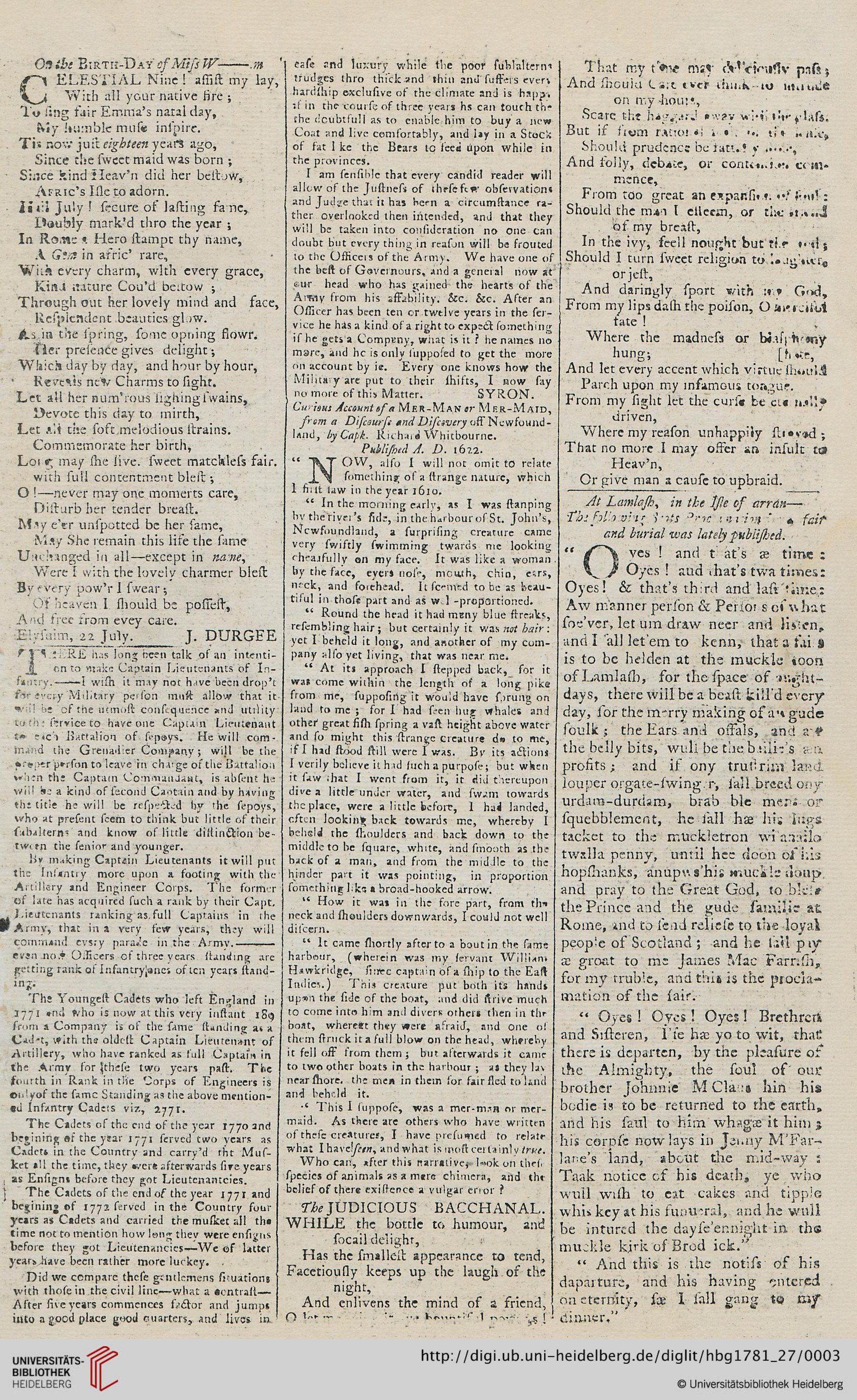
THERE has long been talk of an intention to make Captain Lieutenants of Infantry.—I wish it may not have been drop't for every Military person must allow that it will be of the utmost consequence and utility to the service to have one Captain Lieutenant to each Battalion of sepoys. He will command the Grenadier Company; will be the proper person to leave in charge of the Battalion when the Captain Commandant, is absent he will be a kind of second Captain and by having the title he will be respected by the sepoys, who at present seem to think but little of their subalterns and know of little distinction between the senior and younger.
By making Captain Lieutenants it will put the Infantry more upon a footing with the Artillery and Engineer Corps. The former of late has acquired such a rank by their Capt. Lieutenants ranking as full Captains in the Army, that in a very few years, they will command every parade in the Army.—even now Officers of three years standing are getting rank of Infantry ones of ten years standing.
The Youngest Cadets who left England in 1771 and who is now at this very instant 189 from a Company is of the same standing as a Cadet, with the oldest Captain Lieutenant of Artillery, who have ranked as full Captain in the Army for these two years past. The fourth in Rank in the Corps of Engineers is only of the same Standing as the above mentioned Infantry Cadets viz, 1771.
The Cadets of the end of the year 1770 and begining of the year 1771 served two years as Cadets in the Country and carry'd the Musket all the time, they were afterwards five years as Ensigns before they got Lieutenancies.
The Cadets of the end of the year 1771 and begining of 1772 served in the Country four years as Cadets and carried the musket all the time not to mention how long they were ensigns before they got Lieutenancies—We of latter years have been rather more luckey.
Did we compare these gentlemens situations with those in the civil line—what a contrast—After five years commences factor and jumps into a good place good quarters, and lives in ease and luxury while the poor subalterns trudges thro thick and thin and suffers every hardship exclusive of the climate and is happy if in the course of three years he can touch the the doubtfull as to enable him to buy a new Coat and live comfortably, and lay in a Stock of fat like the Bears to feed upon while in the provinces.
I am sensible that every candid reader will allow of the Justness of these few observations and Judge that it has been a circumstance rather overlooked then intended, and that they will be taken into consideration no one can doubt but every thing in reason will be frouted to the Officers of the Army. We have one of the best of Governours, and a general now at our head who has gained the hearts of the Army from his affability. &c. &c. After an Officer has been ten or twelve years in the service he has a kind of a right to expect something if he gets a Company, what is it? he names no more, and he is only supposed to get the more on account by it. Every one knows how the Military are put to their shifts, I now say no more of this Matter. SYRON.
Curious Account of a MER-MAN or MER-MAID, from a Discourse and Discovery off Newfoundland, by Capt. Richard Whitbourne.
Published A. D. 1622.
"NOW, also I will not omit to relate something of a strange nature, which I first saw in the year 1610.
"In the morning early, as I was standing by the river's side, in the harbour of St. John's, Newfoundland, a surprising creature came very swiftly swimming towards me looking chearfully on my face. It was like a woman by the face, eyers nose, mouth, chin, ears, neck, and forehead. It seemed to be as beautiful in those part and as wel-proportioned.
"Round the head it had many blue streaks, resembling hair; but certainly it was not hair: yet I beheld it long, and another of my company also yet living, that was near me.
"At its approach I stepped back, for it was come within the length of a long pike from me, supposing it would have sprung on land to me; for I had seen hug whales and other great fish spring a vast height above water and so might this strange creature do to me, if I had stood still were I was. By its actions I verily believe it had such a purpose; but when it saw that I went from it, it did thereupon dive a little under water, and swam towards the place, were a little before, I had landed, often looking back towards me, whereby I beheld the shoulders and back down to the middle to be square, white, and smooth as the back of a man, and from the middle to the hinder part it was pointing, in proportion something like a broad-hooked arrow.
"How it was in the fore part, from the neck and shoulders downwards, I could not well discern.
"It came shortly after to a bout in the same harbour, (wherein was my servant William Hawkridge, since captain of a ship to the East Indies.) This creature put both its hands upon the side of the boat, and did strive much to come into him and divers others then in the boat, whereat they were afraid, and one of them struck it a full blow on the head, whereby it fell off from them; but afterwards it came to two other boats in the harbour; as they lay near shore. the men in them for fair fled to land and beheld it.
"This I suppose, was a mer-man or mer-maid. As there are others who have written of these creatures, I have presumed to relate what I have seen, and what is most certainly true.
Who can, after this narrative, look on these species of animals as a mere chimera, and the belief of there existence a vulgar error?
The JUDICIOUS BACCHANAL.
WHILE the bottle to humour, and socail delight,
Has the smallest appearance to tend,
Facetiously keeps up the laugh of the night,
And enlivens the mind of a friend,
O let me enjoy the bountiful glass!
That my time may deliciously pass;
And should Care ever think to intrude on my hours,
Scare the haggard away with the glass.
But if from rational joys to the senses,
Should prudence be fatally given,
And folly, debate, or contention commence,
From too great an expansion of soul:
Should the man I esteem, or the friend of my breast,
In the ivy, seell nought but the owl;
Should I turn sweet religion to laughter or jest,
And daringly sport with my God,
From my lips dash the poison, O merciful fate!
Where the madness or blasphemy hung; [hate,
And let every accent which virtue should
Parch upon my infamous tongue.
From my sight let the curse be eternally driven,
Where my reason unhappily strayed;
That no more I may offer an insult to Heav'n,
Or give man a cause to upbraid.
At Lamlash, in the Isle of arran—
The following Scots Proclamation of a fair and burial was lately published.
"OYes! and that's æ time: Oyes! aud that's twa times: Oyes! & that's third and last time: Aw manner person & Persons of what soe'ver, let um draw neer and listen, and I 'all let'em to kenn, that a fair is to be helden at the muckle toon of Lamlash, for the space of aught-days, there will be a beast kill'd every day, for the merry making of aw gude foulk; the Ears and offals, and aw the belly bits, wull be the bailie's aw profits; and if ony truthrim land louper orgate-swingar, fall breed ony urdam-durdam, brab ble mens or squebblement, he sall hæ his lugs tacket to the muckletron wi anailo twalla penny, until hee doon of his hopshanks, anupws his muckle doup and pray to the Great God, to bleis the Prince and the gude familie at Rome, and to send reliefe to the loyal people of Scotland; and he sall pay æ groat to me James Mac Farrish, for my truble, and this is the proclamation of the fair.
"Oyes! Oyes! Oyes! Brethren and Sisteren, I'se hæ yo to wit, that there is departen, by the pleasure of the Almighty, the soul of our brother Johnnie M Claus hin his bodie is to be returned to the earth, and his saul to him whagæ it him; his corpse now lays in Jenny M'Farlane's land, about the mid-way: Taak notice of his death, ye who wull wish to eat cakes and tipple whiskey at his funueral, and he wull be intured the dayse'ennight in the muckle kirk of Brod ick."
"And this is the notiss of his daparture, and his having entered on eternity, sæ I sall gang to my dinner."
Page 4
AI transcription (Google Gemini, 2026)
Continued from our last.
Chap. 2.
On the Absurdity of our Female EDUCATION.
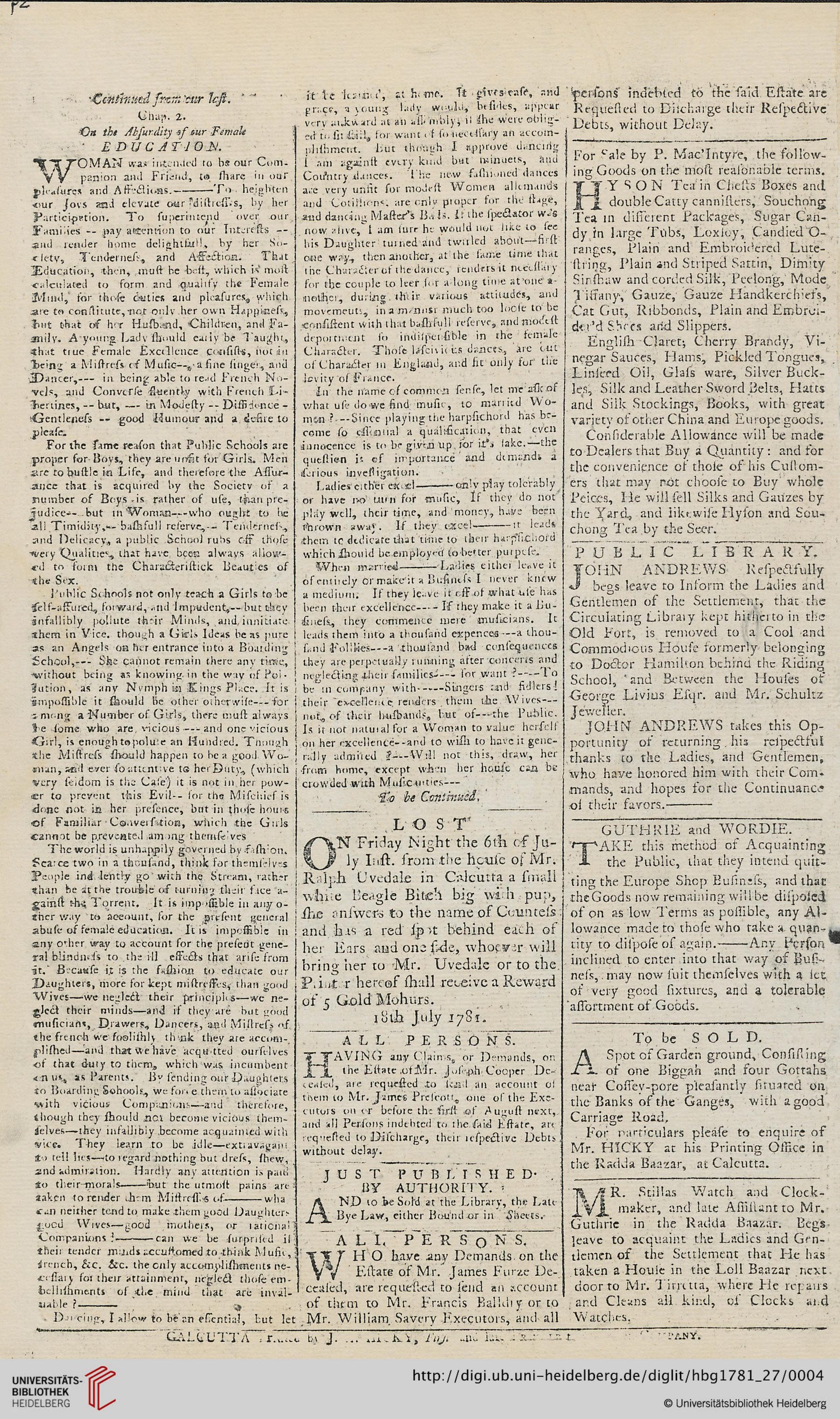
WOMAN was intended to be our Companion and Friend, to share in our pleasures and Affections.—To heighten our Joys and elevate our distresses, by her Participation. To superintend over our Families -- pay attention to our Interests -- and render home delightfull, by her Society, Tenderness, and Affection. That Education, then, must be best, which is most calculated to form and qualify the Female Mind, for those duties and pleasures, which are to constitute, not only her own Happiness, but that of her Husband, Children, and Family. A young Lady should early be Taught, that true Female Excellence consists, not in being a Mistress of Music--, a fine singer, and Dancer,--- in being able to read French Novels, and Converse fluently with French Libertines, -- but, --- in Modesty -- Diffidence -- Gentleness -- good Humour and a desire to please.
For the same reason that Public Schools are proper for Boys, they are unfit for Girls. Men are to bustle in Life, and therefore the Assurance that is acquired by the Society of a number of Boys is rather of use, than prejudice—but in Woman---who ought to be all Timidity,-- bashfull reserve,-- Tenderness, and Delicacy, a public School rubs off those very Qualities, that have been always allowed to form the Characteristick Beauties of the Sex.
Public Schools not only teach a Girls to be self-assured, forward, and Impudent,--but they infallibly pollute their Minds, and innitiate them in Vice. though a Girls Ideas be as pure as an Angels on her entrance into a Boarding School,--- She cannot remain there any time, without being as knowing in the way of Pollution, as any Nymph in Kings Place. It is impossible it should be other otherwise---for among a Number of Girls, there must always be some who are vicious---and one vicious Girl, is enough to pollute an Hundred. Though the Mistress should happen to be a good Woman, and ever so attentive to her Duty, (which very seldom is the Case) it is not in her power to prevent this Evil--for the Mischief is done not in her presence, but in those hours of Familiar Conversation, which the Girls cannot be prevented among themselves.
The world is unhappily governed by fashion. Scarce two in a thousand, think for themselves. People indolently go with the Stream, rather than be at the trouble of turning their face against the Torrent. It is impossible in any other way to account, for the present general abuse of female education. It is impossible in any other way to account for the present general blindness to the ill effects that arise from it. Because it is the fashion to educate our Daughters, more for kept mistresses, than good Wives—we neglect their principles—we neglect their minds—and if they are but good musicians, Drawers, Dancers, and Mistress of the french we foolishly think they are accomplished—and that we have acquitted ourselves of that duty to them, which was incumbent on us, as Parents. By sending our Daughters to Boarding Schools, we force them to associate with vicious Companions—and therefore, though they should not become vicious themselves—they infallibly become acquainted with vice. They learn to be idle—extravagant—to tell lies—to regard nothing but dress, shew, and admiration. Hardly any attention is paid to their morals—but the utmost pains are taken to render them Mistresses of—what can neither tend to make them good Daughters—good Wives—good mothers, or rational Companions!—can we be surprised if their tender minds accustomed to think Music, french, &c. &c. the only accomplishments necessary for their attainment, neglect those embellishments of the mind that are invaluable?
Dancing, I allow to be an essential, but let it be learned, at home. It gives ease, and grace, a young lady would, besides, appear very aukward at an assembly, if she were obliged to sit still, for want of so necessary an accomplishment. But though I approve dancing I am against every kind but minuets, and Country dances. The new fashioned dances are very unfit for modest Women allemands and Cotillions, are only proper for the stage, and dancing Master's Bals. If the spectator was now alive, I am sure he would not like to see his Daughter turned and twirled about—first one way, then another, at the same time that the Character of the dance, renders it necessary for the couple to leer for a long time at one another, during their various attitudes, and movements, in a manner much too loose to be consistent with that bashfull reserve, and modest deportment so indispensible in the female Character. Those lascivious dances, are out of Character in England, and fit only for the levity of France.
In the name of common sense, let me ask of what use do we find music, to married Women?---Since playing the harpsichord has become so essential a qualification, that even innocence is to be given up for it's sake.—the question is of importance and demands a serious investigation.
Ladies either excel—only play tolerably—or have no turn for music, If they do not play well, their time, and money, have been thrown away. If they excel—it leads them to dedicate that time to their harpsichord which should be employed to better purpose. When married—Ladies either leave it of entirely or make it a Business I never knew a medium. If they leave it off of what use has been their excellence.—If they make it a Business, they commence mere musicians. It leads them into a thousand expences.—a thousand Follies---a thousand bad consequences they are perpetually running after concerts and neglecting their families----for want?----To be in company with-----Singers and fidlers! their excellence renders them the Wives---not, of their husbands, but of---the Public. Is it not natural for a Woman to value herself on her excellence--and to wish to have it generally admired?---Will not this, draw, her from home, except when her house can be crowded with Musicanties---
To be Continued.
LOST
ON Friday Night the 6th of July Inst. from the house of Mr. Ralph Uvedale in Calcutta a small white Beagle Bitch big with pup, she answers to the name of Countess and has a red spot behind each of her Ears and one side, whoever will bring her to Mr. Uvedale or to the Printer hereof shall receive a Reward of 5 Gold Mohurs.
18th July 1781.
ALL PERSONS.
HAVING any Claims, or Demands, on the Estate of Mr. Joseph Cooper Deceased, are requested to send an account of them to Mr. James Prescott, one of the Executors on or before the first of August next, and all Persons indebted to the said Estate, are requested to Discharge, their respective Debts without delay.
JUST PUBLISHED,
BY AUTHORITY.
AND to be Sold at the Library, the Late Bye Law, either Bound or in Sheets.
ALL PERSONS.
WHO have any Demands on the Estate of Mr. James Furze Deceased, are requested to send an account of them to Mr. Francis Balldry or to Mr. William Savery Executors, and all persons indebted to the said Estate are Requested to Discharge their Respective Debts, without Delay.
For Sale by P. Mac’Intyre, the following Goods on the most reasonable terms.
HYSON Tea in Chests Boxes and double Catty cannisters, Souchong Tea in different Packages, Sugar Candy in large Tubs, Loxioy, Candied Oranges, Plain and Embroidered Lutestring, Plain and Striped Sattin, Dimity Sinshaw and corded Silk, Peelong, Mode Tiffany, Gauze, Gauze Handkerchiefs, Cat Gut, Ribbonds, Plain and Embroidered Shoes and Slippers.
English Claret; Cherry Brandy, Vinegar Sauces, Hams, Pickled Tongues, Linseed Oil, Glass ware, Silver Buckles, Silk and Leather Sword Belts, Hatts and Silk Stockings, Books, with great variety of other China and Europe goods.
Considerable Allowance will be made to Dealers that Buy a Quantity: and for the convenience of those of his Customers that may not choose to Buy whole Peices, He will sell Silks and Gauzes by the Yard, and likewise Hyson and Souchong Tea by the Seer.
PUBLIC LIBRARY.
JOHN ANDREWS Respectfully begs leave to Inform the Ladies and Gentlemen of the Settlement, that the Circulating Library kept hitherto in the Old Fort, is removed to a Cool and Commodious House formerly belonging to Doctor Hamilton behind the Riding School, and Between the Houses of George Livius Esqr. and Mr. Schultz Jeweller.
JOHN ANDREWS takes this Opportunity of returning his respectful thanks to the Ladies, and Gentlemen, who have honored him with their Commands, and hopes for the Continuance of their favors.
GUTHRIE and WORDIE.
TAKE this method of Acquainting the Public, that they intend quitting the Europe Shop Business, and that the Goods now remaining will be disposed of on as low Terms as possible, any Allowance made to those who take a quantity to dispose of again.—Any Person inclined to enter into that way of Business, may now suit themselves with a set of very good fixtures, and a tolerable assortment of Goods.
To be S O L D.
A Spot of Garden ground, Consisting of one Biggah and four Gottahs near Cossey-pore pleasantly situated on the Banks of the Ganges, with a good Carriage Road,
For particulars please to enquire of Mr. HICKY at his Printing Office in the Radda Baazar, at Calcutta.
MR. Stillas Watch and Clock-maker, and late Assistant to Mr. Guthrie in the Radda Baazar. Begs leave to acquaint the Ladies and Gentlemen of the Settlement that He has taken a House in the Loll Baazar next door to Mr. Tirretta, where He repairs and Cleans all kind, of Clocks and Watches.