Browse › 1781
Saturday 7 July 1781
Page 1
AI transcription (Google Gemini, 2026)
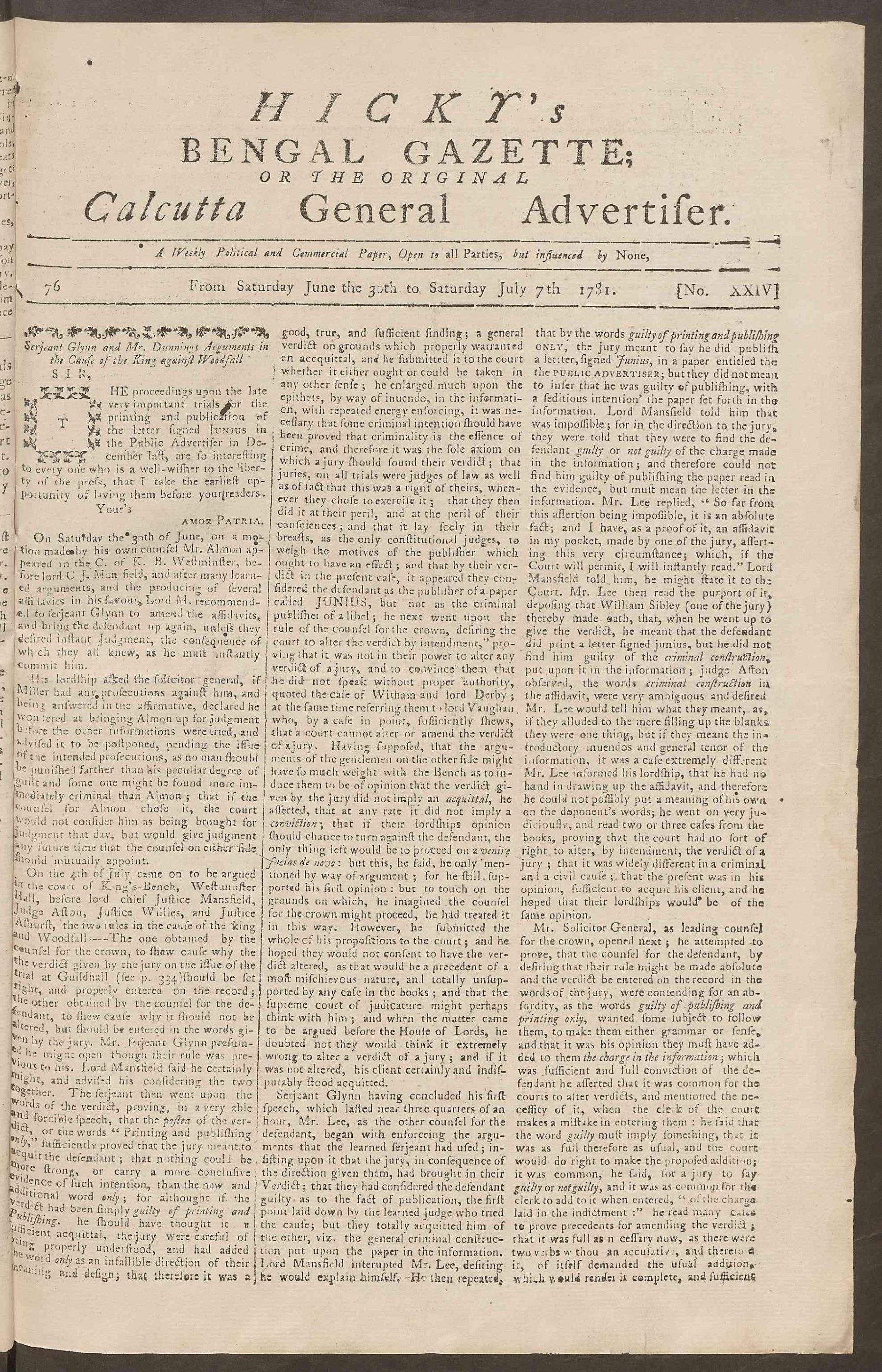
HICKY'S
BENGAL GAZETTE;
OR THE ORIGINAL
Calcutta General Advertiser.
A Weekly Political and Commercial Paper, Open to all Parties, but influenced by None,
76 From Saturday June the 30th to Saturday July 7th 1781. [No. XXIV]
Serjeant Glynn and Mr. Dunnings Arguments in the Cause of the King against Woodfall
SIR,
THE proceedings upon the late very important trials for the printing and publication of the letter signed JUNIUS in the Public Advertiser in December last, are so interesting to every one who is a well-wisher to the liberty of the press, that I take the earliest opportunity of laying them before your readers.
Your's
AMOR PATRIA.
On Saturday the 30th of June, on a motion made by his own counsel Mr. Almon appeared in the C. of K. B. Westminster, before lord C J. Mansfield, and after many learned arguments, and the producing of several affidavits in his favour, Lord M. recommended to serjeant Glynn to amend the affidavits, and bring the defendant up again, unless they desired instant Judgment, the consequence of which they all knew, as he must instantly commit him.
His lordship asked the solicitor general, if Miller had any prosecutions against him, and being answered in the affirmative, declared he wondered at bringing Almon up for judgment before the other informations were tried, and advised it to be postponed, pending the issue of the intended prosecutions, as no man should be punished farther than his peculiar degree of guilt and some one might be found more immediately criminal than Almon; that if the counsel for Almon chose it, the court would not consider him as being brought for judgment that day, but would give judgment any future time that the counsel on either side should mutually appoint.
On the 4th of July came on to be argued in the court of King's-Bench, Westminster Hall, before lord chief Justice Mansfield, Judge Aston, Justice Willies, and Justice Ashurst, the two rules in the cause of the king and Woodfall.---The one obtained by the counsel for the crown, to shew cause why the the verdict given by the jury on the issue of the trial at Guildhall (see p. 334) should be set right, and properly entered on the record; the other obtained by the counsel for the defendant, to shew cause why it should not be altered, but should be entered in the words given by the jury. Mr. serjeant Glynn presumed he might open though their rule was previous to his. Lord Mansfield said he certainly might, and advised his considering the two together. The serjeant then went upon the words of the verdict, proving, in a very able and forcible speech, that the postea of the verdict, or the words "Printing and publishing only," sufficiently proved that the jury meant to acquit the defendant; that nothing could be more strong, or carry a more conclusive evidence of such intention, than the new and additional word only; for although if the verdict had been simply guilty of printing and Publishing. he should have thought it a sufficient acquittal, the jury were careful of being properly understood, and had added the word only as an infallible direction of their meaning and design; that therefore it was a
good, true, and sufficient finding; a general verdict on grounds which properly warranted an acquittal, and he submitted it to the court whether it either ought or could be taken in any other sense; he enlarged much upon the epithets, by way of inuendo, in the information, with repeated energy enforcing, it was necessary that some criminal intention should have been proved that criminality is the essence of crime, and therefore it was the sole axiom on which a jury should found their verdict; that juries, on all trials were judges of law as well as of fact that this was a right of theirs, whenever they chose to exercise it; that they then did it at their peril, and at the peril of their consciences; and that it lay solely in their breasts, as the only constitutional judges, to weigh the motives of the publisher which ought to have an effect; and that by their verdict in the present case, it appeared they considered the defendant as the publisher of a paper called JUNIUS, but not as the criminal publisher of a libel; he next went upon the rule of the counsel for the crown, desiring the court to alter the verdict by intendment," proving that it was not in their power to alter any verdict of a jury, and to convince them that he did not speak without proper authority, quoted the case of Witham and lord Derby; at the same time referring them to lord Vaughan who, by a case in point, sufficiently shews, that a court cannot alter or amend the verdict of a jury. Having supposed, that the arguments of the gentlemen on the other side might have so much weight with the Bench as to induce them to be of opinion that the verdict given by the jury did not imply an acquittal, he asserted, that at any rate it did not imply a conviction; that if their lordships opinion should chance to turn against the defendant, the only thing left would be to proceed on a venire facias de novo: but this, he said, he only mentioned by way of argument; for he still supported his first opinion: but to touch on the grounds on which, he imagined the counsel for the crown might proceed, he had treated it in this way. However, he submitted the whole of his propositions to the court; and he hoped they would not consent to have the verdict altered, as that would be a precedent of a most mischievous nature, and totally unsupported by any case in the books; and that the supreme court of judicature might perhaps think with him; and when the matter came to be argued before the House of Lords, he doubted not they would think it extremely wrong to alter a verdict of a jury; and if it was not altered, his client certainly and indisputably stood acquitted.
Serjeant Glynn having concluded his first speech, which lasted near three quarters of an hour, Mr. Lee, as the other counsel for the defendant, began with enforcing the arguments that the learned serjeant had used; insisting upon it that the jury, in consequence of the direction given them, had brought in their Verdict; that they had considered the defendant guilty as to the fact of publication, the first point laid down by the learned judge who tried the cause; but they totally acquitted him of the other, viz. the general criminal construction put upon the paper in the information. Lord Mansfield interupted Mr. Lee, desiring he would explain himself. He then repeated,
that by the words guilty of printing and publishing ONLY, the jury meant to say he did publish a letter, signed Junius, in a paper entitled the the PUBLIC ADVERTISER; but they did not mean to infer that he was guilty of publishing, with a seditious intention' the paper set forth in the information. Lord Mansfield told him that was impossible; for in the direction to the jury, they were told that they were to find the defendant guilty or not guilty of the charge made in the information; and therefore could not find him guilty of publishing the paper read in the evidence, but must mean the letter in the information. Mr. Lee replied, "So far from this assertion being impossible, it is an absolute fact; and I have, as a proof of it, an affidavit in my pocket, made by one of the jury, asserting this very circumstance; which, if the Court will permit, I will instantly read." Lord Mansfield told him, he might state it to the Court. Mr. Lee then read the purport of it, deposing that William Sibley (one of the jury) thereby made oath, that, when he went up to give the verdict, he meant that the defendant did print a letter signed Junius, but he did not find him guilty of the criminal construction, put upon it in the information; judge Aston observed, the words criminal construction in the affidavit, were very ambiguous and desired Mr. Lee would tell him what they meant, as, if they alluded to the mere filling up the blanks they were one thing, but if they meant the introductory inuendos and general tenor of the information, it was a case extremely different Mr. Lee informed his lordship, that he had no hand in drawing up the affidavit, and therefore he could not possibly put a meaning of his own on the deponent's words; he went on very judiciously, and read two or three cases from the books, proving that the court had no sort of right to alter, by intendment, the verdict of a jury; that it was widely different in a criminal and a civil cause; that the present was in his opinion, sufficient to acquit his client, and he hoped that their lordships would be of the same opinion.
Mr. Solicitor General, as leading counsel for the crown, opened next; he attempted to prove, that the counsel for the defendant, by desiring that their rule might be made absolute and the verdict be entered on the record in the words of the jury, were contending for an absurdity, as the words guilty of publishing and printing only, wanted some subject to follow them, to make them either grammar or sense, and that it was his opinion they must have added to them the charge in the information; which was sufficient and full conviction of the defendant he asserted that it was common for the courts to alter verdicts, and mentioned the necessity of it, when the clerk of the court makes a mistake in entering them: he said that the word guilty must imply something, that it was as full therefore as usual, and the court would do right to make the proposed addition; it was common, he said, for a jury to say guilty or not guilty, and it was as common for the clerk to add to it when entered, "of the charge laid in the indictment:" he read many cases to prove precedents for amending the verdict; that it was full as necessary now, as there were two verbs without an accusative, and therefore it, of itself demanded the usual addition, which would render it complete, and sufficient
Page 2
AI transcription (Google Gemini, 2026)
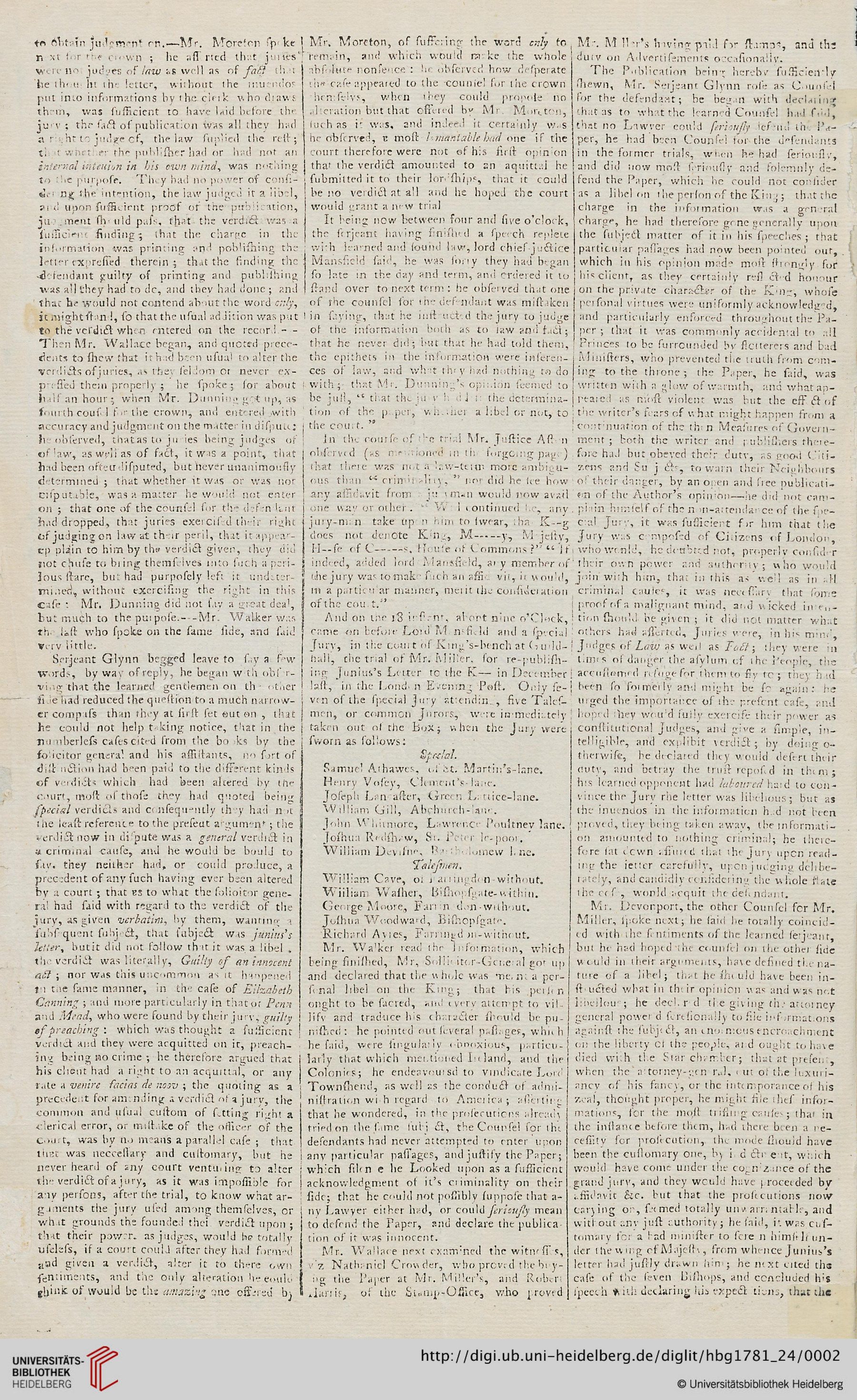
to obtain judgment on. — Mr. Moreton spoke next for the crown; he asserted that juries were not judges of law as well as of fact that he thought the letter, without the inuendos put into informations by the clerk who draws them, was sufficient to have laid before the jury; the fact of publication was all they had a right to judge of, the law supplied the rest; that whether the publisher had or had not an internal intention in his own mind, was nothing to the purpose. They had no power of considering the intention, the law judged it a libel, and upon sufficient proof of the publication, judgment should pass, that the verdict was a sufficient finding; that the charge in the information was printing and publishing the letter expressed therein; that the finding the defendant guilty of printing and publishing was all they had to do, and they had done; and that he would not contend about the word only, it might stand, so that the usual addition was put to the verdict when entered on the record! — Then Mr. Wallace began, and quoted precedents to shew that it had been usual to alter the verdicts of juries, as they seldom or never expressed them properly; he spoke; for about half an hour; when Mr. Dunning got up, as fourth counsel for the crown, and entered with accuracy and judgment on the matter in dispute; he observed, that as to juries being judges of of law, as well as of fact, it was a point, that had been often disputed, but never unanimously determined; that whether it was or was not disputable, was a matter he would not enter on; that one of the counsel for the defendant had dropped, that juries exercised their right of judging on law at their peril, that it appear-ep plain to him by the verdict given, they did not chuse to bring themselves into such a perilous stare, but had purposely left it undetermined, without exercising the right in this case: Mr. Dunning did not say a great deal, but much to the purpose. — Mr. Walker was the last who spoke on the same side, and said very little.
Serjeant Glynn begged leave to say a few words, by way of reply, he began with observing that the learned gentlemen on the other side had reduced the question to a much narrower compass than they at first set out on, that he could not help taking notice, that in the numberless cases cited from the books by the solicitor general and his assistants, no sort of distinction had been paid to the different kinds of verdicts which had been altered by the court, most of those they had quoted being special verdicts and consequently they had not the least reference to the present argument; the verdict now in dispute was a general verdict in a criminal cause, and he would be bould to say, they neither had, or could produce, a precedent of any such having ever been altered by a court; that as to what the solicitor general had said with regard to the verdict of the jury, as given verbatim, by them, wanting a subsequent subject, that subject was Junius's letter, but it did not follow that it was a libel, the verdict was literally, Guilty of an innocent act; nor was this uncommon as it happened in the same manner, in the case of Elizabeth Canning; and more particularly in that of Penn and Mead, who were found by their jury, guilty of preaching: which was thought a sufficient verdict and they were acquitted on it, preaching being no crime; he therefore argued that his client had a right to an acquittal, or any rate a venire facias de novo; the quoting as a precedent for amending a verdict of a jury, the common and usual custom of setting right a clerical error, or mistake of the officer of the court, was by no means a parallel case; that that was necessary and customary, but he never heard of any court venturing to alter the verdict of a jury, as it was impossible for any persons, after the trial, to know what arguments the jury used among themselves, or what grounds the founded their verdict upon; that their power, as judges, would be totally useless, if a court could after they had formed and given a verdict, alter it to there own sentiments, and the only alteration he could think of would be the amazing one offered by Mr. Moreton, of suffering the word only to remain, and which would make the whole absolute nonsense: he observed how desperate the case appeared to the counsel for the crown themselves, when they could propose no alteration but that offered by Mr. Moreton, such as it was, and indeed it certainly was he observed, a most lamentable bad one if the court therefore were not of his first opinion that the verdict amounted to an aquittal he submitted it to their lordships, that it could be no verdict at all and he hoped the court would grant a new trial
It being now between four and five o'clock, the serjeant having finished a speech replete with learned and sound law, lord chief justice Mansfield said, he was sorry they had began so late in the day and term, and ordered it to stand over to next term: he observed that one of the counsel for the defendant was mistaken in saying, that he instructed the jury to judge of the information both as to law and fact; that he never did; but that he had told them, the epithets in the information were inferences of law, and what they had nothing to do with; that Mr. Dunning's opinion seemed to be just, "that the jury had left the determination of the paper, whether a libel or not, to the court."
In the course of the trial Mr. Justice Aston observed (as mentioned in the forgoing page) that there was not a law-term more ambiguous than "criminality," nor did he see how any affidavit from a jury-man would now avail one way or other. "Will continued he, any jury-man take upon him to swear, that K--g does not denote King, M----y, Majesty, H--se of C----s, House of Commons?" "If indeed, added lord Mansfield, any member of the jury was to make such an affidavit, it would, in a particular manner, merit the consideration of the court."
And on the 18 instant, about nine o'Clock, came on before Lord Mansfield and a special Jury, in the court of King's-bench at Guild-hall, the trial of Mr. Miller, for re-publishing Junius's Letter to the K-- in December last, in the London Evening Post. Only seven of the special Jury attending, five Tales-men, or common Jurors, were immediately taken out of the Box; when the Jury were sworn as follows:
Special.
Samuel Athawes, of St. Martin's-lane.
Henry Vosey, Clement's-lane.
Joseph Lancaster, Green Lattice-lane.
William Gill, Abchurch-lane.
John Whitmore, Lawrence Poultney lane.
Joshua Redshaw, St. Peter le-poor.
William Devifne, Bartholomew lane.
Talesmen.
William Cave, of Faringdon-without.
William Washer, Bishopsgate-within.
George Moore, Faringdon-without.
Joshua Woodward, Bishopsgate.
Richard Ayres, Faringdon-without.
Mr. Walker read the Information, which being finished, Mr. Sollicitor-General got up and declared that the whole was meant a personal libel on the King; that his person ought to be sacred, and every attempt to villify and traduce his character should be punished: he pointed out several passages, which he said, were singularly obnoxious, particularly that which mentioned Ireland, and the Colonies; he endeavoured to vindicate Lord Townshend, as well as the conduct of administration with regard to America; asserting that he wondered, in the prosecutions already tried on the same subject, the Counsel for the defendants had never attempted to enter upon any particular passages, and justify the Paper; which silence he Looked upon as a sufficient acknowledgment of it's criminality on their side; that he could not possibly suppose that any Lawyer either had, or could seriously mean to defend the Paper, and declare the publication of it was innocent.
Mr. Wallace next examined the witnesses, viz Nathaniel Crowder, who proved the buying the Paper at Mr. Miller's, and Robert Harris, of the Stamp-Office, who proved Mr. Miller's having paid for stamps, and the duty on Advertisements occasionally.
The Publication being hereby sufficiently shewn, Mr. Serjeant Glynn rose as Counsel for the defendant; he began with declaring that as to what the learned Counsel had said, that no Lawyer could seriously defend the Paper, he had been Counsel for the defendants in the former trials, when he had seriously, and did now most seriously and solemnly defend the Paper, which he could not consider as a libel on the person of the King; that the charge in the information was a general charge, he had therefore gone generally upon the subject matter of it in his speeches; that particular passages had now been pointed out, which in his opinion made most strongly for his client, as they certainly reflected honour on the private character of the King, whose personal virtues were uniformly acknowledged, and particularly enforced throughout the Paper; that it was commonly accidental to all Princes to be surrounded by flatterers and bad Ministers, who prevented the truth from coming to the throne; the Paper, he said, was written with a glow of warmth, and what appeared as most violent was but the effect of the writer's fears of what might happen from a continuation of the then Measures of Government; both the writer and publishers therefore had but obeyed their duty, as good Citizens and Subjects, to warn their Neighbours of their danger, by an open and free publication of the Author's opinion — he did not complain himself of the non-attendance of the special Jury, it was sufficient for him that the Jury was composed of Citizens of London, who would, he doubted not, properly consider their own power and authority; who would join with him, that in this as well as in all criminal causes, it was necessary that some proof of a malignant mind, and wicked intention should be given; it did not matter what others had asserted, Juries were, in his mind, Judges of Law as well as Fact; they were in times of danger the asylum of the People, the accustomed refuge for them to fly to; they had been so formerly and might be so again: he urged the importance of the present case, and hoped they would fully exercise their power as constitutional Judges, and give a simple, intelligible, and explicit verdict; by doing otherwise, he declared they would desert their duty, and betray the trust reposed in them; his learned opponent had laboured hard to convince the Jury the letter was libellous; but as the inuendos in the information had not been proved, they being taken away, the information amounted to nothing criminal; he therefore sat down assured that the Jury upon reading the letter carefully, upon judging deliberately, and candidly considering the whole state the case, would acquit the defendant.
Mr. Devonport, the other Counsel for Mr. Miller, spoke next; he said he totally coincided with the sentiments of the learned serjeant, but he had hoped the counsel on the other side would in their arguments, have defined the nature of a libel; that he should have been instructed what in their opinion was and was not libellous; he declared the giving the attorney general power discretionally to file informations against the subject, an enormous encroachment on the liberty of the people, and ought to have died with the Star chamber; that at present, when the attorney-general, out of the luxuriancy of his fancy, or the intemperance of his zeal, thought proper, he might file these informations, for the most trifling causes; that in the instance before them, had there been a necessity for prosecution, the mode should have been the customary one, by indictment, which would have come under the cognizance of the grand jury, and they would have proceeded by affidavit &c. but that the prosecutions now carrying on, seemed totally unwarrantable, and without any just authority; he said, it was customary for a bad minister to screen himself under the wing of Majesty, from whence Junius's letter had justly drawn him; he next cited the case of the seven Bishops, and concluded his speech with declaring his expectations, that the
Page 3
AI transcription (Google Gemini, 2026)
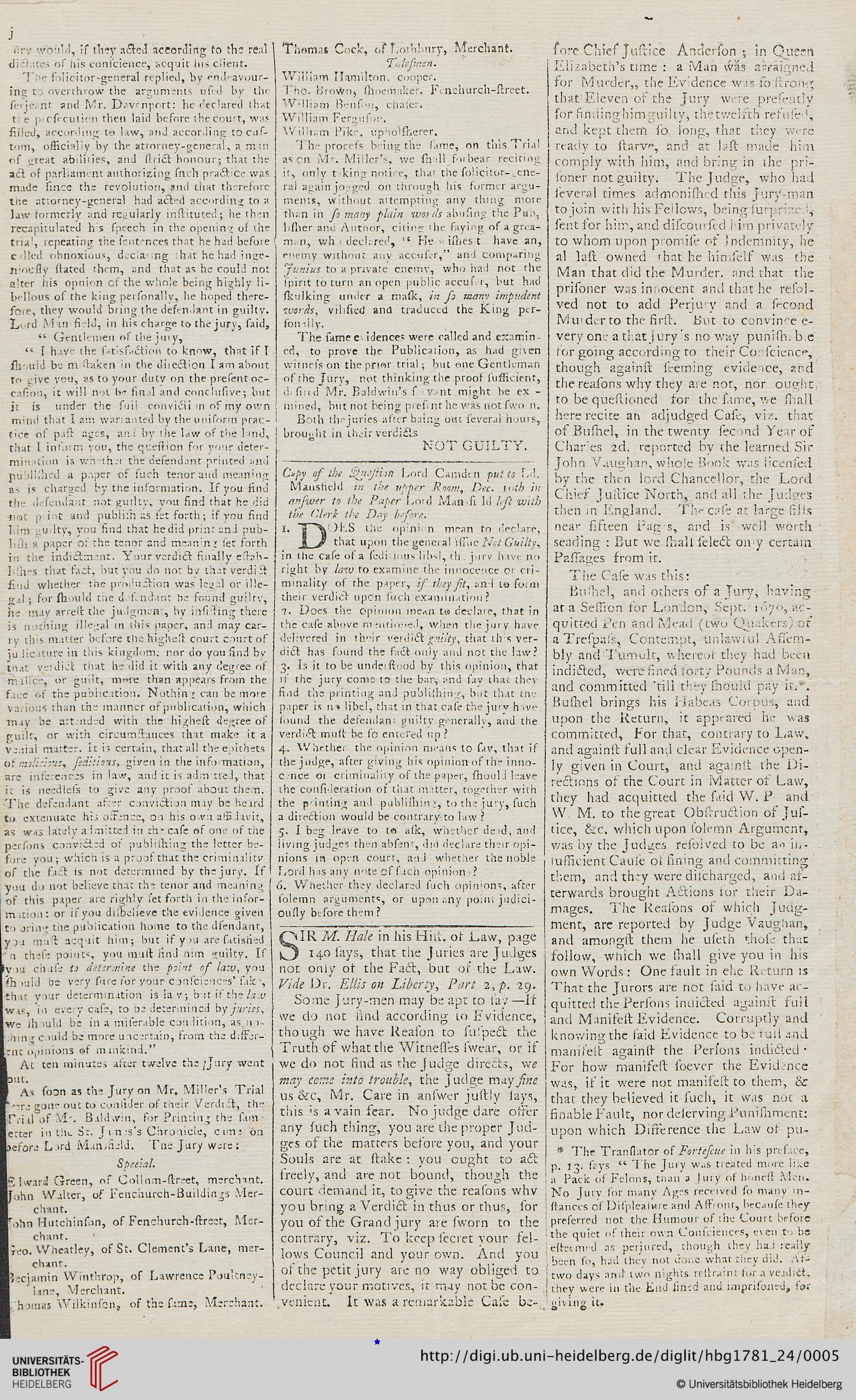
Jury would, if they acted according to the real dictates of his conscience, acquit his client.
The solicitor-general replied, by endeavouring to overthrow the arguments used by the serjeant and Mr. Davenport: he declared that the prosecution then laid before the court, was filed, according to law, and according to custom, officially by the attorney-general, a man of great abilities, and strict honour; that the act of parliament authorizing such practice was made since the revolution, and that therefore the attorney-general had acted according to a law formerly and regularly instituted; he then recapitulated his speech in the opening of the trial, repeating the sentences that he had before called obnoxious, declaring that he had ingeniously stated them, and that as he could not alter his opinion of the whole being highly libellous of the king personally, he hoped therefore, they would bring the defendant in guilty. Lord Mansfield, in his charge to the jury, said,
"Gentlemen of the jury,
"I have the satisfaction to know, that if I should be mistaken in the direction I am about to give you, as to your duty on the present occasion, it will not be final and conclusive; but it is under the full conviction of my own mind that I am warranted by the uniform practice of past ages, and by the law of the land, that I inform you, the question for your determination is whether the defendant printed and published a paper of such tenor and meaning as is charged by the information. If you find the defendant not guilty, you find that he did not print and publish as set forth; if you find him guilty, you find that he did print and publish a paper of the tenor and meaning set forth in the indictment. Your verdict finally establishes that fact, but you do not by that verdict find whether the production was legal or illegal; for should the defendant be found guilty, he may arrest the judgment, by insisting there is nothing illegal in this paper, and may carry this matter before the highest court court of judicature in this kingdom: nor do you find by that verdict that he did it with any degree of malice, or guilt, more than appears from the face of the publication. Nothing can be more various than the manner of publication, which may be attended with the highest degree of guilt, or with circumstances that make it a venial matter. It is certain, that all the epithets of malicious, seditious, given in the information, are inferences in law, and it is admitted, that it is needless to give any proof about them. The defendant after conviction may be heard to extenuate his offence, on his own affidavit, as was lately admitted in the case of one of the persons convicted of publishing the letter before you; which is a proof that the criminality of the fact is not determined by the jury. If you do not believe that the tenor and meaning of this paper are rightly set forth in the information: or if you disbelieve the evidence given to bring the publication home to the defendant, you must acquit him; but if you are satisfied in these points, you must find him guilty. If you chuse to determine the point of law, you should be very sure for your consciences' sake, that your determination is law; but if the law was, in every case, to be determined by juries, we should be in a miserable condition, as nothing could be more uncertain, from the different opinions of mankind."
At ten minutes after twelve the Jury went out.
As soon as the Jury on Mr. Miller's Trial were gone out to consider of their Verdict, the Trial of Mr. Baldwin, for Printing the same letter in the St. James's Chronicle, came on before Lord Mansfield. The Jury were:
Special.
Edward Green, of Collum-street, merchant.
John Walter, of Fenchurch-Buildings Merchant.
John Hutchinson, of Fenchurch-street, Merchant.
Geo. Wheatley, of St. Clement's Lane, merchant.
Benjamin Winthrop, of Lawrence Poultney-lane, Merchant.
Thomas Wilkinson, of the same, Merchant.
Thomas Cock, of Lothbury, Merchant.
Talesmen.
William Hamilton, cooper.
Tho. Brown, shoemaker, Fenchurch-street.
William Benson, chaier.
William Ferguson.
William Pike, upholsterer.
The process being the same, on this Trial as on Mr. Miller's, we shall forbear reciting it, only taking notice, that the solicitor-general again jogged on through his former arguments, without attempting any thing more than in so many plain words abusing the Publisher and Author, citing the saying of a great man, who declared, "He wishes to have an enemy without any accuser," and comparing Junius to a private enemy, who had not the spirit to turn an open public accuser, but had skulking under a mask, in so many impudent words, vilified and traduced the King personally.
The same evidences were called and examined, to prove the Publication, as had given witness on the prior trial; but one Gentleman of the Jury, not thinking the proof sufficient, desired Mr. Baldwin's servant might be examined, but not being present he was not sworn.
Both the juries after being out several hours, brought in their verdicts
NOT GUILTY.
Copy of the Question Lord Camden put to Ld. Mansfield in the upper Room, Dec. 10th in answer to the Paper Lord Mansfield left with the Clerk the Day before.
1. DOES the opinion mean to declare, that upon the general issue Not Guilty, in the case of a seditious libel, the jury have no right by law to examine the innocence or criminality of the paper, if they fit, and to form their verdict upon such examination?
2. Does the opinion mean to declare, that in the case above mentioned, when the jury have delivered in their verdict guilty, that this verdict has found the fact only and not the law?
3. Is it to be understood by this opinion, that if the jury come to the bar, and say that they find the printing and publishing, but that the paper is no libel, that in that case the jury have found the defendant guilty generally, and the verdict must be so entered up?
4. Whether the opinion means to say, that if the judge, after giving his opinion of the innocence or criminality of the paper, should leave the consideration of that matter, together with the printing and publishing, to the jury, such a direction would be contrary to law?
5. I beg leave to to ask, whether dead, and living judges then absent, did declare their opinions in open court, and whether the noble Lord has any note of such opinions?
6. Whether they declared such opinions, after solemn arguments, or upon any point judicially before them?
SIR M. Hale in his Hist. of Law, page 140 says, that the Juries are Judges not only of the Fact, but of the Law. Vide Dr. Ellis on Liberty, Part 2, p. 29.
Some Jury-men may be apt to say—If we do not find according to Evidence, though we have Reason to suspect the Truth of what the Witnesses swear, or if we do not find as the Judge directs, we may come into trouble, the Judge may fine us &c, Mr. Care in answer justly says, this is a vain fear. No judge dare offer any such thing, you are the proper Judges of the matters before you, and your Souls are at stake: you ought to act freely, and are not bound, though the court demand it, to give the reasons why you bring a Verdict in thus or thus, for you of the Grand jury are sworn to the contrary, viz. To keep secret your fellows Council and your own. And you of the petit jury are no way obliged to declare your motives, it may not be convenient. It was a remarkable Case be-
fore Chief Justice Anderson; in Queen Elizabeth's time: a Man was arraigned for Murder, the Evidence was so strong that Eleven of the Jury were presently for finding him guilty, the twelfth refused, and kept them so long, that they were ready to starve, and at last made him comply with him, and bring in the prisoner not guilty. The Judge, who had several times admonished this Jury-man to join with his Fellows, being surprized, sent for him, and discoursed him privately to whom upon promise of Indemnity, he at last owned that he himself was the Man that did the Murder, and that the prisoner was innocent and that he resolved not to add Perjury and a second Murder to the first. But to convince every one that a Jury's no way punishable for going according to their Conscience, though against seeming evidence, and the reasons why they are not, nor ought to be questioned for the same, we shall here recite an adjudged Case, viz. that of Bushel, in the twenty second Year of Charles 2d. reported by the learned Sir John Vaughan, whose Book was licensed by the then lord Chancellor, the Lord Chief Justice North, and all the Judges then in England. The case at large fills near fifteen Pages, and is well worth reading: But we shall select only certain Passages from it.
The Case was this:
Bushel, and others of a Jury, having at a Session for London, Sept. 1670, acquitted Pen and Mead (two Quakers) of a Trespass, Contempt, unlawful Assembly and Tumult, whereof they had been indicted, were fined forty Pounds a Man, and committed 'till they should pay it.*. Bushel brings his Habeas Corpus, and upon the Return, it appeared he was committed, For that, contrary to Law, and against full and clear Evidence openly given in Court, and against the Directions of the Court in Matter of Law, they had acquitted the said W. P and W M. to the great Obstruction of Justice, &c. which upon solemn Argument, was by the Judges resolved to be an insufficient Cause of fining and committing them, and they were discharged, and afterwards brought Actions for their Damages. The Reasons of which Judgment, are reported by Judge Vaughan, and amongst them he useth those that follow, which we shall give you in his own Words: One fault in the Return is That the Jurors are not said to have acquitted the Persons indicted against full and Manifest Evidence. Corruptly and knowing the said Evidence to be full and manifest against the Persons indicted. For how manifest soever the Evidence was, if it were not manifest to them, & that they believed it such, it was not a finable Fault, nor deserving Punishment: upon which Difference the Law of pu-
* The Translator of Fortescue in his preface, p. 13. says "The Jury was treated more like a Pack of Felons, than a Jury of honest Men. No Jury for many Ages received so many instances of Displeasure and Affront, because they preferred not the Humour of the Court before the quiet of their own Consciences, even to be esteemed as perjured, though they had really been so, had they not done what they did. After two days and two nights restraint for a verdict, they were in the End fined and imprisoned, for giving it.
Page 4
AI transcription (Google Gemini, 2026)
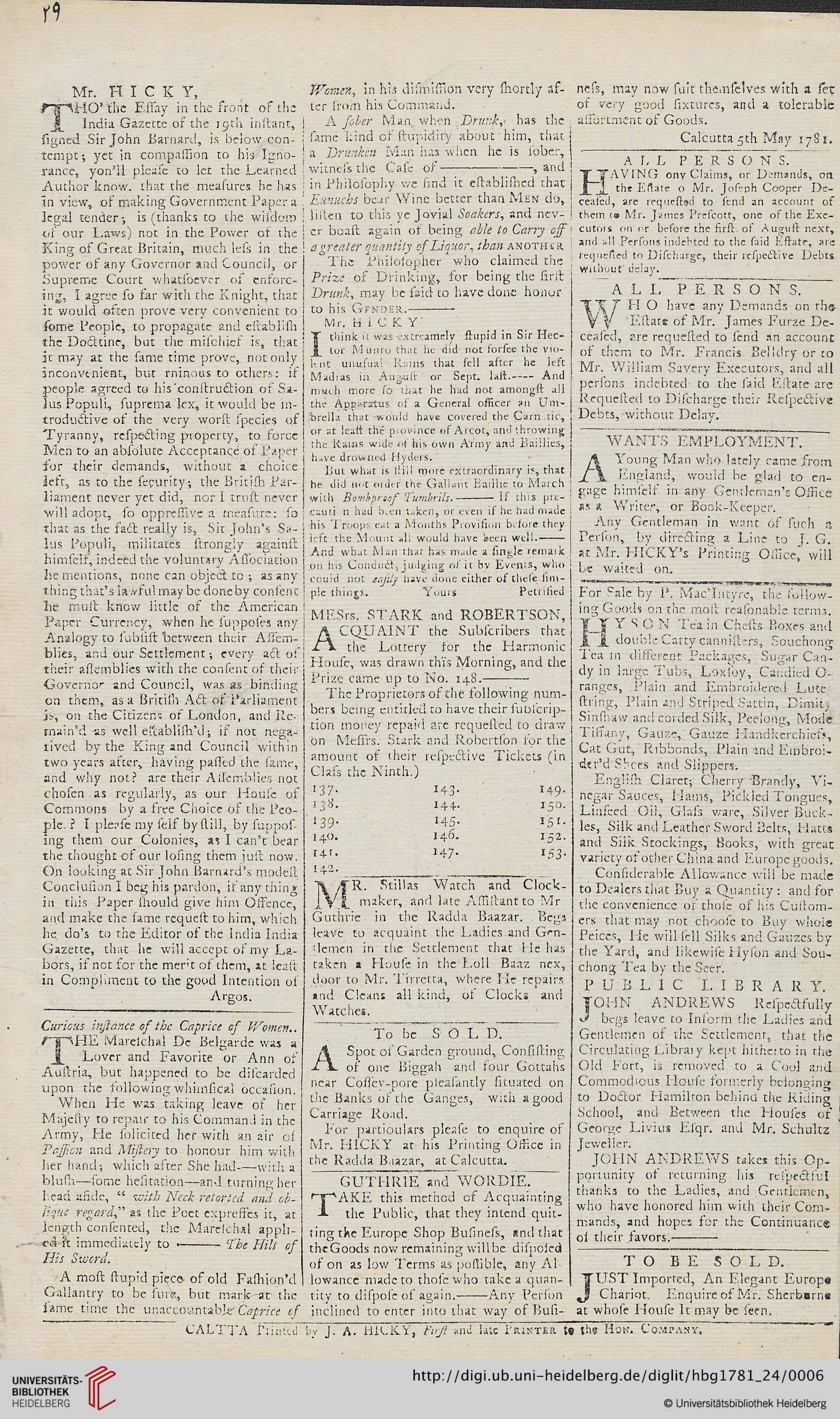
Mr. HICKY,
THO' the Essay in the front of the India Gazette of the 19th instant, signed Sir John Barnard, is below contempt; yet in compassion to his Ignorance, you'll please to let the Learned Author know, that the measures he has in view, of making Government Paper a legal tender; is (thanks to the wisdom of our Laws) not in the Power of the King of Great Britain, much less in the power of any Governor and Council, or Supreme Court whatsoever of enforcing, I agree so far with the Knight, that it would often prove very convenient to some People, to propagate and establish the Doctrine, but the mischief is, that it may at the same time prove, not only inconvenient, but ruinous to others: if people agreed to his construction of Salus Populi, suprema lex, it would be introductive of the very worst species of Tyranny, respecting property, to force Men to an absolute Acceptance of Paper for their demands, without a choice left, as to the security; the British Parliament never yet did, nor I trust never will adopt, so oppressive a measure: so that as the fact really is, Sir John's Salus Populi, militates strongly against himself, indeed the voluntary Association he mentions, none can object to; as any thing that's lawful may be done by consent he must know little of the American Paper Currency, when he supposes any Analogy to subsist between their Assemblies, and our Settlement; every act of their assemblies with the consent of their Governor and Council, was as binding on them, as a British Act of Parliament is, on the Citizens of London, and Remain'd as well establish'd; if not negatived by the King and Council within two years after, having passed the same, and why not? are their Assemblies not chosen as regularly, as our House of Commons by a free Choice of the People.? I please my self by still, by supposing them our Colonies, as I can't bear the thought of our losing them just now. On looking at Sir John Barnard's modest Conclusion I beg his pardon, if any thing in this Paper should give him Offence, and make the same request to him, which he do's to the Editor of the India India Gazette, that he will accept of my Labors, if not for the merit of them, at least in Compliment to the good Intention of
Argos.
Curious instance of the Caprice of Women.
THE Marechal De Belgarde was a Lover and Favorite or Ann of Austria, but happened to be discarded upon the following whimsical occasion.
When He was taking leave of her Majesty to repair to his Command in the Army, He solicited her with an air of Passion and Mistery to honour him with her hand; which after She had—with a blush—some hesitation—and turning her head aside, "with Neck retorted and oblique regard," as the Poet expresses it, at length consented, the Marechal applied it immediately to — The Hilt of His Sword.
A most stupid piece of old Fashion'd Gallantry to be sure, but mark at the same time the unaccountable Caprice of Women, in his dismission very shortly after from his Command.
A sober Man when Drunk, has the same kind of stupidity about him, that a Drunken Man has when he is sober, witness the Case of — , and in Philosophy we find it established that Eunuchs bear Wine better than MEN do, listen to this ye Jovial Soakers, and never boast again of being able to Carry off a greater quantity of Liquor, than ANOTHER
The Philosopher who claimed the Prize of Drinking, for being the first Drunk, may be said to have done honor to his GENDER.
Mr. HICKY
I think it was extreamely stupid in Sir Hector Munro that he did not forsee the violent unusual Rains that fell after he left Madras in August or Sept. last.---- And much more so that he had not amongst all the Apparatus of a General officer an Umbrella that would have covered the Carnatic, or at least the province of Arcot, and throwing the Rains wide of his own Army and Baillies, have drowned Hyders.
But what is still more extraordinary is, that he did not order the Gallant Baillie to March with Bombproof Tumbrils. — If this precaution had been taken, or even if he had made his Troops eat a Months Provision before they left the Mount all would have been well. — And what Man that has made a single remark on his Conduct, judging of it by Events, who could not easily have done either of these simple things.
Yours Petrified
MESrs. STARK and ROBERTSON, ACQUAINT the Subscribers that the Lottery for the Harmonic House, was drawn this Morning, and the Prize came up to No. 148.
The Proprietors of the following numbers being entitled to have their subscription money repaid are requested to draw on Messrs. Stark and Robertson for the amount of their respective Tickets (in Class the Ninth.)
137. 143. 149.
138. 144. 150.
139. 145. 151.
140. 146. 152.
141. 147. 153.
142.
MR. Stillas Watch and Clockmaker, and late Assistant to Mr Guthrie in the Radda Baazar. Begs leave to acquaint the Ladies and Gentlemen in the Settlement that He has taken a House in the Loll Baaz nex, door to Mr. Tirretta, where He repairs and Cleans all kind, of Clocks and Watches.
To be SOLD.
A Spot of Garden ground, Consisting of one Biggah and four Gottahs near Cossey-pore pleasantly situated on the Banks of the Ganges, with a good Carriage Road.
For particulars please to enquire of Mr. HICKY at his Printing Office in the Radda Baazar, at Calcutta.
GUTHRIE and WORDIE.
TAKE this method of Acquainting the Public, that they intend quitting the Europe Shop Business, and that the Goods now remaining will be disposed of on as low Terms as possible, any Allowance made to those who take a quantity to dispose of again. — Any Person inclined to enter into that way of Business, may now suit themselves with a set of very good fixtures, and a tolerable assortment of Goods.
Calcutta 5th May 1781.
ALL PERSONS.
HAVING any Claims, or Demands, on the Estate of Mr. Joseph Cooper Deceased, are requested to send an account of them to Mr. James Prescott, one of the Executors on or before the first of August next, and all Persons indebted to the said Estate, are requested to Discharge, their respective Debts without delay.
ALL PERSONS.
WHO have any Demands on the Estate of Mr. James Furze Deceased, are requested to send an account of them to Mr. Francis Belldry or to Mr. William Savery Executors, and all persons indebted to the said Estate are Requested to Discharge their Respective Debts, without Delay.
WANTS EMPLOYMENT.
A Young Man who lately came from England, would be glad to engage himself in any Gentleman's Office as a Writer, or Book-Keeper.
Any Gentleman in want of such a Person, by directing a Line to J. G. at Mr. HICKY's Printing Office, will be waited on.
For Sale by P. Mac'Intyre, the following Goods on the most reasonable terms.
HYSON Tea in Chests Boxes and double Catty cannisters, Souchong Tea in different Packages, Sugar Candy in large Tubs, Loxsoy, Candied Oranges, Plain and Embroidered Lute string, Plain and Striped Sattin, Dimity Sinshaw and corded Silk, Peelong, Mode Tiffany, Gauze, Gauze Handkerchiefs, Cat Gut, Ribbonds, Plain and Embroider'd Shoes and Slippers.
English Claret, Cherry Brandy, Vinegar Sauces, Hams, Pickled Tongues, Linseed Oil, Glass ware, Silver Buckles, Silk and Leather Sword Belts, Hatts and Silk Stockings, Books, with great variety of other China and Europe goods.
Considerable Allowance will be made to Dealers that Buy a Quantity: and for the convenience of those of his Customers that may not choose to Buy whole Peices, He will sell Silks and Gauzes by the Yard, and likewise Hyson and Souchong Tea by the Seer.
PUBLIC LIBRARY.
JOHN ANDREWS Respectfully begs leave to Inform the Ladies and Gentlemen of the Settlement, that the Circulating Library kept hitherto in the Old Fort, is removed to a Cool and Commodious House formerly belonging to Doctor Hamilton behind the Riding School, and Between the Houses of George Livius Esqr. and Mr. Schultz Jeweller.
JOHN ANDREWS takes this Opportunity of returning his respectful thanks to the Ladies, and Gentlemen, who have honored him with their Commands, and hopes for the Continuance of their favors.
TO BE SOLD.
JUST Imported, An Elegant Europe Chariot. Enquire of Mr. Sherburne at whose House It may be seen.
CALTTA Printed by J. A. HICKY, First and late PRINTER to the HON. COMPANY.