Browse › 1780
Saturday 9 December 1780
Page 1
AI transcription (Google Gemini, 2026)
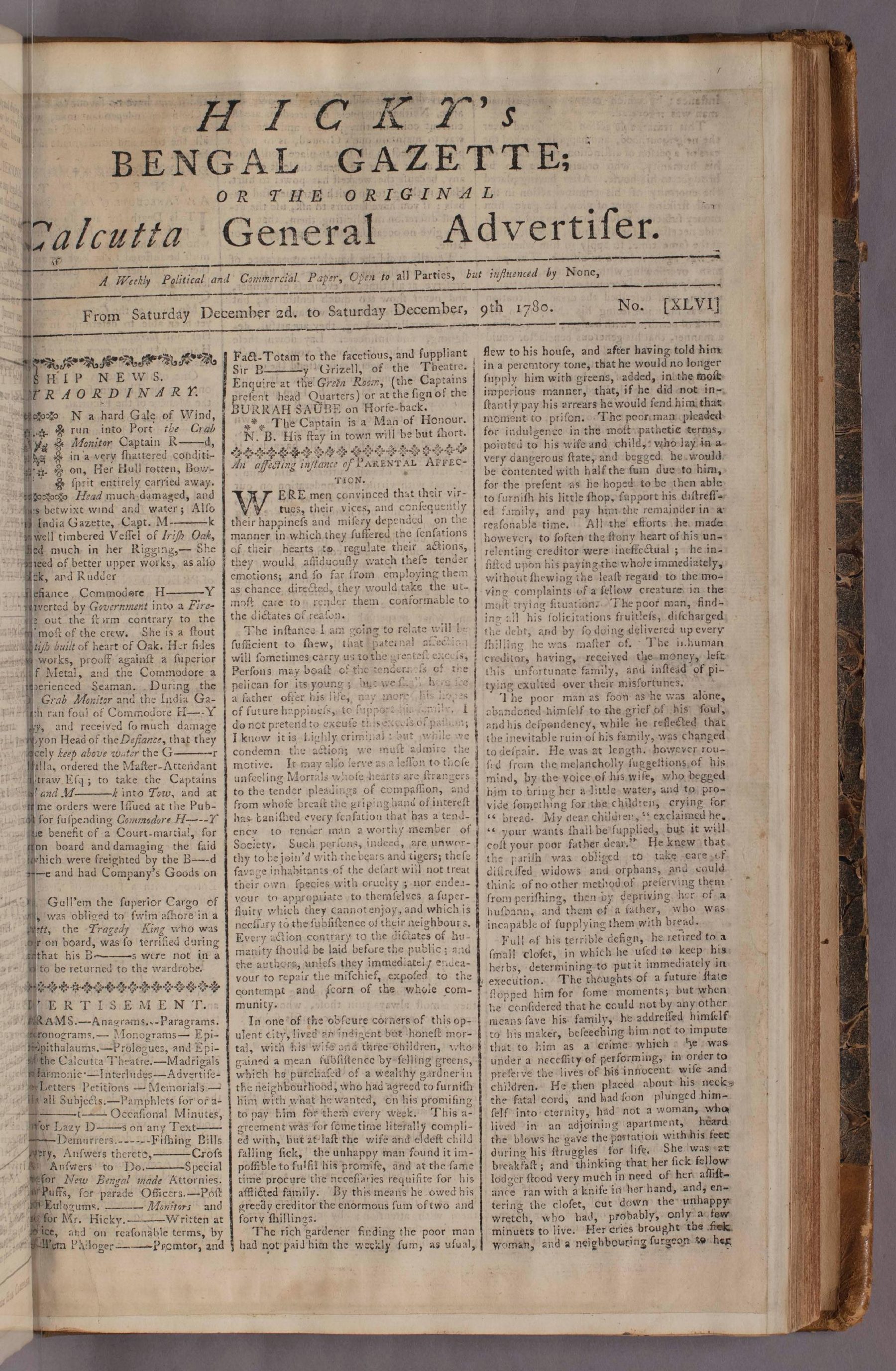
HICKY's
BENGAL GAZETTE;
OR THE ORIGINAL
Calcutta General Advertiser.
A Weekly Political and Commercial Paper, Open to all Parties, but influenced by None.
From Saturday December 2d. to Saturday December, 9th 1780. No. [XLVI]
SHIP NEWS.
EXTRAORDINARY.
IN a hard Gale of Wind, run into Port the Crab Monitor Captain R——d, in a very shattered condition, Her Hull rotten, Bowsprit entirely carried away. Head much damaged, and many holes betwixt wind and water; Also the Ketch India Gazette, Capt. M——k, a square well timbered Vessel of Irish Oak, has suffered much in her Rigging,— She stands in need of better upper works, as also a new Deck, and Rudder.
The defiance Commodore H——Y (lately converted by Government into a Fire-Ship) rode out the storm contrary to the opinion of most of the crew. She is a stout Vessel British built of heart of Oak. Her sides and upper works, prooff against a superior Weight of Metal, and the Commodore a brave experienced Seaman. During the Gale, the Grab Monitor and the India Gazette Ketch ran foul of Commodore H——Y in the Bay, and received so much damage from the Lyon Head of the Defiance, that they could scarcely keep above water the G——r of Barrabulla, ordered the Master-Attendant Edward Straw Esq; to take the Captains R——d and M——k into Tow, and at the same time orders were issued at the Public Offices for suspending Commodore H——Y without the benefit of a Court-martial, for running on board and damaging the said Vessels, which were freighted by the B——d of T——e and had Company's Goods on Board.
Captain Gull'em the superior Cargo of the Ketch, was obliged to swim ashore in a Cork-Jackett, the Tragedy King who was a passenger on board, was so terrified during the Gale that his B——s were not in a condition to be returned to the wardrobe.
ADVERTISEMENT.
EPIGRAMS.—Anagrams.—Paragrams. Chronograms.—Monograms.—Epitaphs.—Epithalaums.—Prologues, and Epilogues for the Calcutta Theatre.—Madrigals for the Harmonic—Interludes—Advertisements.—Letters Petitions—Memorials—Essays on all Subjects.—Pamphlets for or against G——t—Occasional Minutes, Sermons for Lazy D——s on any Text—Briefs—Demurrers.—Fishing Bills in Chancery, Answers thereto,—Cross Bills and Answers to Do.—Special pleadings for New Bengal made Attornies. Millitary Puffs, for parade Officers.—Post Mortem Eulogums.—Monitors and sweatings for Mr. Hicky.—Written at short Notice, and on reasonable terms, by Capt. Gull'om Philoger—Promtor, and Fact-Totam to the facetious, and suppliant Sir B——y Grizell, of the Theatre.
Enquire at the Green Room, (the Captains present head Quarters) or at the sign of the BURRAH SAUBE on Horse-back.
* * * The Captain is a Man of Honour.
N. B. His stay in town will be but short.
An affecting instance of PARENTAL AFFECTION.
WERE men convinced that their virtues, their vices, and consequently their happiness and misery depended on the manner in which they suffered the sensations of their hearts to regulate their actions, they would assiduously watch these tender emotions; and so far from employing them as chance directed, they would take the utmost care to render them conformable to the dictates of reason.
The instance I am going to relate will be sufficient to shew, that paternal affection will sometimes carry us to the greatest excess, Persons may boast of the tenderness of the pelican for its young; but we shall here see a father offer his life, nay more his hopes of future happiness, to support his family. I do not pretend to excuse this excess of passion; I know it is highly criminal: but while we condemn the action; we must admire the motive. It may also serve as a lesson to those unfeeling Mortals whose hearts are strangers to the tender pleadings of compassion, and from whose breast the griping hand of interest has banished every sensation that has a tendency to render man a worthy member of Society. Such persons, indeed, are unworthy to be join'd with the bears and tigers; these savage inhabitants of the desart will not treat their own species with cruelty; nor endeavour to appropriate to themselves a superfluity which they cannot enjoy, and which is necessary to the subsistence of their neighbours. Every action contrary to the dictates of humanity should be laid before the public; and the authors, unless they immediately endeavour to repair the mischief, exposed to the contempt and scorn of the whole community.
In one of the obscure corners of this opulent city, lived an indigent but honest mortal, with his wife and three children, who gained a mean subsistence by selling greens, which he purchased of a wealthy gardner in the neighbourhood, who had agreed to furnish him with what he wanted, on his promising to pay him for them every week. This agreement was for some time literally complied with, but at last the wife and eldest child falling sick, the unhappy man found it impossible to fulfil his promise, and at the same time procure the necessaries requisite for his afflicted family. By this means he owed his greedy creditor the enormous sum of two and forty shillings.
The rich gardener finding the poor man had not paid him the weekly sum, as usual, flew to his house, and after having told him in a peremtory tone, that he would no longer supply him with greens, added, in the most imperious manner, that, if he did not instantly pay his arrears he would send him that moment to prison. The poor man pleaded for indulgence in the most pathetic terms, pointed to his wife and child, who lay in a very dangerous state, and begged he would be contented with half the sum due to him, for the present as he hoped to be then able to furnish his little shop, support his distressed family, and pay him the remainder in a reasonable time. All the efforts he made however, to soften the stony heart of his unrelenting creditor were ineffectual; he insisted upon his paying the whole immediately, without shewing the least regard to the moving complaints of a fellow creature in the most trying situation. The poor man, finding all his solicitations fruitless, discharged the debt, and by so doing delivered up every shilling he was master of. The inhuman creditor, having, received the money, left this unfortunate family, and instead of pitying exulted over their misfortunes.
The poor man as soon as he was alone, abandoned himself to the grief of his soul, and his despondency, while he reflected that the inevitable ruin of his family, was changed to despair. He was at length, however roused from the melancholly suggestions of his mind, by the voice of his wife, who begged him to bring her a little water, and to provide something for the children, crying for bread. "My dear children," exclaimed he, "your wants shall be supplied, but it will cost your poor father dear." He knew that the parish was obliged to take care of distressed widows and orphans, and could think of no other method of preserving them from perishing, than by depriving her of a husband, and them of a father, who was incapable of supplying them with bread.
Full of his terrible design, he retired to a small closet, in which he used to keep his herbs, determining to put it immediately in execution. The thoughts of a future state stopped him for some moments; but when he considered that he could not by any other means save his family, he addressed himself to his maker, beseeching him not to impute that to him as a crime which he was under a necessity of performing, in order to preserve the lives of his innocent wife and children. He then placed about his neck the fatal cord, and had soon plunged himself into eternity, had not a woman, who lived in an adjoining apartment, heard the blows he gave the partation with his feet during his struggles for life. She was at breakfast; and thinking that her sick fellow lodger stood very much in need of her assistance ran with a knife in her hand, and, entering the closet, cut down the unhappy wretch, who had, probably, only a few minuets to live. Her cries brought the sick woman, and a neighbouring surgeon to her
Page 2
AI transcription (Google Gemini, 2026)
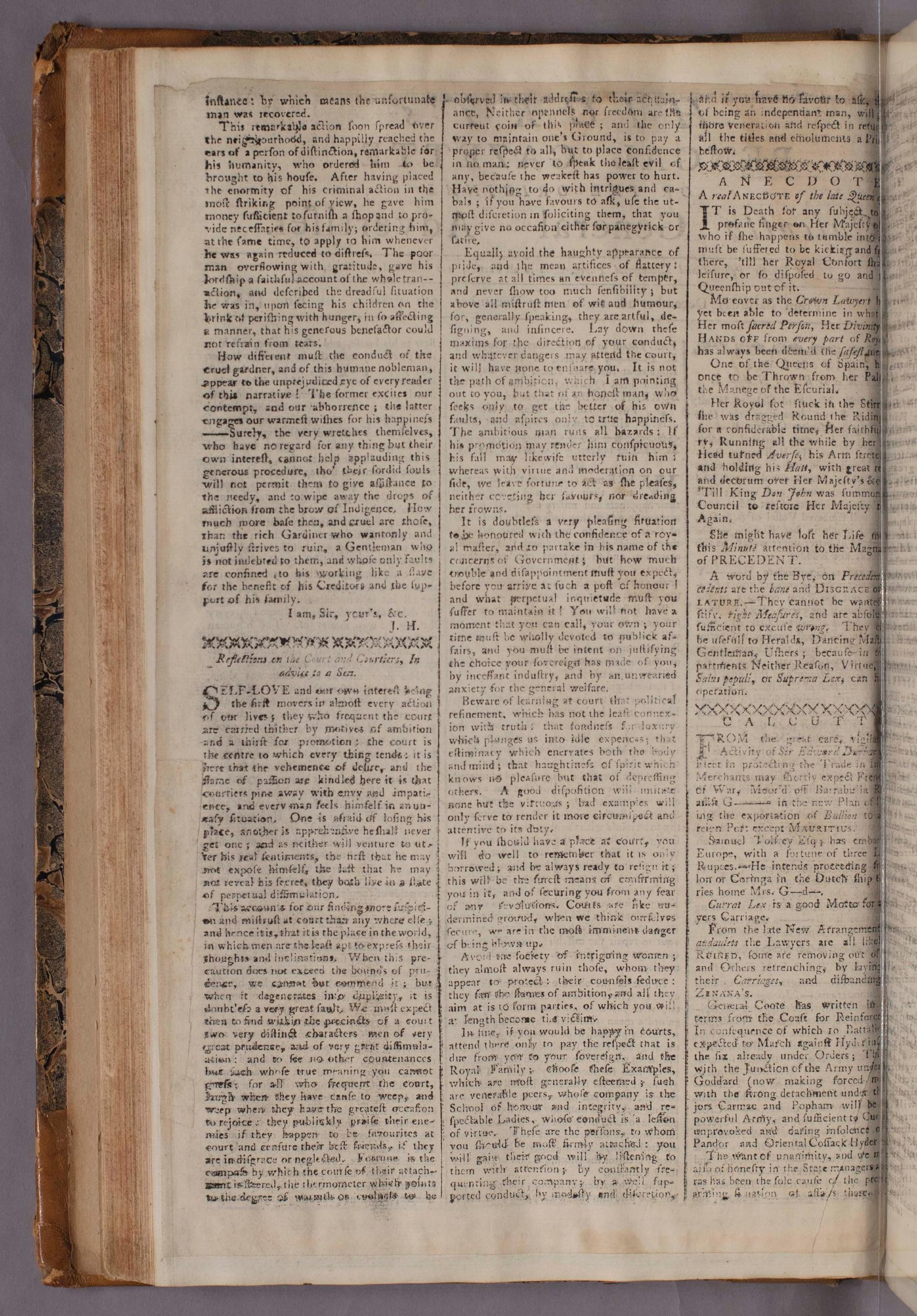
inſtance: by which means the unfortunate
man was recovered.
This remarkable action ſoon ſpread over
the neighbourhood, and happilly reached the
ears of a perſon of diſtinction, remarkable for
his humanity, who ordered him to be
brought to his houſe. After having placed
the enormity of his criminal action in the
moſt ſtriking point of view, he gave him
money ſufficient to furniſh a ſhop and to pro-
vide neceſſaries for his family; ordering him,
at the ſame time, to apply to him whenever
he was again reduced to diſtreſs. The poor
man overflowing with gratitude, gave his
lordſhip a faithful account of the whole tran-
action, and deſcribed the dreadful ſituation
he was in, upon ſeeing his children on the
brink of periſhing with hunger, in ſo affecting
a manner, that his generous benefactor could
not refrain from tears.
How different muſt the conduct of the
cruel gardner, and of this humane nobleman,
appear to the unprejudiced eye of every reader
of this narrative! The former excites our
contempt, and our abhorrence; the latter
engages our warmeſt wiſhes for his happineſs
—Surely, the very wretches themſelves,
who have no regard for any thing but their
own intereſt, cannot help applauding this
generous procedure, tho' their ſordid ſouls
will not permit them to give aſſiſtance to
the needy, and to wipe away the drops of
affliction from the brow of Indigence. How
much more baſe then, and cruel are thoſe,
than the rich Gardiner who wantonly and
unjuſtly ſtrives to ruin, a Gentleman who
is not indebted to them, and whoſe only faults
are confined to his working like a ſlave
for the benefit of his Creditors and the ſup-
port of his family.
I am, Sir, your's, &c.
J. H.
Reflections on the Court and Courtiers, In
advice to a Son.
SELF-LOVE and our own intereſt being
the firſt movers in almoſt every action
of our lives; they who frequent the court
are carried thither by motives of ambition
and a thirſt for promotion: the court is
the centre to which every thing tends: it is
here that the vehemence of deſire, and the
flame of paſſion are kindled here it is that
courtiers pine away with envy and impati-
ence, and every man feels himſelf in an un-
eaſy ſituation. One is afraid of loſing his
place, another is apprehenſive he ſhall never
get one; and as neither will venture to ut-
ter his real ſentiments, the firſt that he may
not expoſe himſelf, the laſt that he may
not reveal his ſecret, they both live in a ſtate
of perpetual diſſimulation.
This accounts for our finding more ſuſpici-
on and miſtruſt at court than any where elſe;
and hence it is, that it is the place in the world,
in which men are the leaſt apt to expreſs their
thoughts and inclinations. When this pre-
caution does not exceed the bounds of pru-
dence, we cannot but commend it; but
when it degenerates into duplicity, it is
doubtleſs a very great fault. We muſt expect
then to find within the precincts of a court
two very diſtinct characters men of very
great prudence, and of very great diſſimula-
ation: and to ſee no other countenances
but ſuch whoſe true meaning you cannot
gueſs: for all who frequent the court,
laugh when they have cauſe to weep, and
weep when they have the greateſt occaſion
to rejoice: they publickly praiſe their ene-
mies if they happen to be favourites at
court and cenſure their beſt friends, if they
are in diſgrace or neglected. Fortune is the
compaſs by which the courſe of their attach-
ment is ſteered, the thermometer which points
to the degree of warmth or coolneſs to be
obſerved in their addreſſes to their acquain-
ance, Neither openneſs nor freedom are the
current coin of this place; and the only
way to maintain one's Ground, is to pay a
proper reſpect to all, but to place confidence
in no man: never to ſpeak the leaſt evil of
any, becauſe the weakeſt has power to hurt.
Have nothing to do with intrigues and ca-
bals; if you have favours to aſk, uſe the ut-
moſt diſcretion in ſoliciting them, that you
may give no occaſion either for panegyrick or
ſatire.
Equally avoid the haughty appearance of
pride, and the mean artifices of flattery:
preſerve at all times an evenneſs of temper,
and never ſhow too much ſenſibility; but
above all miſtruſt men of wit and humour,
for, generally ſpeaking, they are artful, de-
ſigning, and inſincere. Lay down theſe
maxims for the direction of your conduct,
and whatever dangers may attend the court,
it will have none to enſnare you. It is not
the path of ambition, which I am pointing
out to you, but that of an honeſt man, who
ſeeks only to get the better of his own
faults, and aſpires only to true happineſs.
The ambitious man runs all hazards: if
his promotion may render him conſpicuous,
his fall may likewiſe utterly ruin him:
whereas with virtue and moderation on our
ſide, we leave fortune to act as ſhe pleaſes,
neither coveting her favours, nor dreading
her frowns.
It is doubtleſs a very pleaſing ſituation
to be honoured with the confidence of a roy-
al maſter, and to partake in his name of the
concerns of Government; but how much
trouble and diſappointment muſt you expect,
before you arrive at ſuch a poſt of honour!
and what perpetual inquietude muſt you
ſuffer to maintain it! You will not have a
moment that you can call, your own; your
time muſt be wholly devoted to publick af-
fairs, and you muſt be intent on juſtifying
the choice your ſovereign has made of you,
by inceſſant induſtry, and by an unwearied
anxiety for the general welfare.
Beware of learning at court that political
refinement, which has not the leaſt connex-
ion with truth: that fondneſs for luxury
which plunges us into idle expences; that
effiminacy which enervates both the body
and mind; that haughtineſs of ſpirit which
knows no pleaſure but that of depreſſing
others. A good diſpoſition will imitate
none but the virtuous; bad examples will
only ſerve to render it more circumſpect and
attentive to its duty.
If you ſhould have a place at court, you
will do well to remember that it is only
borrowed; and be always ready to reſign it;
this will be the ſureſt means of confirming
you in it, and of ſecuring you from any fear
of any revolutions. Courts are like un-
dermined ground, when we think ourſelves
ſecure, we are in the moſt imminent danger
of being blown up.
Avoid the ſociety of intriguing women;
they almoſt always ruin thoſe, whom they
appear to protect: their counſels ſeduce:
they fan the flames of ambition, and all they
aim at is to form parties, of which you will
at length become the victim.
In fine, if you would be happy in courts,
attend there only to pay the reſpect that is
due from you to your ſovereign, and the
Royal Family; chooſe theſe Examples,
which are moſt generally eſteemed; ſuch
are venerable peers, whoſe company is the
School of honour and integrity, and re-
ſpectable Ladies, whoſe conduct is a leſſon
of virtue. Theſe are the perſons, to whom
you ſhould be moſt firmly attached: you
will gain their good will by liſtening to
them with attention; by conſtantly fre-
quenting their company; by a well ſup-
ported conduct, by modeſty and diſcretion,
and if you have no favour to aſk,
of being an independant man, will
more veneration and reſpect in retur
all the titles and emoluments a Pri
beſtow.
A N E C D O T E
A real ANECDOTE of the late Queen
IT is Death for any ſubject to
profane finger on Her Majeſty o
who if ſhe happens to tumble into
muſt be ſuffered to be kicking and ſ
there, 'till her Royal Conſort ſha
leiſure, or ſo diſpoſed to go and
Queenſhip out of it.
Moreover as the Crown Lawyers h
yet been able to determine in what
Her moſt ſacred Perſon, Her Divinity
HANDS OFF from every part of Roy
has always been deem'd the ſafeſt me
One of the Queens of Spain, h
once to be Thrown from her Pall
the Manege of the Eſcurial.
Her Royal fot ſtuck in the Stirr
ſhe was dragged Round the Ridin
for a conſiderable time, Her faithfu
ry, Running all the while by her
Head turned Averſe, his Arm ſtretc
and holding his Hatt, with great re
and decorum over Her Majeſty's &c
'Till King Don John was ſummon
Council to reſtore Her Majeſty t
Again.
She might have loſt her Life m
this Minute attention to the Magna
of PRECEDENT.
A word by the Bye, on Preceden
cedents are the bane and DISGRACE of
LATURE.—They cannot be wante
ſtify, right Meaſures, and are abſolu
ſufficient to excuſe wrong. They c
be uſefull to Heralds, Dancing Maſt
Gentleman, Uſhers; becauſe in th
partments Neither Reaſon, Virtue,
Salus populi, or Suprema Lex, can h
operation.
C A L C U T T
FROM the great care, vigila
Activity of Sir Edward Derhar
Fleet in protecting the Trade in In
Merchants may ſhortly expect Fren
of War, Moor'd off Barrabulla R
aſſiſt G— in the new Plan of
ing the exportation of Bullion to a
reign Port except MAURITIUS.
Samuel Tolfrey Eſq; has embar
Europe, with a fortune of three L
Rupees.—He intends proceeding fr
lon or Coringa in the Dutch ſhip t
ries home Mrs. G—d—.
Currat Lex is a good Motto for a
yers Carriage.
From the late New Arrangement
andaulets the Lawyers are all likel
RUINED, ſome are removing out of
and Others retrenching, by laying
their Carriages, and diſbanding
ZENANA'S.
General Coote has written in
terms from the Coaſt for Reinforce
In conſequence of which 10 Battali
expected to March againſt Hyder in
the ſix already under Orders; Th
with the Junction of the Army under
Goddard (now making forced m
with the ſtrong detachment under th
jors Carnac and Popham will be
powerful Army, and ſufficient to Cur
unprovoked and daring inſolence o
Pandor and Oriental Coſſack Hyder
The want of unanimity, and we m
alſo of honeſty in the State managers a
ras has been the ſole cauſe of the pre
arming ſituation of affairs there.
Page 3
AI transcription (Google Gemini, 2026)
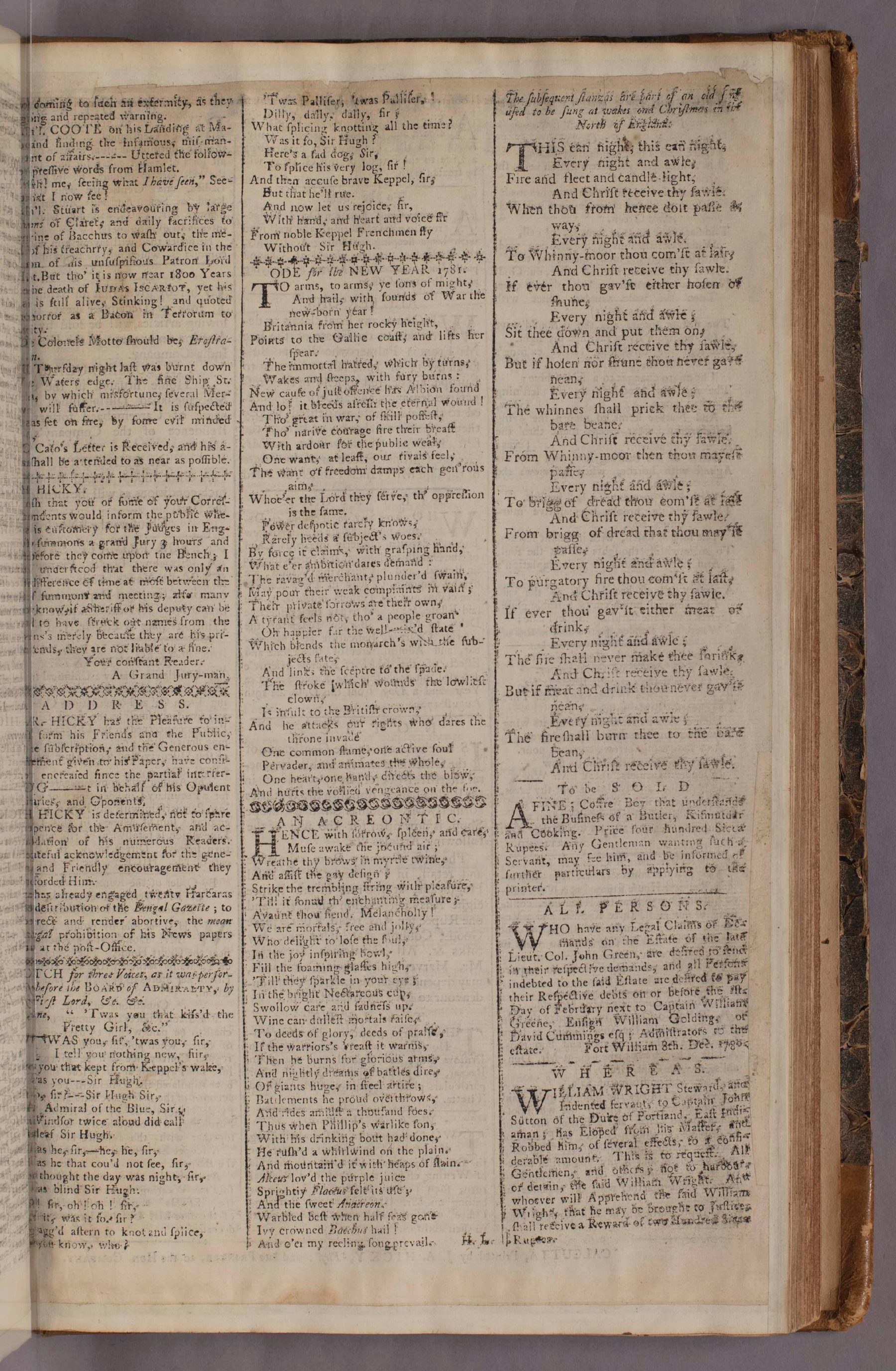
coming to such an extermity, as they had long and repeated warning.
Gen'l. COOTE on his Landing at Madras, and finding the infamous, mis-management of affairs.----- Uttered the following expressive words from Hamlet.
"Ah! me, seeing what I have seen," Seeing what I now see!
Gen'l. Stuart is endeavouring by large Libations of Claret, and daily sacrifices to the shrine of Bacchus to wash out, the memory of his treachrry, and Cowardice in the on of his unsuspisious Patron Lord Igot, But tho' it is now near 1800 Years since the death of IUDAS ISCARIOT, yet his Name is still alive, Stinking! and quoted with horror as a Bacon in Terrorum to Posterity.
The Colonels Motto should be, Erostratus sum.
On Thursday night last was burnt down to the Waters edge. The fine Ship St. Helena, by which misfortune, several Merchants will suffer.---- It is suspected she was set on fire, by some evil minded Person.
Cato's Letter is Received, and his advice shall be attended to as near as possible.
Mr. HICKY.
I wish that you or some of your Correspondents would inform the public whether it is customery for the Judges in England to summons a grand Jury 3 hours and a half before they come upon the Bench; I understood that there was only an hours difference of time at most between the summons and meeting; also many wish to know, if a Sheriff or his deputy can be proved to have struck out names from the summons's merely because they are his private friends, they are not liable to a fine.
Your constant Reader.
A Grand Jury-man.
ADDRESS.
MR. HICKY has the Pleasure to inform his Friends and the Public, that the subscription, and the Generous encouragement given to his Paper, have considerably encreased since the partial interference of G—t in behalf of his Opulent Adversaries, and Oponents,
Mr. HICKY is determined, not to spare no expence for the Amusement, and accommodation of his numerous Readers. as a grateful acknowledgement for the generous, and Friendly encouragement they have afforded Him.
He has already engaged twenty Harcaras for the destribution of the Bengal Gazette; to Counterect and render abortive, the mean and illegal prohibition of his News papers passing at the post-Office.
A CATCH for three Voices, as it was performed before the BOARD of ADMIRALTY. by the first Lord, &c. &c.
The Tune, " 'Twas you that kiss'd the Pretty Girl, &c."
'TWAS you, sir, 'twas you, sir,
I tell you nothing new, sir,
'Twas you that kept from Keppel's wake,
'Twas you—Sir Hugh.
Who, sir?—Sir Hugh Sir,
Vice Admiral of the Blue, Sir;
Bold Windsor twice aloud did call
To dear Sir Hugh.
'Twas he, sir—he, he, fir,
'Twas he that cou'd not see, sir,
Who thought the day was night, fir,
'Twas blind Sir Hugh.
Oh! sir, oh! oh! fir,
Was it, was it so, fir?
Who lagg'd astern to knot and splice,
Do you know, who?
'Twas Palliser, 'twas Palliser!
Dilly, dally, dally, fir;
What splicing knotting all the time?
Was it so, Sir Hugh?
Here's a sad dog, Sir,
To splice his very log, fir!
And then accuse brave Keppel, fir;
But that he'll rue.
And now let us rejoice, fir,
With hand, and heart and voice fir
From noble Keppel Frenchmen fly
Without Sir Hugh.
ODE for the NEW YEAR 1781.
TO arms, to arms, ye sons of might,
And hail, with sounds of War the new-born year!
Britannia from her rocky height,
Points to the Gallic coast, and lifts her spear.
The immortal hatred, which by turns,
Wakes and sleeps, with fury burns:
New cause of just offence has Albion found
And lo! it bleeds afresh the eternal wound!
Tho' great in war, of skill possest,
Tho' native courage fire their breast
With ardour for the public weal;
One want, at least, our rivals feel,
The want of freedom damps each gen'rous aim,
Whoe'er the Lord they serve, th' oppression is the same.
Power despotic rarely knows,
Rarely heeds a subject's woes:
By force it claims, with grasping hand,
What e'er ambition dares demand:
The ravag'd merchant, plunder'd swain,
May pour their weak complaints in vain;
Their private sorrows are their own,
A tyrant feels not, tho' a people groan.
Oh happier far the well-mix'd state
Which blends the monarch's with the subjects fate,
And links the sceptre to the spade.
The stroke which wounds the lowliest clown,
Is insult to the British crown,
And he attacks our rights who dares the throne invade
One common flame, one active soul
Pervades, and animates the whole,
One heart, one hand, directs the blow,
And hurls the vollied vengeance on the foe.
AN ACREONTIC.
HENCE with sorrow, spleen, and care,
Muse awake the jocund air;
Wreathe thy brows in myrtle twine,
And assist the gay design;
Strike the trembling string with pleasure,
'Till it sound th' enchanting measure;
Avaunt thou fiend, Melancholly!
We are mortals, free and jolly,
Who delight to lose the soul,
In the joy inspiring bowl,
Fill the foaming glasses high,
'Till they sparkle in your eye;
In the bright Nectareous cup,
Swollow care and sadness up.
Wine can dullest mortals raise,
To deeds of glory, deeds of praise,
If the warriours's breast it warms,
Then he burns for glorious arms,
And nightly dreams of battles dire,
Of giants huge, in steel attire;
Battlements he proud overthrows,
And rides amidst a thousand foes.
Thus when Phillip's warlike son,
With his drinking bout had done,
He rush'd a whirlwind on the plain,
And mountain'd it with heaps of slain.
Alceus lov'd the purple juice
Sprightly Flaccus felt its use;
And the sweet Anacreon,
Warbled best when half seas gone
Ivy crowned Bacchus hail!
And o'er my reeling song prevail. H. L.
The subsequent stanzas are part of an old song used to be sung at wakes and Christmas in the North of England.
THIS ean night, this ean night,
Every night and awle,
Fire and fleet and candle-light,
And Christ receive thy sawle.
When thou from hence doit passe away,
Every night and awle,
To Whinny-moor thou com'st at last,
And Christ receive thy sawle.
If ever thou gav'st either hosen or shune,
Every night and awle;
Sit thee down and put them on,
And Christ receive thy sawle.
But if hosen nor shune thou never gav'st nean,
Every night and awle;
The whinnes shall prick thee to the bare beane,
And Christ receive thy sawle.
From Whinny-moor then thou mayest passe,
Every night and awle;
To brigg of dread thou com'st at last
And Christ receive thy sawle.
From brigg of dread that thou may'st passe,
Every night and awle;
To purgatory fire thou com'st at last,
And Christ receive thy sawle.
If ever thou gav'st either meat or drink,
Every night and awle;
The fire shall never make thee shrink,
And Christ receive thy sawle.
But if meat and drink thou never gav'st nean,
Every night and awle;
The fire shall burn thee to the bare bean,
And Christ receive thy sawle.
To be SOLD.
A FINE Coffre Boy that understands the Business of a Butler, Kismutdar and Cooking. Price four hundred Sicca Rupees. Any Gentleman wanting such a Servant, may see him, and be informed of further particulars by applying to the printer.
ALL PERSONS.
WHO have any Legal Claims or Demands on the Estate of the late Lieut. Col. John Green, are desired to send in their respective demands, and all Persons indebted to the said Estate are desired to pay their Respective debts on or before the 1st. Day of February next to Captain William Greene, Ensign William Golding, or David Cummings esq; Admistrators to the estate. Fort William 8th. Dec. 1780.
WHEREAS.
WILLIAM WRIGHT Steward, and Indented servant, to Captain John Sutton of the Duke of Portland, East Indiaman; has Eloped from his Master, and Robbed him, of several effects, to a considerable amount. This is to request. All Gentlemen, and others not to harbour or detain, the said William Wright. And whoever will Apprehend the said William Wright, that he may be brought to Justice; shall receive a Reward of two Hundred Sicca Rupees.
Page 4
AI transcription (Google Gemini, 2026)
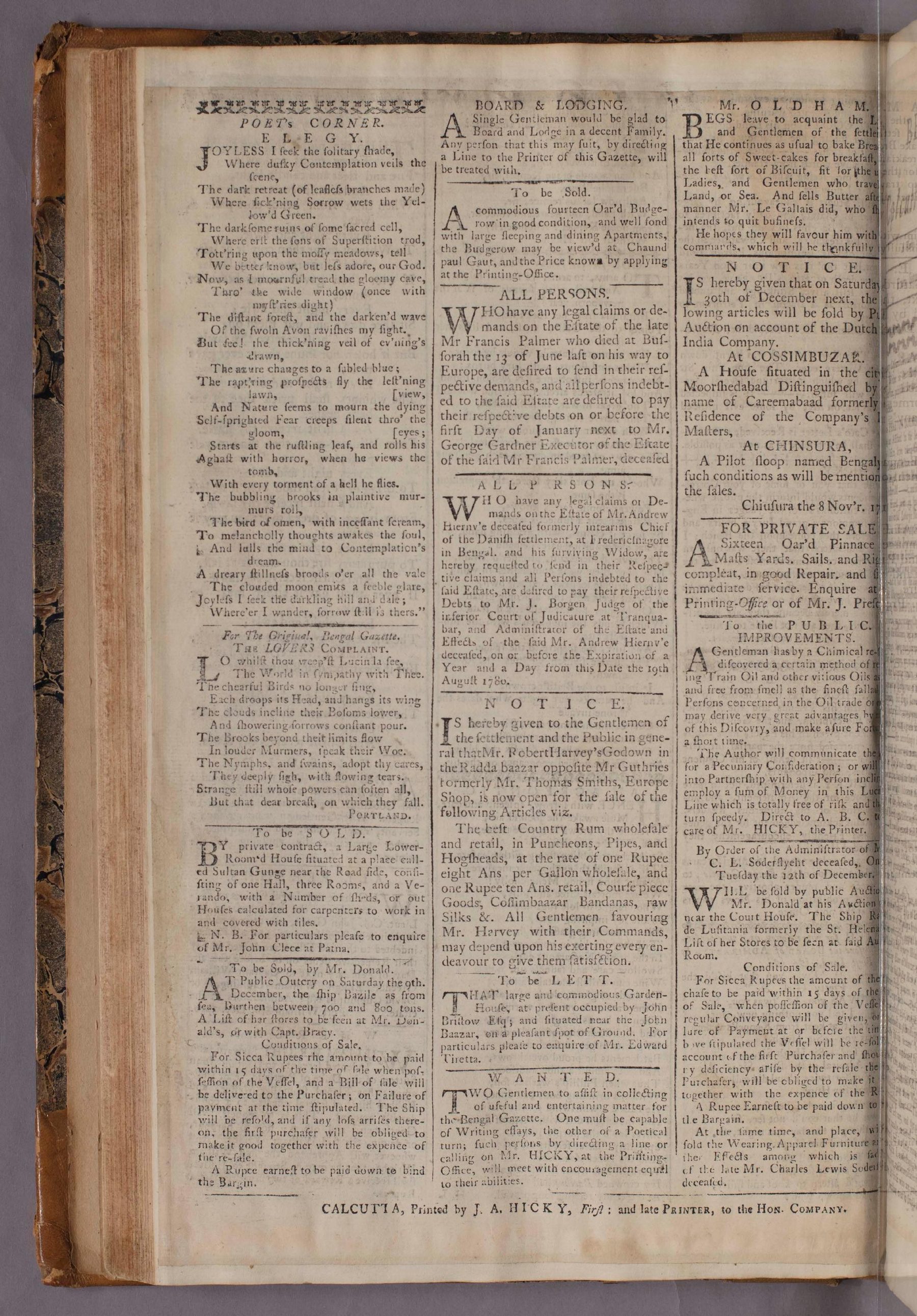
POET's CORNER.
E L E G Y.
JOYLESS I seek the solitary shade,
Where dusky Contemplation veils the scene,
The dark retreat (of leafless branches made)
Where sick'ning Sorrow wets the Yellow'd Green.
The darksome ruins of some sacred cell,
Where erst the sons of Superstition trod,
Tott'ring upon the mossy meadows, tell
We better know, but less adore, our God.
Now, as I mournful tread the gloomy cave,
Thro' the wide window (once with myst'ries dight)
The distant forest, and the darken'd wave
Of the swoln Avon ravishes my sight.
But see! the thick'ning veil of ev'ning's drawn,
The azure changes to a fabled blue;
The rapt'ring prospects fly the less'ning lawn, [view,
And Nature seems to mourn the dying
Self-frighted Fear creeps silent thro' the gloom, [eyes;
Starts at the rustling leaf, and rolls his
Aghast with horror, when he views the tomb,
With every torment of a hell he flies.
The bubbling brooks in plaintive murmurs roll,
The bird of omen, with incessant scream,
To melancholy thoughts awakes the soul,
And lulls the mind to Contemplation's dream.
A dreary stillness broods o'er all the vale
The clouded moon emits a feeble glare,
Joyless I seek the darkling hill and dale;
Where'er I wander, sorrow still is there."
For The Original Bengal Gazette.
THE LOVERS COMPLAINT.
LO whilst thou weep'st Lucinda see,
The World in sympathy with Thee.
The chearful Birds no longer sing,
Each droops its Head, and hangs its wing
The clouds incline their Bosoms lower,
And showering sorrows constant pour.
The Brooks beyond their limits flow
In louder Murmers, speak their Woe.
The Nymphs, and swains, adopt thy cares,
They deeply sigh, with flowing tears.
Strange still whose powers can soften all,
But that dear breast, on which they fall.
PORTLAND.
To be SOLD.
BY private contract, a Large Lower-Room'd House situated at a place called Sultan Gunge near the Road side, consisting of one Hall, three Rooms, and a Verando, with a Number of sheds, or out Houses calculated for carpenters to work in and covered with tiles.
N. B. For particulars please to enquire of Mr. John Clece at Patna.
To be Sold, by Mr. Donald.
AT Public Outcry on Saturday the 9th. December, the ship Bazile as from sea, Burthen between 700 and 800 tons. A List of her stores to be seen at Mr. Donald's, or with Capt. Bracy.
Conditions of Sale.
For Sicca Rupees the amount to be paid within 15 days of the time of sale when possession of the Vessel, and a Bill of sale will be delivered to the Purchaser; on Failure of payment at the time stipulated. The Ship will be resold, and if any loss arises thereon, the first purchaser will be obliged to make it good together with the expence of the re-sale.
A Rupee earnest to be paid down to bind the Bargain.
BOARD & LODGING.
A Single Gentleman would be glad to Board and Lodge in a decent Family. Any person that this may suit, by directing a Line to the Printer of this Gazette, will be treated with.
To be Sold.
A commodious fourteen Oar'd Budgerow in good condition, and well fond with large sleeping and dining Apartments, the Budgerow may be view'd at Chaund paul Gaut, and the Price known by applying at the Printing-Office.
ALL PERSONS,
WHO have any legal claims or demands on the Estate of the late Mr Francis Palmer who died at Bussorah the 13 of June last on his way to Europe, are desired to send in their respective demands, and all persons indebted to the said Estate are desired to pay their respective debts on or before the first Day of January next to Mr. George Gardner Executor of the Estate of the said Mr Francis Palmer, deceased
ALL PERSONS
WHO have any legal claims or Demands on the Estate of Mr. Andrew Hiernv'e deceased formerly intearims Chief of the Danish settlement, at Fredericnagore in Bengal. and his surviving Widow, are hereby requested to send in their Respective claims and all Persons indebted to the said Estate, are desired to pay their respective Debts to Mr. J. Borgen Judge of the inferior Court of Judicature at Tranquebar, and Administrator of the Estate and Effects of the said Mr. Andrew Hiernv'e deceased, on or before the Expiration of a Year and a Day from this Date the 19th August 1780.
N O T I C E.
IS hereby given to the Gentlemen of the settlement and the Public in general that Mr. Robert Harvey's Godown in the Radda baazar opposite Mr Guthries formerly Mr. Thomas Smiths, Europe Shop, is now open for the sale of the following Articles viz.
The best Country Rum wholesale and retail, in Puncheons, Pipes, and Hogsheads, at the rate of one Rupee eight Ans per Gallon wholesale, and one Rupee ten Ans. retail, Course piece Goods, Cossimbaazar Bandanas, raw Silks &. All Gentlemen favouring Mr. Harvey with their Commands, may depend upon his exerting every endeavour to give them satisfetion.
To be LETT.
THAT large and commodious Garden-House, at present occupied by John Bristow Esq; and situated near the John Baazar, on a pleasant spot of Ground. For particulars please to enquire of Mr. Edward Tiretta.
W A N T E D.
TWO Gentlemen to assist in collecting of useful and entertaining matter for the Bengal Gazette. One must be capable of Writing essays, the other of a Poetical turn; such persons by directing a line or calling on Mr. HICKY, at the Printing-Office, will meet with encouragement equal to their abilities.
Mr. O L D H A M.
BEGS leave to acquaint the Ladies and Gentlemen of the settlement that He continues as usual to bake Bread and all sorts of Sweet-cakes for breakfast, also the best sort of Biscuit, fit for the use of Ladies, and Gentlemen who travel by Land, or Sea. And sells Butter after the manner Mr. Le Gallais did, who shortly intends to quit business.
He hopes they will favour him with their commands, which will be thankfully received
N O T I C E.
IS hereby given that on Saturday the 30th of December next, the following articles will be sold by Public Auction on account of the Dutch East India Company.
At COSSIMBUZAR.
A House situated in the city of Moorshedabad Distinguished by the name of Careemabaad formerly the Residence of the Company's Head Masters.
At CHINSURA,
A Pilot sloop named Bengal with such conditions as will be mentioned at the sales.
Chinsura the 8 Nov'r. 1780
FOR PRIVATE SALE
A Sixteen Oar'd Pinnace with Masts Yards. Sails. and Rigging compleat, in good Repair, and fit for immediate service. Enquire at the Printing-Office or of Mr. J. Prescott.
To the PUBLIC.
IMPROVEMENTS.
A Gentleman has by a Chimical receipt discovered a certain method of refining Train Oil and other vitious Oils as clear and free from smell as the finest sallad Oil Persons concerned in the Oil trade or others may derive very great advantages by means of this Discovery, and make a sure Fortune in a short time.
The Author will communicate the secret for a Pecuniary Consideration; or will enter into Partnership with any Person inclined to employ a sum of Money in this Lucrative Line which is totally free of risk and the Return speedy. Direct to A. B. C. to the care of Mr. HICKY, the Printer.
By Order of the Administrator of Mr. C. L. Soderflyeht deceased, On Tuesday the 12th of December.
WILL be sold by public Auction by Mr. Donald at his Auction Room near the Court House. The Ship Rainha de Lusitania formerly the St. Helena. A List of her Stores to be seen at said Auction Room.
Conditions of Sale.
For Sicca Rupees the amount of the purchase to be paid within 15 days of the time of Sale, when possession of the Vessel and regular Conveyance will be given, on failure of Payment at or before the time above stipulated the Vessel will be re-sold on account of the first Purchaser and should any deficiency arise by the resale the first Purchaser, will be obliged to make it good together with the expence of the Re-sale
A Rupee Earnest to be paid down to bind the Bargain.
At the same time, and place, will be sold the Wearing Apparel Furniture and other Effects among which is sadlery of the late Mr. Charles Lewis Soderflyeht deceased.
CALCUTTA, Printed by J. A. HICKY, First and late PRINTER, to the Hon. COMPANY.